
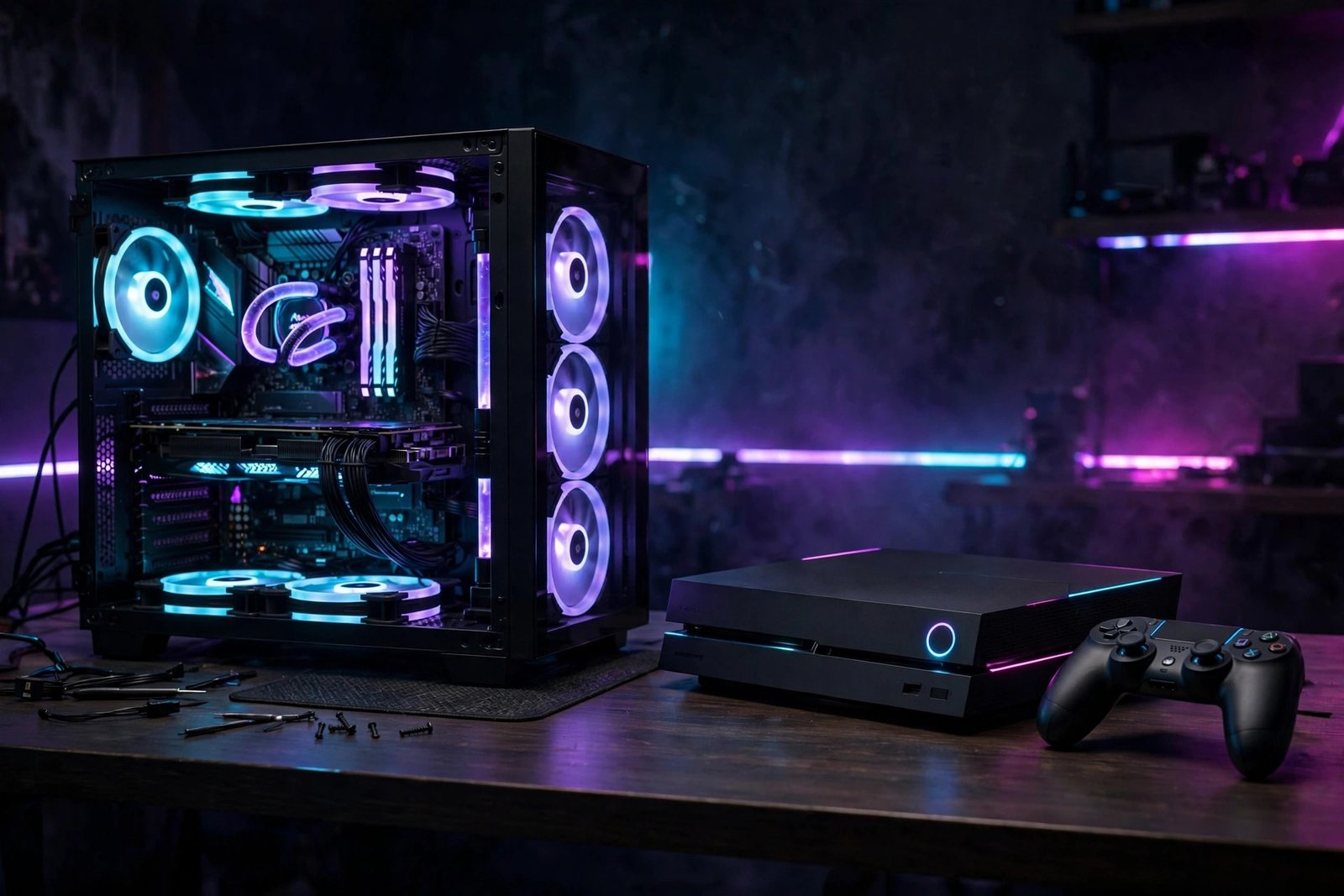
PC or console? It’s the oldest debate in gaming, and in 2026 the answer is genuinely less obvious than ever. These quick answers: PC or console for beginners cut through the noise: Consoles have become powerful and PC-like; PCs have become more living-room friendly; and cloud gaming is nibbling at both. For a beginner, the choice comes down to budget, technical comfort, where you play, and what your friends play. This guide gives you the honest tradeoffs — no fanboyism — so you can pick the right platform the first time.
The Money Question: What Each Really Costs
Consoles: a PlayStation 5 or Xbox Series X runs $400-500 (digital editions less), and that’s the whole cost — you’re gaming at high settings immediately. Add $60-80/year for online multiplayer subscriptions (PS Plus / Xbox Game Pass Core) and $70 per major game, though subscription libraries soften this enormously. Total first-year realistic cost: $600-800.
PC: a capable gaming PC starts around $800-1,000 prebuilt ($600-800 if you build it yourself — easier than its reputation suggests), with no ceiling. No subscription needed for online play on most games, and PC game sales are famously deep — Steam’s seasonal sales routinely hit 50-80% off. Total first-year realistic cost: $900-1,300, but cheaper games narrow the gap over time. The hidden PC costs: you’ll eventually want a decent monitor ($150-300), and upgrades tempt continuously. For parents checking age-appropriateness either way, the ESRB ratings are the essential first stop.
Performance and Experience: Where Each Wins
PC advantages: higher frame rates and resolutions (144+ fps gaming is a PC-exclusive experience that genuinely changes how shooters feel), graphics customization, mods (Skyrim with mods is practically a different game), backwards compatibility stretching back decades, and multipurpose use — it’s also your work/school machine. Mouse-and-keyboard remains unmatched for shooters and strategy games.
Console advantages: zero-fuss operation — buy game, play game, no drivers, no settings menus, no “will it run?” anxiety. Standardized hardware means every game is optimized for exactly your machine. Couch gaming with a controller is native, not adapted. Quick Resume (Xbox) and Activity Cards (PlayStation) streamline the pick-up-and-play experience. And exclusives still matter: Sony’s first-party titles (Spider-Man, God of War, Horizon) and Nintendo’s entire universe remain console-only, while Microsoft now puts its games on PC day one — a point for the PC side if you lean Xbox franchises.
Lifestyle Fit: The Deciding Factors
Where do you play? Couch + big TV favors console (though PCs can do this too with effort). Desk setup favors PC. Small apartment? A console’s tiny footprint wins. Who do you play with? This is the trump card — buy what your friends have. Cross-play now covers many multiplayer games, but party chat, shared libraries, and frictionless joining still work best within one ecosystem. Ask your group before spending a dollar.
Technical comfort: be honest. If troubleshooting sounds fun, PC rewards you; if it sounds like homework, console respects your time. Upgrade itch: PC owners upgrade incrementally (new GPU every 3-5 years); console owners wait for mid-generation refreshes or the next generation (~7 years). Neither is wrong — they’re different relationships with hardware. And if your decision involves the living room setup, check whether upgrading to a smart TV is worth it — display quality affects both platforms enormously.
The Hidden Costs Nobody Mentions
The sticker price isn’t the whole story on either platform. Consoles: $70 games add up fast — ten full-price games is $700, more than the console itself. Online subscriptions ($60-80/year) total $400-560 over a generation. Extra controllers run $70 each, and storage expansion (that 1TB fills quickly with 100GB games) costs $100-200. A “cheap” console generation easily totals $2,000+ for an active gamer.
PC: the upgrade treadmill is the hidden tax — a GPU that’s glorious today feels mid-range in four years, and the temptation to upgrade is constant. Peripherals (mechanical keyboards, gaming mice, headsets) become their own hobby. But PC game discounts are dramatically deeper, free online play saves $400+ over a console generation, and the machine doubles as a work computer — value that’s real if you’d buy a computer anyway. Budget honestly: price out three years of your actual habits (games per year, subscriptions, upgrades), not just day one. The “cheaper” platform is whichever matches how you really play.
The Third Option: Cloud and Hybrid
Before committing, know that cloud gaming (GeForce Now, Xbox Cloud Gaming) now lets modest hardware play demanding games via streaming — a $200 Chromebook can run Cyberpunk if your internet cooperates. It’s not a full replacement (latency, game ownership quirks), but it’s a legitimate way to test whether you even like modern gaming before investing. Many beginners start with a console + cloud combo and add a PC later if the hobby sticks.
The Nintendo factor: the Switch (and its successor) occupies its own lane — less powerful, utterly unique games, unbeatable for local multiplayer and family play. If Mario, Zelda, and Pokémon are the draw, the PC-vs-PlayStation-vs-Xbox debate is irrelevant. For casual and family gaming, also browse the most relaxing video games for casual players — platform matters less than picking games that fit your life. Industry-wide, the Entertainment Software Association reports gaming now spans all ages, with the average player in their 30s — this isn’t a kids-only decision anymore.
The Bottom Line
For beginners in 2026: choose console if you want simplicity, couch play, and Sony/Nintendo exclusives at the lowest entry price. Choose PC if you want maximum performance, mods, cheaper games long-term, and a machine that does everything. Choose based on where your friends play above all — and remember that cloud gaming lets you experiment before committing hundreds of dollars.
Frequently Asked Questions
Is PC gaming better than console?
“Better” depends on priorities: PCs offer higher performance, mods, and cheaper games; consoles offer simplicity, lower entry cost, and exclusives. Neither is objectively superior — they optimize for different values.
How much does a good gaming PC cost in 2026?
$800-1,000 for a solid 1080p prebuilt, $1,200-1,500 for high-refresh 1440p. Building yourself saves $100-200. Below $600, a console delivers far better gaming value per dollar.
Can I play with friends on different platforms?
Often yes — cross-play now covers major titles like Fortnite, Call of Duty, Minecraft, and Rocket League. But some games remain platform-locked, and voice chat/party systems work smoothest within one ecosystem. Confirm your specific games before buying.
Do I need PlayStation Plus or Xbox Game Pass to play online?
For most multiplayer games, yes — both consoles require their subscription tiers for online play ($60-80/year base). Free-to-play games (Fortnite, Apex) are exempt. PC has no such requirement for the vast majority of games.
What’s the best console for a beginner?
The one your friends own. Failing that: PS5 for exclusives and the DualSense controller, Xbox Series X for Game Pass value (hundreds of games for a monthly fee), Nintendo Switch for family/casual play. You can’t go wrong — only go lonely.
Should I build my own PC or buy prebuilt?
Building saves $100-200 and teaches you your machine, but prebuilts include warranties, support, and zero risk of a $300 mistake. Beginners who enjoy tinkering should build (it’s adult LEGO with YouTube guidance); everyone else should buy prebuilt from a reputable builder and spend the saved stress on games.