
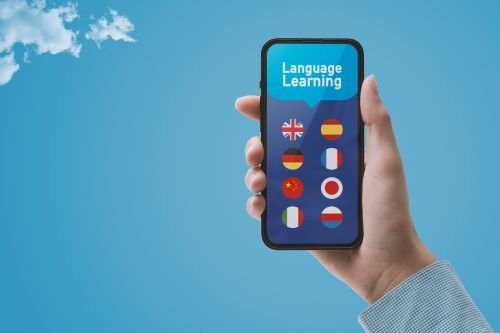
Language apps have promised fluency for a decade, mostly delivering streak anxiety and the ability to say “the cat drinks milk” in six languages. But AI is changing what’s possible. The best AI apps for learning a new language now include conversation partners with infinite patience, instant grammar explanations, and personalized practice that adapts to your actual weaknesses.
Here’s what’s genuinely worth your time — and what still requires old-fashioned human effort.
What Are the Best AI Apps for Learning a New Language? What Works Now
Duolingo Max layers AI conversation practice and detailed answer explanations onto the familiar gamified lessons. The “Explain My Answer” feature is the real upgrade — instead of just marking you wrong, it tells you why, like a tutor would. ChatGPT/Claude as conversation partners might be the biggest breakthrough: prompt “converse with me in Spanish at A2 level, correct my mistakes gently, and stay in character as a café owner in Madrid” and you get unlimited, judgment-free speaking practice at 11 p.m. when no human partner is available.
Specialized apps fill the gaps. Speak and Elsa Speak use AI speech recognition for pronunciation coaching that catches subtleties generic apps miss. LanguaTalk / TalkPal offer AI tutors with structured curricula. And for input — the listening and reading that actually builds comprehension — AI tools can now generate graded readers at exactly your level on any topic you find interesting, which solves the eternal problem of beginner materials being boring. Pair these with can AI Help me Create a Resume that Gets Noticed techniques to keep your study organized.
The Conversation Breakthrough
This deserves emphasis because it’s genuinely new. Historically, speaking practice required another human — a tutor ($$$), an exchange partner (scheduling, awkwardness), or a class. AI conversation removes all three barriers simultaneously: it’s free or cheap, available instantly, and infinitely patient with your mistakes. Set the scenario (job interview, restaurant, small talk), set your level, and talk. It’s not a perfect substitute for human interaction — it won’t teach you slang timing or cultural nuance — but as a practice volume multiplier, it’s transformative. Learners who previously spoke 30 minutes a week can now speak 30 minutes a day.
- Duolingo Max: gamified lessons plus AI explanations and roleplay.
- ChatGPT/Claude: unlimited custom conversation practice, any scenario.
- Speak / Elsa: AI pronunciation coaching with detailed feedback.
- AI graded readers: reading material at exactly your level, any topic.
What AI Can’t Do for Language Learning
Honest limitations matter here. AI can’t give you the cultural immersion that makes language stick — the jokes, the body language, the lived context. Its corrections, while good, occasionally miss pragmatic nuances a native speaker would catch instantly. It can also create a comfort bubble: the AI adapts to you, but real humans don’t, and learners who only practice with AI sometimes freeze in real conversations. And motivation remains stubbornly human — no app, however clever, does the daily practice for you.
The research consensus on language acquisition hasn’t changed: comprehensible input plus real interaction plus consistent practice. AI dramatically improves the input and practice parts — personalized, unlimited, adaptive. But the interaction part still needs humans eventually. The winning formula learners report: AI for daily volume (speaking practice, explanations, graded reading) plus human contact weekly (tutor, exchange partner, community) for the real-world calibration. Neither alone is as good as both together.
A Practical Weekly Routine
Keep it sustainable: 15–20 minutes daily beats 3 hours on Sunday. A workable week: daily AI conversation practice (10 min) + one app’s structured lesson (10 min), twice-weekly AI-generated reading at your level, one weekly human session (tutor or exchange) for real interaction, and passive input (shows, podcasts) whenever you’d otherwise scroll. Track one metric — minutes spoken per week — and watch it climb. Most learners plateau not from bad tools but from inconsistency, and AI’s greatest gift is removing every excuse for skipping a day.
Avoiding the App Trap: When Tools Become Procrastination
There’s a well-known failure mode in language learning: collecting apps instead of practicing. Five apps, three podcasts, two tutors booked — and somehow zero minutes of actual speaking today. AI tools make this worse because they’re fun to explore; configuring the perfect prompt feels productive while producing nothing. Set a hard rule: one primary app, one AI conversation tool, and a daily minimum of actual practice before you’re allowed to try anything new.
Also beware the streak trap — maintaining a 200-day streak by doing the bare minimum teaches you to protect the streak, not the language. If you miss a day, the language doesn’t care; just resume. And periodically test yourself against reality: can you actually hold a five-minute conversation with a human? Order food? Handle a misunderstanding? Those are the metrics that matter. Apps and AI are the gym; real conversation is the sport. Train for the sport.
The single best thing you can do today: open a chatbot, set your target language and level, and start a five-minute conversation about your day. Awkward, imperfect, and entirely private — it’s the first of hundreds of conversations that, added together, become fluency.
And be patient with the plateau that hits around month two or three, when progress feels invisible. It’s normal — your brain is consolidating. Learners who push through that flat stretch with daily AI conversation practice almost always break through to noticeably better fluency within weeks. The plateau isn’t a wall; it’s a hallway.
Start Talking Today
The best AI apps for learning a new language have removed the biggest historical barriers: cost, scheduling, and embarrassment. Open a chatbot tonight, set your level, and have your first conversation — awkward, halting, and entirely private. Then do it again tomorrow. Fluency is just a long series of conversations, and for the first time in history, you can have as many as you want, whenever you want, for free. The only remaining ingredient is showing up daily. For general AI learning strategies, how can Writers Use AI Without Losing their own Voice and how is AI Used in Online Shopping Recommendations round things out.
For trustworthy further reading, bookmark PCMag’s app reviews alongside Duolingo’s official site.