Daniel Day-Lewis: Net Worth, Age, Family and Career Explained
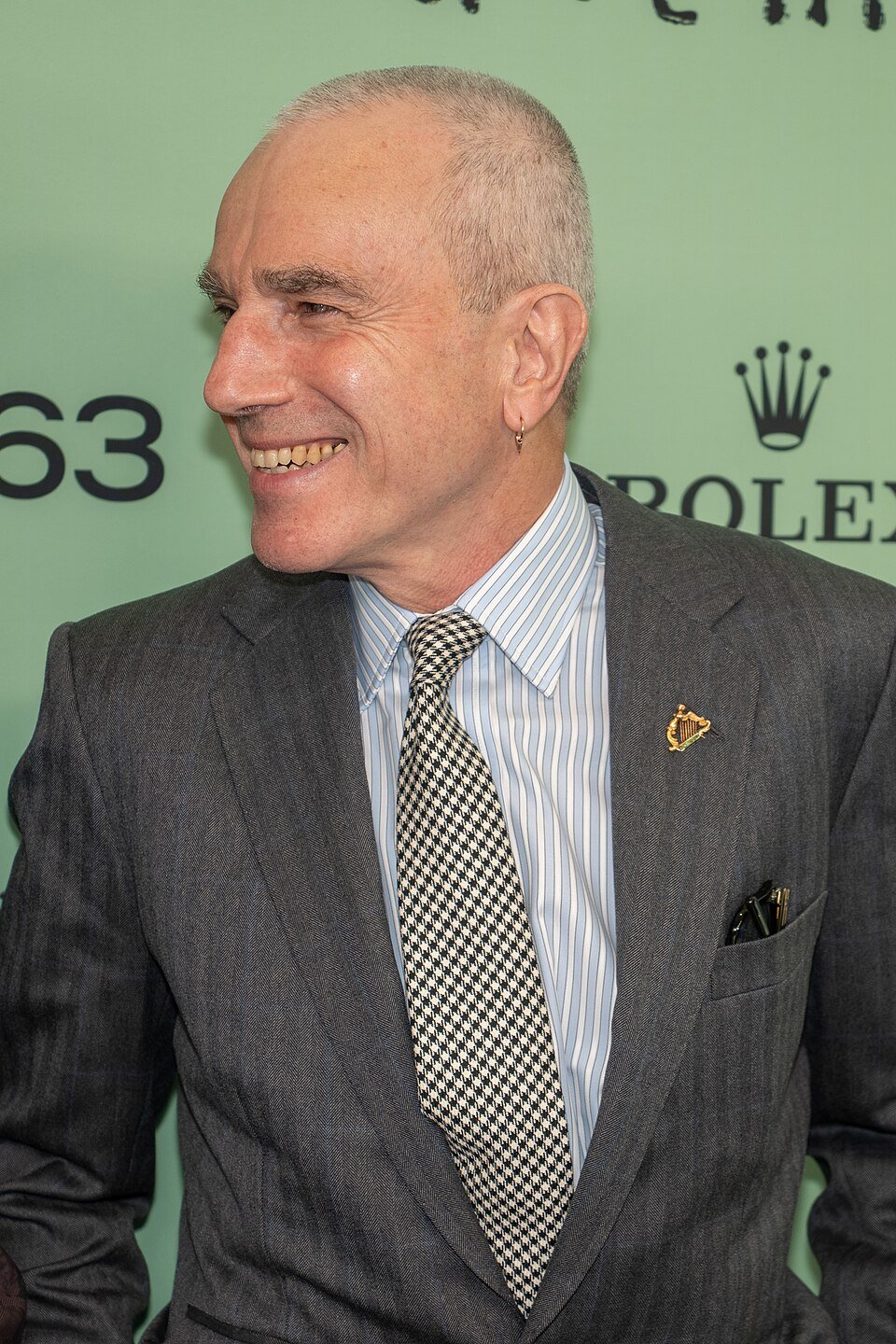
Daniel Day-Lewis is 69 years old, born on 29 April 1957 in Kensington, London, and he is widely regarded as the greatest screen actor of his generation — the only man to win three Academy Awards for Best Actor, and now, after eight years away, back on screen in a film he wrote with his son. Celebrity Net Worth estimates his fortune at $40 million, and this profile covers his wife Rebecca Miller, his three sons, his parents, his dual citizenship, and the films that built a legend out of total immersion.
My Left Foot won the first Oscar; Lincoln won the third
1971–1988: Stage years and a double breakthrough
Day-Lewis appeared on screen as a teenager in the early 1970s and spent the decade in theatre before film claimed him: a small role in Gandhi in 1982, The Bounty in 1984, and then, in 1985, a double breakthrough that announced a major talent. In My Beautiful Laundrette he played Johnny, a street punk in a tender, complicated relationship, while in A Room with a View, released almost simultaneously, he was the priggish, repressed Cecil Vyse — two performances so different that critics who saw both in the same season struggled to believe they came from the same actor. The Unbearable Lightness of Being followed in 1988, and with it his reputation as the most intense young actor in cinema.
1989–1997: My Left Foot and the first Oscar
In 1989 he played Christy Brown, the Irish writer and painter with cerebral palsy, in My Left Foot, remaining in character and in a wheelchair throughout the production in a display of immersion that became the template for his legend. It won him the Academy Award for Best Actor. The Last of the Mohicans in 1992 added a physical, romantic leading man to the range; The Age of Innocence in 1993 and In the Name of the Father the same year — as Gerry Conlon, wrongly imprisoned for a bombing he did not commit — deepened it further. The Crucible in 1996 and The Boxer in 1997 closed the decade, after which, characteristically, he walked away from acting altogether and spent the years around the turn of the century in Florence, Italy, working as an apprentice shoemaker — the first of his famous disappearances, undertaken not as publicity but because he wanted to learn a craft with his hands.
2002–2012: Gangs of New York, There Will Be Blood and Lincoln
Martin Scorsese persuaded him back for Gangs of New York in 2002, in which his Bill the Butcher — moustached, magnetic and terrifying — dominated every frame he entered. The Ballad of Jack and Rose followed in 2005, written and directed by his wife, Rebecca Miller. Then came There Will Be Blood in 2007, Paul Thomas Anderson’s story of oil and obsession, in which his Daniel Plainview, all coiled charm and curdled ambition, produced one of the most quoted performances in modern cinema and his second Academy Award for Best Actor. After the musical Nine in 2009, he played Abraham Lincoln in Steven Spielberg’s Lincoln in 2012 with a quiet, high-voiced, utterly inhabited stillness that won him a third Best Actor Oscar — a record for a leading man that still stands — and made the argument about the greatest actor of his generation feel, to most observers, settled.
2017–2026: Phantom Thread, the long pause and Anemone
Phantom Thread in 2017, again with Anderson, cast him as the couturier Reynolds Woodcock, a performance of control and fragility that earned another Oscar nomination. Before its release, in June 2017, his spokeswoman issued a short statement: Day-Lewis would no longer be working as an actor, it was a private decision, and no further comment would be made. For eight years the statement held. Then, in 2024, came the news that he would star in Anemone, the first film directed by his son Ronan Day-Lewis — and, for the first time in his career, he took a writing credit, having co-written the script with Ronan over several years. Anemone, in which he plays Ray Stoker, a man who has withdrawn from the world and is drawn back by a family emergency, alongside Sean Bean and Samantha Morton, premiered at the New York Film Festival on 28 September 2025 and was released that October. Interviewed by Rolling Stone in September 2025, he corrected the record on his own legend with a shrug: he had never truly intended to retire, he said; he had simply stopped that particular type of work to do other work for a while, and the chance to make a film with his son was not something he was willing to refuse out of pride. At 69, the most decorated actor of his age is, on the evidence, simply working again.
A Kensington boy, a poet for a father, and a school he hated
Daniel Michael Blake Day-Lewis was born on 29 April 1957 in Kensington, London, into one of the most artistic families in the country, and his birthday is shared with no less a figure of the stage than the tradition he would come to dominate. His father, Cecil Day-Lewis, was an Irish-born poet of major reputation who became Poet Laureate in 1968 and, under the name Nicholas Blake, also wrote a successful series of detective novels. His mother, Jill Balcon, was a stage and screen actress who had worked in films since the 1940s. The family moved to Greenwich, in south London, when Daniel was two, and the contrast between the book-lined, literary household and the tougher streets around it marked him early: he has described himself as an outsider as a boy, posh and bookish among children who were neither.
His nationality is often simplified, so it is worth stating precisely, because it is a genuine part of his identity and not a technicality. Day-Lewis was born in London and is British; he also holds Irish citizenship, which he took in 1993, through his Irish-born father, and he has described a deep attachment to Ireland that long predates the paperwork. He therefore holds both British and Irish citizenship — dual citizenship — and profiles that file him under one nationality alone are only telling half the story.
His father died in 1972, when Daniel was fifteen, a loss that shadowed his adolescence. Acting, which he had begun as a boy, became the serious pursuit: he worked in theatre through the 1970s, trained professionally as an actor in Bristol, and built his craft in repertory companies where the discipline of becoming someone else, night after night, was the whole job. It was the perfect apprenticeship for the method that later made him famous — years of stage work in which research, accent, physicality and patience were not publicity talking points but the trade itself. In a family of poets and performers, where a parent might discuss a line of verse the way other households discuss the weather, the idea that creative work deserves total commitment was simply absorbed; it is the same instinct that leads adults with no such background to ask how they can learn basic drawing skills as an adult and rebuild, deliberately, what his household gave him by osmosis.
Sixty-nine, three Best Actor Oscars, $40 million: Day-Lewis in brief
| At a Glance | Details |
|---|---|
| Born | 29 April 1957, Kensington, London |
| Age | 69 years old |
| Height | 6 feet 1 inch (185 cm) |
| Weight | No reliable published figure exists |
| Nationality | British and Irish — he holds dual citizenship (Irish citizenship since 1993) |
| Wife | Rebecca Miller (married 1996) |
| Children | Three sons: Gabriel-Kane (born 1995), Ronan Cal (born 1998) and Cashel Blake (born 2002) |
| Parents | Cecil Day-Lewis and Jill Balcon |
| Net Worth | $40 million (Celebrity Net Worth) |
| No official account — he maintains no social media presence |
Rebecca Miller, three sons, and a cottage in Ireland
His parents’ marriage joined two artistic traditions — his father’s poetry and his mother’s stage career — and his father’s early death, when Daniel was fifteen, is the biographical fact he has returned to most often when explaining himself: grief, privacy and a suspicion of easy talk all date from there. He guards his private life more fiercely than any comparable star, rarely gives interviews and has spent long periods entirely out of public view, which is precisely why the interviews around Anemone in 2025 attracted such attention.
From 1989 to 1995 he was in a relationship with the French actress Isabelle Adjani, and their son, Gabriel-Kane Day-Lewis, was born in 1995, after the relationship had ended; Gabriel-Kane has worked as a model and musician. In 1996, while filming The Crucible — adapted by the playwright Arthur Miller from his own play — Day-Lewis met Miller’s daughter, the writer and film-maker Rebecca Miller. They married on 13 November 1996 and have two sons together: Ronan Cal Day-Lewis, born in 1998, and Cashel Blake Day-Lewis, born in 2002. The family have lived a deliberately quiet life, divided between Ireland and New York, and the collaboration with Ronan on Anemone is the first time the family’s private closeness has become public work — father and son writing together for years before a camera rolled, a process both described in 2025 as the entire reason the film exists.
He was knighted in 2014 for services to drama, accepting the honour with the same brevity he brings to most public statements. Beyond that, the personal record is intentionally thin, and this profile respects it: what is documented is a marriage of nearly thirty years, three sons, a dual national identity he chose for himself in 1993, and a man who twice walked away from the summit of his profession because other work — shoemaking, family, writing with his son — seemed more worth doing.
Forty million dollars, earned slowly and spent quietly
Celebrity Net Worth estimates Daniel Day-Lewis’s net worth at $40 million, the figure on its current page, updated in October 2025. It is a solo figure, and it is notably modest beside the fortunes of less decorated contemporaries — a fact that reflects his working pattern rather than his standing. Day-Lewis has made only around twenty films across five decades, took years away from acting entirely, and has never built the endorsements, production empires or franchise salaries that inflate other stars’ totals. Higher figures of $50 million to $60 million circulate on low-quality tracker sites, but they are not published by Forbes, Celebrity Net Worth or the Sunday Times Rich List, and they are not used here; no net-worth figure for him is published by Forbes or the Rich List. As with every figure in this series, the Celebrity Net Worth number is a tracker estimate built from public reporting, not a disclosure — Day-Lewis has never published his finances, which will surprise nobody.
His lifestyle, so far as it is documented at all, matches the number: a working life organised around long preparations and long absences, craft skills learned properly rather than performed for cameras, and privacy treated as a possession in itself. On Instagram there is, fittingly, nothing to report: Daniel Day-Lewis has no official account and maintains no presence on any public social media platform. Accounts using his name and image are unofficial. In an industry that now launches careers on those platforms, the most acclaimed actor alive remains entirely, deliberately unreachable on them — and the work, when it comes, still stops the industry in its tracks.
Day-Lewis left, came back, and still sets the standard
Daniel Day-Lewis’s career is the strongest modern argument that scarcity is a strategy: twenty films, three Academy Awards, two long disappearances, and a return made not for money or applause but to write a film with his son. At 69, a holder of British and Irish citizenship, married to Rebecca Miller for nearly thirty years, father of Gabriel-Kane, Ronan and Cashel, and worth an estimated $40 million, he remains the standard against which screen acting is measured — largely by staying away from it.