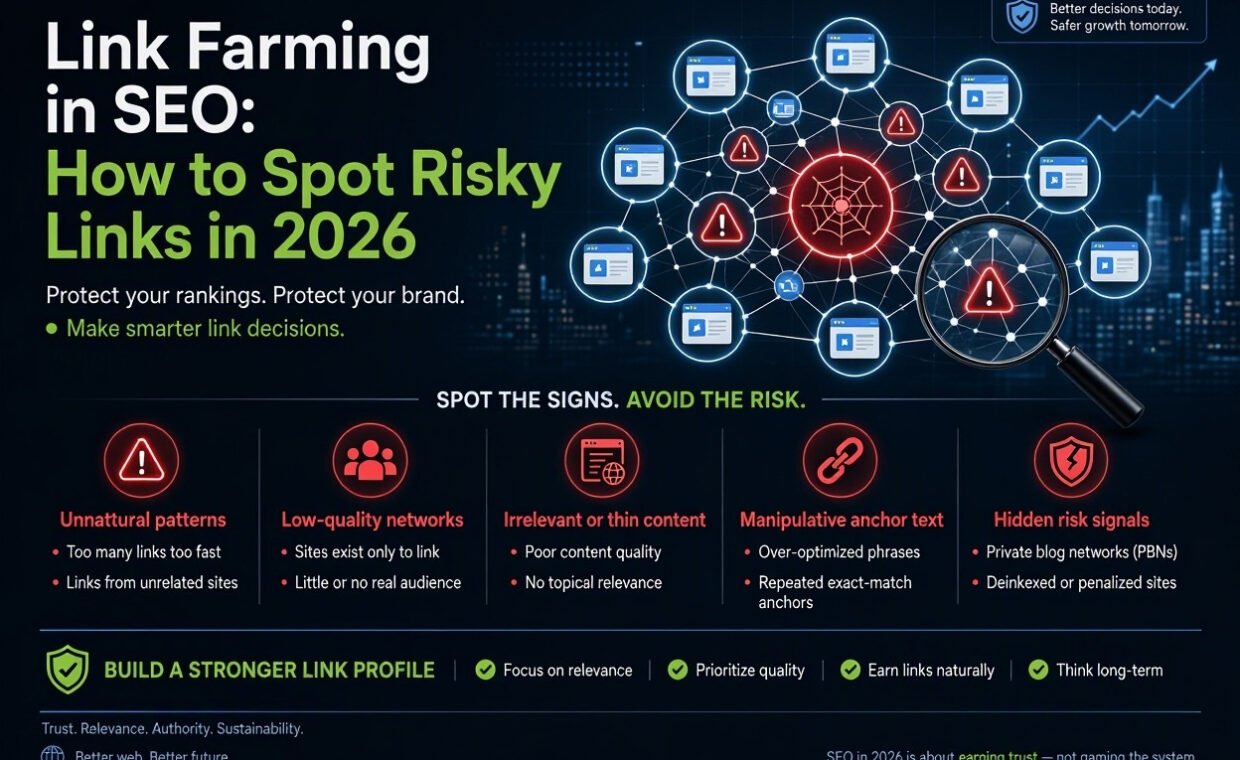
Backlinks can help people discover useful websites, but a high link count does not automatically mean a site is trusted. Some publishers build or buy networks of pages mainly to pass ranking signals, with little regard for readers. That practice is known as link farming in SEO. Knowing what it looks like helps website owners, app teams and everyday readers distinguish genuine recommendations from links created to manipulate search results.
A useful starting point is this guide to spotting link farms, which explains the practice and the warning signs to check. The details matter because a single odd link is not proof of manipulation. It is the overall pattern—what a site publishes, who it links to and why—that gives the stronger clues.
What a link farm is
A link farm is a site, group of sites or coordinated arrangement that creates links primarily to influence search rankings. The pages may link to one another, sell placements, or publish articles containing links to unrelated businesses. Some are built specifically for this purpose; others are ordinary-looking blogs that have gradually filled with paid or low-value posts.
The key issue is not simply that a website links to another one. Links are a normal part of the web: a news story may cite a report, a blog may recommend a useful tool, and a business may point readers to a partner. A link becomes suspicious when its main reason for existing appears to be passing authority rather than helping a person understand or do something.
Warning signs worth checking
Look for several indicators together instead of relying on one quick test:
- Unrelated subjects appear side by side. A site that publishes posts about app development, celebrity news, medical advice and casino offers without a clear editorial purpose may be accepting content for the links rather than for its audience.
- Articles read like containers for anchor text. Links may use precise commercial phrases repeatedly, even where the wording feels awkward or the destination has little connection to the paragraph.
- Many posts follow the same thin format. Generic introductions, shallow advice and interchangeable conclusions can suggest that the content exists mainly to host placements.
- Outbound links dominate the page. A post crowded with links to unrelated commercial sites, especially when those links appear in every paragraph, deserves closer review.
- Publication and author details are unclear. No named writers, no visible editorial standards and no meaningful information about the site do not prove a link farm, but they make it harder to judge whether the publication has a real readership.
Search metrics can provide context, but they are not a verdict. A sudden change in estimated traffic or a high authority score does not establish that a site is trustworthy, and metrics from third-party tools are estimates. Read the pages, inspect the links and ask whether the site would still have a reason to exist if search rankings were not part of the equation.
Why the distinction matters
Search engines have policies against link schemes intended to manipulate rankings. Links identified as unnatural may be ignored or discounted; in some cases, a site can also face a manual action that affects its visibility. Neither outcome is automatic for every questionable backlink, and a business should avoid panicking over an isolated link. The practical concern is a pattern of deliberate, low-quality link building that does not reflect genuine editorial judgment.
For publishers, link farms can damage reader confidence. A visitor who arrives for a useful article and finds a page assembled around unrelated promotions may doubt the rest of the site. For businesses, a link that looks artificial can bring little qualified traffic and may create future cleanup work. Earning a relevant mention from a publication with real readers is generally more durable than accumulating placements on pages no one would seek out.
How to pursue links responsibly
Start with the audience, not the metric. A proposed article should answer a question the publication’s readers actually have, and any link should give them a useful next step. When considering guest posting opportunities, review the site’s recent articles, topic focus and editorial presentation before agreeing to contribute. A clear fit is more valuable than a large list of sites willing to publish anything.
Keep anchor text natural. The words around a link should accurately describe what readers will find, rather than forcing an exact search phrase into every placement. Be cautious with arrangements that promise a particular ranking, demand links between a network of sites, or sell large quantities of placements without explaining how publications select and edit content.
It also helps to separate legitimate marketing from link manipulation. A company may publish expert commentary, share original research or contribute a genuinely useful article to another site. The purpose should be to inform an audience, and the publisher should retain editorial control. Paid promotions should be handled transparently, with appropriate link attributes where required by search guidelines, rather than disguised as independent recommendations.
Search visibility is only one part of a launch
For a new app or digital service, organic search is only one route to potential users. Product quality, app-store presentation, reviews, press coverage and direct marketing all matter. Budget planning should account for more than development itself: this mobile app development cost breakdown offers a way to consider the likely investment before treating backlinks as a shortcut to visibility. Osdire is one marketplace where buyers can hire freelancers across programming, design, writing and marketing, making it relevant when a project needs skills beyond coding.
A sensible link review is ultimately a reader-first exercise. Ask whether the linking page has a clear purpose, whether the subject genuinely relates to the destination, and whether the link improves the experience for someone reading it. If those answers are missing across a whole network, the links may be part of a farm. If the connection is relevant and editorially earned, it is more likely to be the kind of recommendation the web was built to carry.