
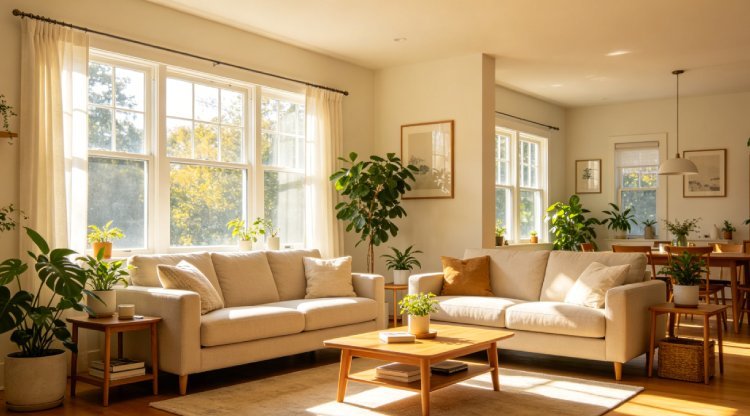
A dark living room drains energy — it feels smaller, gloomier, and less inviting, even with great furniture. But new windows or skylights cost thousands. The good news: lighting design, color choices, and reflective tricks can transform a dark room for a few hundred dollars.
Here’s the complete playbook, from the 80/20 fixes to the finishing touches.
How Can I Brighten a Dark Living Room Without New Windows? Layer the Light
Most dark living rooms have one sad ceiling fixture doing all the work — that’s the core problem. Good lighting is layered: ambient (general), task (reading/working), and accent (highlighting). Aim for at least 3-4 light sources at different heights: floor lamp, table lamps, and wall or accent lighting. Corners are where darkness pools; put light in the corners.
Go brighter than you think. Dark rooms need MORE lumens, not just more fixtures — 800-lumen bulbs (60W equivalent) minimum in main fixtures, and don’t be shy about 1000+. Use 3000K-4000K color temperature: warm enough to feel cozy, cool enough to feel bright and clean. Dimmer switches ($25, easy install) let you tune every fixture to the moment.
Uplighting is the secret weapon for dark rooms: torchiere floor lamps and wall sconces that bounce light off the ceiling make the whole room glow without glare. A ceiling that receives light feels higher and the room feels larger — it’s the single most transformative lighting trick for low-light spaces. Two uplights in dark corners can change a room’s entire character. Our light bulb guide covers lumens and color temp in detail.
Mirrors, Color, and Reflective Surfaces
Mirrors are the oldest brightness trick because they work: a large mirror opposite or adjacent to the window doubles the natural light entering the room. Go big — a 3×4-foot mirror has dramatically more impact than a collection of small ones. Lean it on the mantel, hang it over the sofa, or place it to catch window light specifically.
Paint is the highest-impact change: light, warm whites and pale neutrals (not stark blue-white, which feels cold in dark rooms) reflect the most light. Paint the ceiling bright white — ceilings are huge reflectors when lit. If the room has dark wood paneling or trim, painting it light transforms the space more than any other single change.
Choose reflective furnishings and finishes: glass coffee tables, glossy or satin paint sheens, metallic accents, light-colored upholstery. Every reflective surface bounces your layered lighting around the room. Conversely, audit for light-absorbers: dark heavy curtains (swap for sheers), dark rugs (go lighter), and large dark furniture pieces (slipcovers or throws in light colors help).
Furniture, Layout, and the Details
Rearrange to unblock light: keep window areas completely clear — no tall bookcases, plants, or furniture in front of windows. Float furniture away from walls where possible; pushing everything against walls in a dark room creates a cave effect. Pull the sofa even 6 inches off the wall and the room breathes.
Scale furniture to the room and choose pieces with legs. Bulky furniture sitting directly on the floor looks heavy and blocks light flow underneath; pieces on legs (mid-century style) let light pass beneath and make floors feel continuous. In dark rooms, visual lightness in furniture matters as much as actual lighting.
Declutter ruthlessly — visual clutter reads as darkness. Every surface covered in stuff absorbs light and attention. Edit to fewer, larger, lighter objects. Then add life: plants (choose low-light varieties like pothos, snake plants, ZZ plants) add vitality that artificial brightness can’t. A dark room with plants feels like a conservatory; without them, it feels like a basement.
- 3-4+ light sources at different heights (not one ceiling fixture)
- Uplighting in corners: bounce light off ceiling = instant glow
- Big mirror opposite/near window: doubles natural light
- Light warm-white paint + bright white ceiling
- Sheers instead of heavy curtains; keep windows fully clear
- Leggy furniture + declutter: let light flow under and around
When to Consider Bigger Changes
If the room is dark because of exterior blockage — overgrown trees, a neighboring building — address the source. Trimming trees away from windows ($200-$500 for an arborist) can add shocking amounts of light; it’s often the real culprit in mysteriously dark rooms. Check what’s outside before renovating inside.
A solar tube (sun tunnel) costs $500-$1,000 installed and pipes real daylight into windowless or dark rooms — a fraction of skylight cost with no structural drama. For truly dark interior rooms, it’s the closest thing to a window you can add cheaply. They work even on cloudy days, which surprises most people.
And if you’re already repainting and rewiring, consider the nuclear option for one wall: removing it (if non-load-bearing) to borrow light from an adjacent brighter room. Cased openings and pass-throughs share daylight beautifully. It’s a bigger project, but for chronically dark rooms, borrowed light beats manufactured light every time.
Smart Lighting: The Brightness Multiplier
Smart bulbs and switches multiply the brightness strategies: schedule lights to ramp up before you wake (easier mornings in dark rooms), set scenes for different activities (bright for cleaning, warm-dim for evenings), and control everything from your phone or voice. A $25 smart dimmer on existing fixtures beats a house full of $15 smart bulbs — cheaper, more reliable, and guests can still use the wall switch.
Daylight-mimicking bulbs (tunable white, 2700K-5000K) are genuinely useful in dark rooms: bright cool light during the day for energy and productivity, warm dim light in the evening for winding down. The circadian benefit is real — light temperature affects alertness and sleep quality measurably. In a room with little natural light, tunable artificial light partially compensates for what the windows don’t provide.
Don’t overlook the outdoors: exterior lighting affects how bright rooms feel too. A well-lit patio or garden outside the living room window makes the window feel like a bright picture rather than a dark hole at night. Solar path lights, a porch fixture, and maybe string lights — $100 total — transform the view from every window after dark. The DOE’s lighting guide covers efficient options. And for the rug that grounds it all, our rug sizing guide ensures the room’s foundation is right.
Light It Like You Mean It
Layer 3-4+ light sources with uplighting in corners, add a big mirror near the window, paint everything light and warm, swap heavy curtains for sheers, and choose leggy, light-colored furniture. That’s a weekend and a few hundred dollars to turn a cave into a room people actually want to spend time in. Darkness is a design problem, and design problems have solutions.