
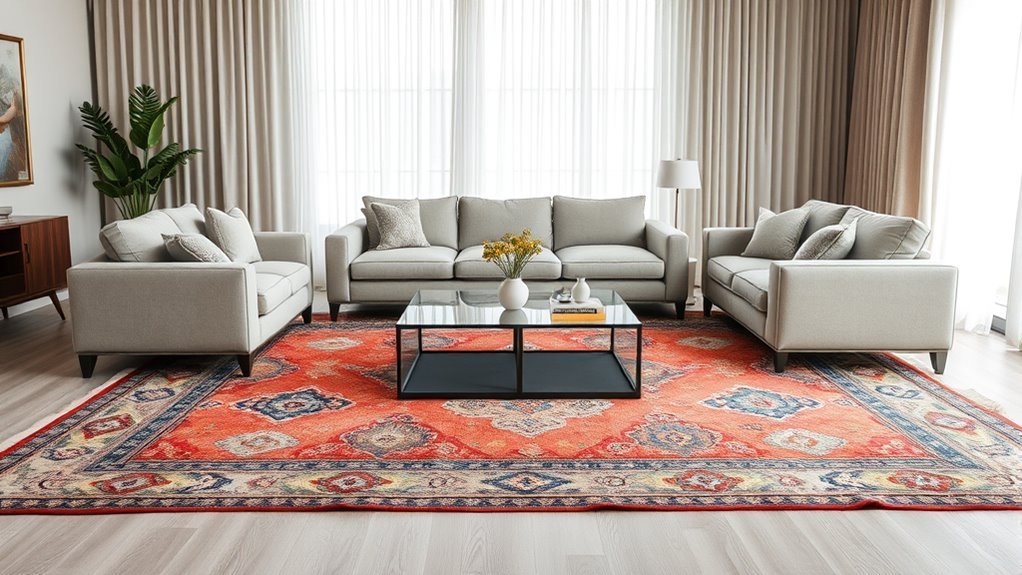
Rug size is the number-one decorating mistake in living rooms — and almost everyone gets it wrong in the same direction: too small. A too-small rug makes a room feel choppy and cheap; the right size pulls everything together and makes even budget furniture look intentional.
Here are the rules designers actually use, the standard sizes for common layouts, and how to avoid the expensive mistake of buying twice.
How Do I Choose the Right Size Rug for My Living Room? The Front-Legs Rule
The golden rule: at least the front legs of all seating should sit on the rug. In an ideal world, all legs of the sofa and chairs are fully on the rug — but front-legs-on is the minimum that looks right. A rug that floats in the middle of the seating area, touching nothing, is the classic mistake — it visually shrinks the room and looks like an afterthought.
Measure your seating area, not your room. Arrange (or imagine) your furniture, then measure the footprint including the front legs — that’s your minimum rug size. Then go one size up if you’re between sizes. Designers repeat this like a mantra: when in doubt, size up. A slightly-too-big rug looks generous; a slightly-to-small rug looks wrong.
Leave 12-18 inches of bare floor between the rug edge and the walls in an average room (a bit more in large rooms, a bit less in small ones). The rug should define the seating zone, not wall-to-wall the room. This breathing room is what makes the layout look designed rather than accidental.
Standard Sizes for Common Layouts
For a standard sofa + two chairs arrangement: 8×10 feet is the workhorse size — it fits most living rooms and gets all front legs on comfortably. Smaller seating areas (loveseat + chair) can use 6×9 or 5×8. Large sectionals and open-plan great rooms need 9×12 or even 10×14 — measure, because sectionals eat rug space fast.
Sectional layouts: the rug should extend beyond the chaise end and under the front of the main sofa section. For L-shaped sectionals, a 9×12 usually works; for smaller apartment sectionals, 8×10. The chaise portion should sit fully or at least substantially on the rug — a chaise hanging off the rug edge looks broken.
Open-plan spaces: use the rug to define the living zone within the larger room. Size it to the furniture grouping, not the room — an 8×10 or 9×12 floating in a great room creates a ‘room within a room.’ Keep at least the front legs of all living-area pieces on it, and let the dining or kitchen zones have their own rugs or bare floor.
Material, Pile, and Practical Choices
With kids and pets, prioritize washable or low-pile rugs. Flatweave, indoor-outdoor, and washable rugs (Ruggable-style) survive real life — spills, claws, crumbs — while high-pile shag shows everything and traps allergens. A beautiful rug you stress over isn’t beautiful; it’s a source of anxiety. Choose for your life, not the showroom.
Pile height affects furniture too: thick rugs make doors drag and chair legs wobble. If your living room has doors swinging over the rug area, stick to low-pile (under 0.5 inch) or use door stops. And always use a rug pad — it prevents slipping, adds cushioning, extends rug life, and protects floors. A $50 pad under a $300 rug is non-negotiable.
Pattern and color: busy patterns hide stains and wear (the family-room secret), while solid light rugs show everything. If you love light rugs, choose washable. Darker, patterned rugs are the practical choice for high-traffic living rooms — they look good years longer with zero extra effort. For homes with dogs, our pet-friendly flooring guide pairs well with these rug strategies.
- Minimum: front legs of ALL seating on the rug
- Standard sofa + chairs: 8×10 ft is the workhorse
- Sectionals: 9×12 usually; chaise must sit on the rug
- Leave 12-18" of bare floor between rug and walls
- When between sizes: ALWAYS size up
- Rug pad underneath: safety, comfort, floor protection
Mistakes to Avoid
Buying before measuring is the cardinal sin. Tape out the rug dimensions on your floor with painter’s tape and live with it for a day — walk around it, look at it from the doorway. This 10-minute test prevents the most common (and most expensive) rug mistake. Online rug shopping without taping is gambling.
Don’t match the rug to the room size — match it to the furniture grouping. A huge rug in a small seating area overwhelms; a small rug in a big room looks lost. The furniture dictates; the room accommodates. And in doubt between 8×10 and 9×12 for a standard living room, the 9×12 almost always looks better in person than on the website.
Finally, don’t forget the rest of the room’s textiles. The rug doesn’t live alone — coordinate (not match) with curtains, pillows, and throws. Pull 2-3 colors from the rug for accents around the room and the whole space clicks together. A great rug with clashing surroundings still looks off; a good rug in a coordinated room looks expensive.
Rug Care: Making It Last
A good rug is an investment — protect it. Rotate rugs 180 degrees yearly (sun fades unevenly and traffic patterns wear one side), use that rug pad (it prevents the rug from grinding against the floor, which wears the backing), and vacuum regularly with suction only or the beater bar off for delicate weaves. Grit is sandpaper; regular vacuuming is the primary life-extender.
Spot-clean spills immediately: blot (never rub — rubbing spreads and pushes stains deeper), work from the outside in, and use the mildest cleaner that works. For wool rugs, avoid harsh chemicals and excessive water; for synthetics, most cleaners are fine. Professional cleaning every 2-3 years for quality rugs in living areas keeps them looking new — it’s $3-$5 per square foot, far cheaper than replacement.
And the placement detail people forget: keep rugs out of direct sustained sunlight if possible, or accept the fade as patina. Sheers on the windows (which also help with the brightness strategies in our dark room guide) protect both rugs and furniture from UV damage. The The Spruce’s rug guides have material-specific care instructions worth bookmarking. A well-chosen, well-cared-for rug lasts decades — the cost per year becomes trivial.
Measure Twice, Buy Once
Tape out the size on your floor, make sure front legs of all seating land on it, and size up when torn. An 8×10 covers most living rooms; sectionals and open plans need 9×12. Add a rug pad, choose washable or low-pile for real life, and you’ll nail the single highest-impact textile decision in your home.