
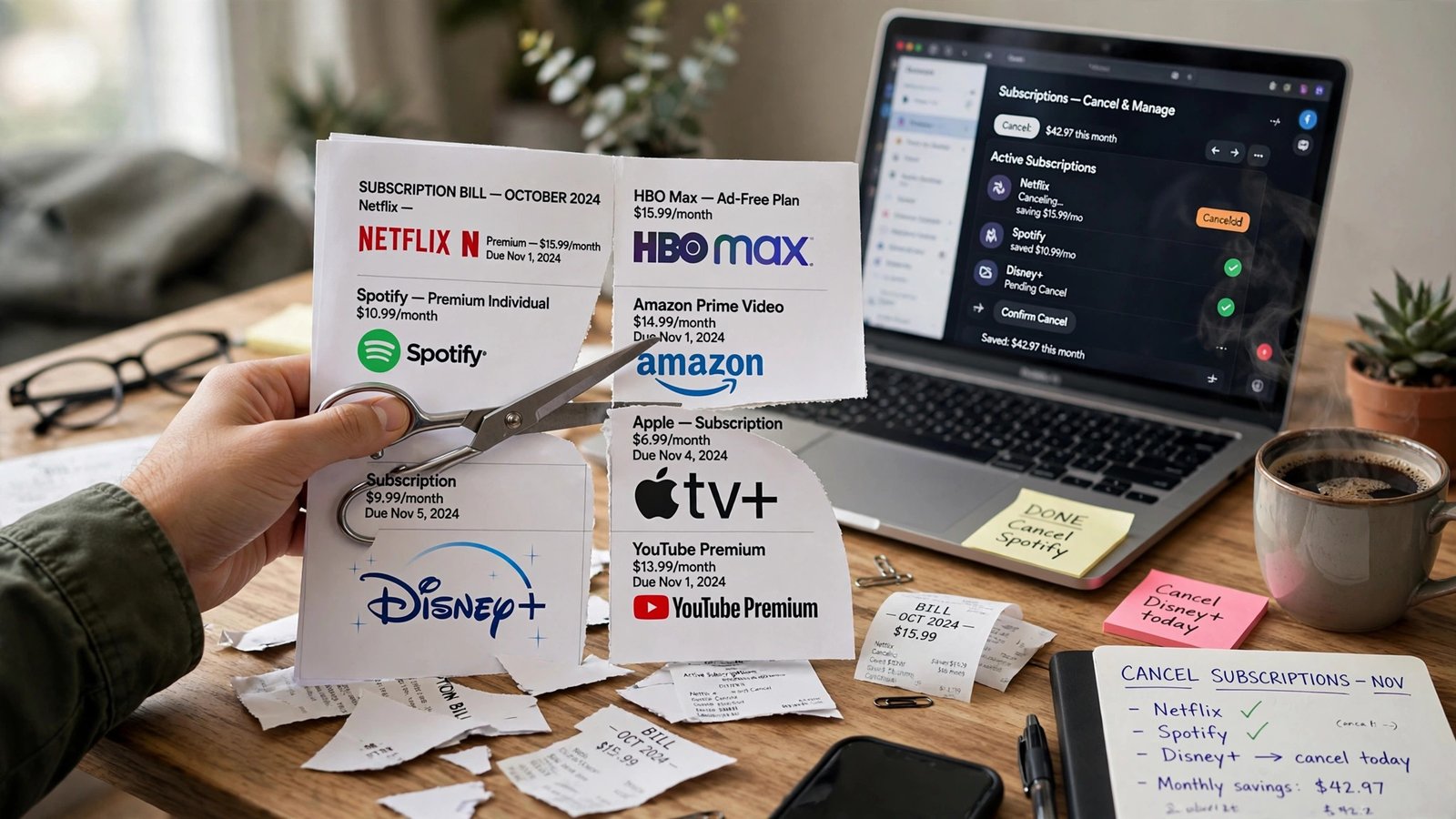
Subscriptions leave an account so quietly that many are discovered only when someone goes looking for them. A service renews in the background, the payment slips out among dozens of other transactions, and the amount feels too small to chase until the same small amount has left many times over. Free trials convert while attention is elsewhere. Annual renewals hide for months between charges. Autopay, designed for convenience, removes the moment of decision that once forced a simple question: is this still wanted? A proper audit restores that question to every service at once. It also raises a pleasant second question once money is recovered, because freed cash can be put to deliberate work instead of drifting away. Many households find that the natural destination debate is should you pay off debt or invest first, and even without settling that debate on the same day, naming a purpose for recovered money makes cancelling feel like gaining something rather than losing a comfort.
Step One: Gather the evidence before judging anything, because memory is an unreliable auditor. Start with three months of statements from every bank account and card that might carry a recurring charge, and read them slowly with a pen or a highlighter to hand. Three months of statements will catch monthly services reliably and will reveal many quarterly patterns as well, while a quick glance further back can help with annual renewals that fall outside the window. Next, open the app-store subscription pages on both phone platforms used in the household, since services bought through an app store often renew through that store rather than through the service itself, and cancelling in one place while the store keeps billing is a common frustration. Check PayPal recurring payments as a separate stop, along with any other payment service where pre-approved payments may be listed. Email deserves a pass as well. Searching an inbox for words such as renewal, receipt, and subscription often surfaces services that statements describe under an unfamiliar billing name. Write down every candidate, even the ones that look legitimate, because the master list built next needs completeness more than it needs early verdicts.
Step Two: Build the master list in a note or spreadsheet where every service can be seen together for the first time. Give each entry the same set of columns so comparisons are fair. One column names the service in plain language. Another column describes the amount in words as a category of cost, such as a small monthly charge or a larger annual charge, without turning the list into a set of worked examples. Further columns should record how often the charge occurs, which account or card pays it, when it next renews, who in the household actually uses it, and when it was last used in honest terms. That last column is where the audit begins to bite, because a service can look cheap and harmless until the last-used answer turns out to be many months ago. Include services that are currently free but hold card details for a future conversion, and mark them clearly so a trial does not become a surprise. Keep the list somewhere it can be found again, since the same document becomes the starting point for the next audit and saves repeating the evidence-gathering from nothing.
Step Three: Classify everything as keep, cancel, or downgrade, using the honest last-used test rather than optimistic intentions. Keep is for services that are used regularly, valued clearly, and would be bought again today at the same terms without hesitation. Cancel is for services that have not been used, duplicate something else already paid for, were kept only because cancelling felt like effort, or survive on the hope that a future version of life will have more time for them. Downgrade is the honest middle path for services that are genuinely used but paid for at a level far beyond actual use, where a smaller tier, an ad-supported tier, or sharing within the rules of a household plan would meet the real need. Be suspicious of the almost category. A service used once in a great while at a full ongoing price is usually a cancel with good manners. Families should apply the test person by person where accounts are personal, and jointly where the bill is shared, so one person’s daily essential is not cancelled because another person never touches it. Mark each decision plainly on the master list, and leave a short space before acting on borderline keeps. A day of distance often turns a reluctant keep into an easy cancel.
Step Four: Cancel one by one and screenshot confirmations, working through the cancel list in a single focused session wherever possible. Momentum matters, because a half-finished audit leaves the hardest services in place, and the hardest services are usually the ones most determined to keep billing. Expect friction and name it for what it is. Many cancellation flows rely on dark patterns designed to stop you cancelling, including preselected retention offers that make staying the default, guilt wording that frames leaving as a personal failing, discount offers that appear only at the exit, and cancel paths hidden behind chat windows or phone calls during limited hours. Slow down at every screen. Read which button actually confirms cancellation rather than which button is largest or brightest, decline extra offers unless they genuinely change the decision, and continue until a clear confirmation message appears. Screenshot that confirmation and save it with the service name and date in the file name, then note the cancellation on the master list. Where a service was bought through an app store, cancel through the store and then verify the subscription page shows it as expiring rather than renewing. Where a paid period has already begun, note the final access date so nobody assumes the cancellation failed when the service continues until the period ends.
Cancelling is only half a skill. Understanding why subscriptions survive for so long makes the next audit easier and the next sign-up slower. Loss aversion plays a central part: giving something up feels heavier than gaining the same thing feels pleasant, so a service framed as something already owned feels painful to surrender even when it is barely used. The gym-membership effect sits alongside it, where paying creates a comforting sense of being the kind of person who exercises, learns a language, or reads serious journalism, and cancelling feels like cancelling the identity rather than the unused payment. Annual-plan traps work more quietly. A plan paid once and forgotten asks for no monthly decision, so it can renew through several changes in habit, household, or taste without ever facing a fresh yes. Free trials exploit optimism about the future, assuming a busier present will somehow become a calmer future with time for everything. Anyone curious about the commercial design behind these habits will recognise the mechanics in any clear account of how the subscription business model makes its money, where retention and quiet renewal are not accidents but the engine of the whole arrangement. Naming the psychology does not remove it, yet it makes a sign-up page feel less like a bargain and more like a negotiation.
Some services resist cancellation with more than awkward screens, and those stubborn cases need a firmer sequence. Start by keeping copies of every cancellation attempt, confirmation, chat transcript, and email, with dates attached. Contact the company once more in writing where possible and state plainly that authorisation for further charges is withdrawn. State consumer-protection rules and the Consumer Financial Protection Bureau’s guidance support the next step: a customer can revoke authorisation and ask a bank to stop payment on future recurring charges, and banks have processes for exactly that request. Phrase the legal position carefully, because federal click-to-cancel rules were struck down in court, so state rules and bank stop-payments are the practical levers rather than a single federal rule that can be quoted at a reluctant company. If a charge lands after authorisation was revoked, dispute it promptly with the bank and provide the saved evidence. Persistence should stay polite and documented. Anger fades from memory, while screenshots, reference names, and dated letters continue to work on behalf of the account holder long after the phone call ends.
The audit earns its keep only if it becomes a habit rather than a heroic one-off rescue. Twice a year is often enough for most households: frequent enough that forgotten services cannot accumulate for long, rare enough that the task stays tolerable. Put a single calendar reminder in place for each audit, name it plainly, and attach the location of the master list so the next session starts from evidence rather than from a blank page. Between audits, two small habits keep the list short. Add every new subscription to the master list on the day it starts, including trials, and set a personal reminder before any trial converts. Treat every renewal email as a prompt to ask the keep question again while the answer is still cheap. Over time the character of spending changes. What remains is a shorter list of services that are used, enjoyed, and chosen on purpose, and what disappears is the quiet background leak that once made a bank balance feel mysterious. Money that stays visible can be directed deliberately, saved calmly, or enjoyed without guilt, which is a better fate than funding services nobody remembers joining.