
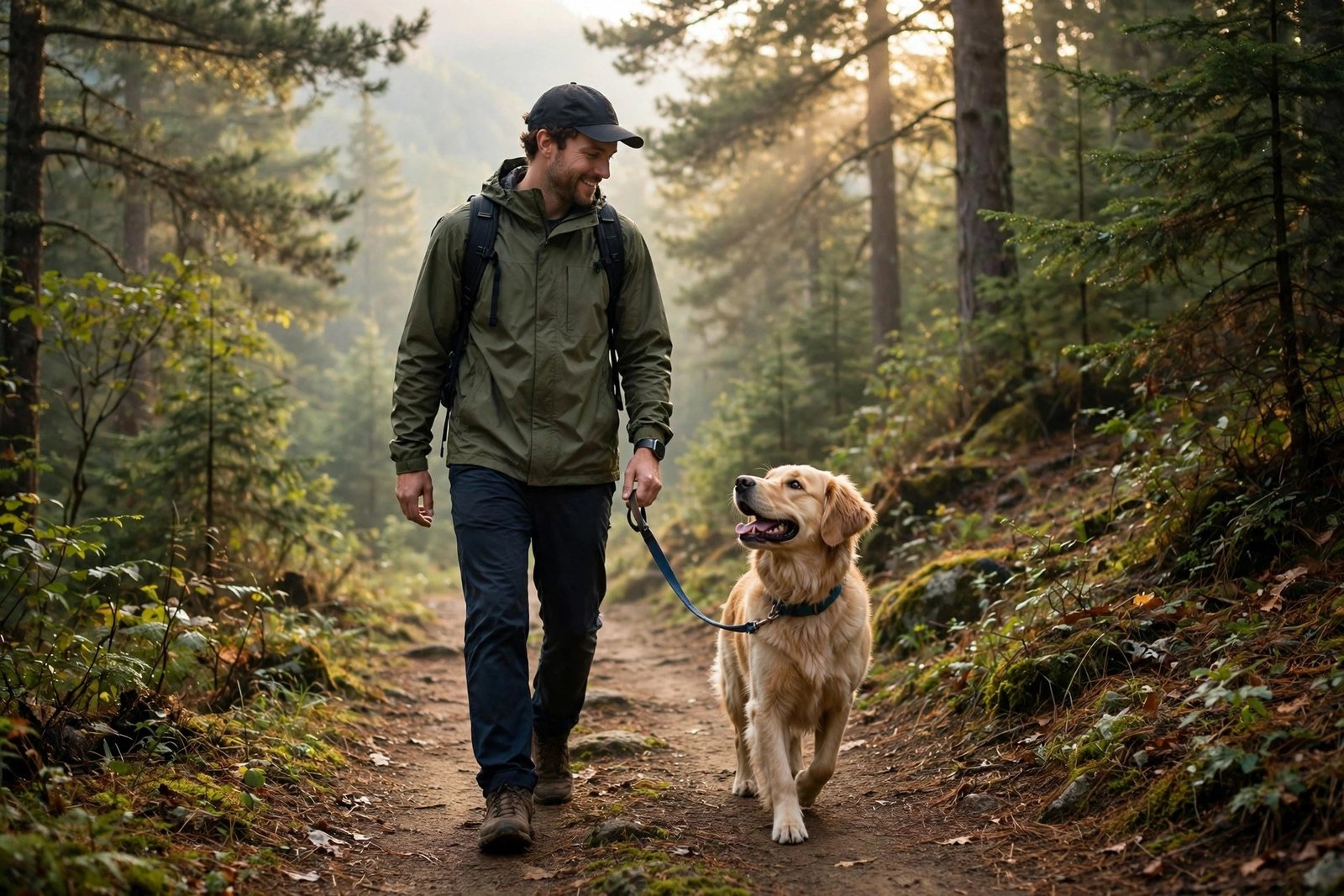
Ask five owners how much walking a dog needs and you will hear five answers — because the honest answer starts with the dog in front of you. Breed, age, health, and energy pull the right amount in very different directions, which is why confident single numbers so often mislead. A young herding dog and an elderly bulldog share a species and almost nothing else about exercise. Still, a sensible starting point exists for most households, and from that starting point the individual dog gives clear feedback about what to adjust.
The short answer
Most healthy adult dogs do well on at least one good walk a day and better on two, totaling roughly half an hour to two hours depending on the dog. That broad range reflects guidance associated with the American Kennel Club, and the width of the range is the point rather than a flaw. Two moderate walks beat one long one for most dogs, because the pair breaks up the day into active stretches instead of one outing followed by long inactivity, and because the pattern matches natural toilet needs far better. A morning walk and an evening walk also give the dog two rounds of sights, smells, and movement, which matters for mental health as much as for muscles.
Weather can reorder those priorities without changing the underlying need. In hot weather the length of a walk matters less than its timing, since cool early or late outings protect paws, breathing, and energy far better than a heroic midday march. Shade, water, and a willingness to cut a walk short belong in the summer routine alongside the lead and the waste bags. Households working through a hot season will find practical help in how to keep your dog cool in summer, and the same timing logic applies whenever heat arrives early or lingers late.
Consistency helps the baseline work in practice. Walks at roughly the same times each day let the dog anticipate outings calmly instead of hovering by the door for hours, and the regularity supports toilet habits, appetite, and sleep in a way that scattered timing rarely does. Weekends tempt owners toward a single heroic outing after a quiet week, yet dogs handle steady daily doses far better than feast-and-famine exercise. Building the two-walk pattern into the ordinary day, anchored to waking and to the evening meal, keeps the routine intact when work, weather, or travel would otherwise squeeze walking out entirely.
Why the range is so wide
Breed energy explains most of the spread. At the high end sit collies, huskies, shepherds, and Jack Russell terriers, dogs bred for sustained work, distance, or relentless alertness. Walking alone may not be enough for that group, however faithfully the walks happen. Running, fetch, training games, or an organized sport often need to join the routine before the dog settles well at home. In the middle sit retrievers and beagles, keen and capable dogs that thrive on solid daily walking with play mixed in. At the gentle end sit bulldogs, pugs, basset hounds, and seniors of every breed, for whom shorter and slower outings suit breathing, joints, and temperament far better.
Size misleads anyone who treats it as a shortcut. Size is an imperfect proxy for energy, and the exceptions are famous for a reason. A small terrier with a working temperament can need far more exercise than a giant dog, and the Great Dane, famously lazy once grown, often wants less mileage than dogs a fraction of its weight. Temperament, breeding purpose, age, weight, and health all outweigh the tape measure. The useful habit is to start from the breed picture, then watch the actual animal. A fuller overview of the essentials of dog walking covers the same ground, from routine building to basic handling, for readers who want the foundations set out in one place.
Puppies and seniors play by different rules
Puppies need protection from enthusiasm, including the enthusiasm of well-meaning owners. The widely used puppy rule of thumb allows about five minutes of structured exercise per month of age, twice a day, and the rule exists because growing joints damage easily under repeated strain. Forced running and long hikes should wait until growth plates close, and the family vet is the right source for when that point arrives for a particular breed and size. Puppies also need frequent short toilet outings through the day, and those outings should not be counted as exercise. Mental work, in the form of gentle training, novel safe objects, and calm social experience, tires a puppy more safely than mileage ever could.
Seniors sit at the opposite end of the same principle. Shorter, gentler, and more frequent strolls usually suit an older dog far better than one long march that leaves stiffness behind. A dog that begins lagging, stiffening after rest, or showing reluctance to head out earns a vet visit rather than a push to keep up, since pain and joint trouble often announce themselves quietly in exactly that way. Swimming stands out as the kind low-impact alternative, supporting weight while still working muscles and heart. The AVMA’s senior-pet resources offer sound backing for adjusting routines with age, and the guiding idea is simple. Keep the older dog moving, but let comfort set the dose.
The sniffing dividend
Distance is not the only measure of a walk, and often not the best one. A shorter sniff-heavy walk can tire a dog more than a longer forced march, because scent is intense mental work for an animal built around smell. Every verge, post, and patch of grass carries layered information, and processing it engages the brain in a way that plain stepping never does. Letting the dog sniff, within reason and safety, turns an ordinary outing into genuine enrichment. Trainers call such outings sniffaris, and the name captures the spirit well. The dog explores, chooses, investigates, and returns home mentally spent rather than merely physically warmed.
Variety multiplies that benefit. Rotate routes instead of walking the identical loop until it fades into background, and give the dog one adventure walk a week somewhere new when the schedule allows, whether that means a trail, a different neighborhood, or a park across town. New ground means new scent, and new scent means fresh work for the brain.
Sniffing still needs light management rather than total freedom. Busy roads, broken glass, discarded food, and unknown dogs all call for a gentle move-on, and a short lead near traffic keeps exploration safe. Away from hazards, patience pays. Standing still while a dog investigates one unremarkable patch of ground can feel like wasted time from the human end of the lead, yet those pauses are often the most valuable part of the outing for the dog. A walk measured by the nose rather than by distance frequently ends with a calmer, more settled animal at home, even when the route covered less ground than a brisk march would have managed. The pattern makes sense once the animal itself is kept in view, since the dog behind the guidelines is a scent-driven species whose wellbeing depends on using that sense, not just on covering ground at a human pace.
Signs you are getting it wrong
Too little exercise rarely stays quiet. The common signs are destructive chewing, persistent barking, indoor hyperactivity that no amount of scolding settles, and steady weight gain. Most problems labeled as bad-dog behavior are more honestly described as under-exercised-dog problems, and they often soften remarkably once the walking routine grows to meet the animal actually living in the house. A dog with energy left over at night will spend it somehow, and furniture, shoes, and door frames are frequent currencies. Before treating such behavior as defiance, any household does well to audit the exercise honestly for a few weeks.
Too much exercise announces itself just as clearly, in the opposite direction. Lagging behind, lying down mid-walk, panting that will not settle with rest, limping, and next-day soreness all signal that the dose exceeded the dog. Flat-faced breeds deserve special caution, since those dogs overheat dangerously fast even on outings that look modest. Cool hours, close attention to breathing, and stopping at the first sign of distress are non-negotiable habits for that group. Hot pavement deserves a direct test as well. Press a palm to the surface, and if the heat feels too sharp for a hand, the surface is too hot for paws and the walk should move to grass, shade, or a cooler hour.
Dogs that find walks hard
Reactive dogs need training, not mileage. Extra distance does nothing for a dog that barks and lunges at other dogs or passing strangers, and crowded routes can deepen the habit. Calmer conditions work better. Walk at off-peak hours, choose wide routes with escape options, and keep enough distance from triggers for the dog to stay under threshold, noticing without exploding. A front-clip harness and a fixed-length lead give steady control without pain or sudden jolts. High-value treats can turn trigger sightings into good news through counter-conditioning, rewarding the dog for calm attention until the emotional response itself begins to change. Serious cases belong with a certified trainer rather than with guesswork.
Fearful dogs need control over the experience itself. Let the fearful dog set the pace, with choice-rich short walks where turning at an intersection, pausing, or retreating altogether stays allowed without frustration from the other end of the lead. A confident companion dog can lend bravery on joint walks, since nervous dogs often borrow calm from a relaxed partner in a way no treat fully matches. A short walk on which a fearful dog feels safe beats an hour-long forced march every time, because confidence grows from successful small experiences and shrinks under flooding. Start with the baseline that fits breed and age, apply the signs and the sniffing test honestly, and then let the individual dog fine-tune the routine from there.