
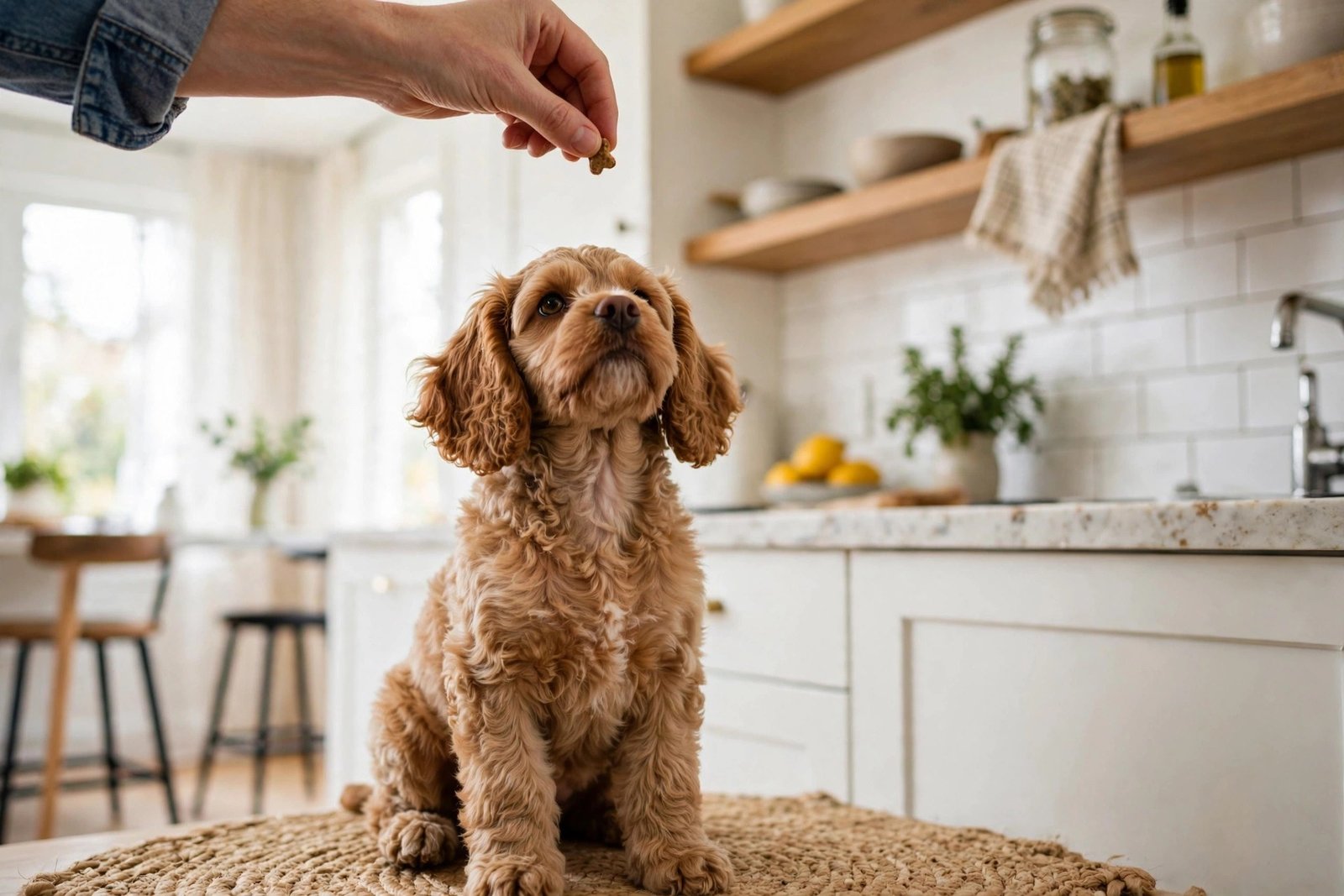
You are not really teaching your dog a new trick with sit — you are putting a name to something it already does a dozen times a day. Dogs sit to watch a bowl being filled, to study a squirrel, and to wait at a door. The training job is simply to connect that familiar action to a word, a hand movement, and a reward, so the dog offers it on request in real life. Sit matters because so much else rests on it.
The lure: mechanics, not magic
Start with a handful of small, smelly treats. Pea-sized pieces of real meat or cheese beat dry biscuits for this job, because the dog needs to care about the reward while learning something new. Hold one treat close to the dog’s nose, let the dog sniff it, and then move the hand slowly up and back over the head, toward the tail. As the nose tips up and back, the rear drops on its own. That is biomechanics, not obedience. The head goes one way, balance shifts, and sitting becomes the easiest thing for the body to do.
The instant the bottom touches the ground, mark the moment with a cheerful yes or a click, and pay the treat at once. Then step back, reset, and repeat the lure a handful of times. Resist the urge to add the word right away. Early repetitions are about the dog discovering that following the hand makes good things happen and that sitting is the action that triggers payment. Keep the movement slow and consistent. A lure that sweeps too high invites jumping, and a lure that moves too fast turns the lesson into a chase.
This method works for a puppy in its first week home and for a rescue of any age, because it asks for no strength, no pushing, and no prior training. A newly arrived dog is still learning where to sleep, where to eat, and which routines the household follows, so a simple win like sit builds confidence early. Anyone bringing home a first dog will find settling-in advice in a quick guide to adopting your first dog helpful alongside early training. Puppies in particular need the work kept tiny: a few minutes at a time, always positive, and always finished while the puppy is still keen. Short, happy sessions suit a young attention span far better than long drills, and reading what to expect from a puppy helps set fair expectations for how much a very young dog can manage in one go.
Timing is the whole game
The marker word, or the click, must land in the very moment of the behavior. The bottom touches the floor, and the mark happens then, not after the dog has stood up again and wandered toward the treat pouch. Dogs connect rewards to whatever happened most recently, so a late mark teaches the wrong lesson. A person who marks late may think the sit earned the treat, while the dog believes standing up, pawing, or staring earned it. Small timing errors repeated over many sessions create the muddled, unreliable sit that frustrates so many households.
If timing feels clumsy, practice without the dog. Bounce a ball and say yes at the exact moment it lands. Repeat until the word and the landing feel like one event. Good timing also means having the treat ready to deliver smoothly, not fumbling in a bag while the moment passes. Set treats within easy reach, keep the marker consistent, and pay quickly after marking. Readers who want the science behind why a well-timed reward carries so much weight can look at how reinforcement drives learning and see why the gap between action and reward matters so much.
Adding the word
Once the lure is producing easy, repeated sits, the word can join the sequence. Say sit once, clearly and cheerfully, a breath before the lure begins, so the word predicts the action that follows. The order matters. Word first, then the guiding hand, then the sit, then the mark and the reward. After enough pairings, the dog starts to anticipate, sitting as soon as the word lands and before the hand has finished moving. At that point the lure can shrink into a smaller hand signal, and later the hand signal can fade too, leaving the word to do the work on its own.
Never chant the cue. Saying sit, sit, sit in rising volume teaches the dog to wait politely for the third shout before responding, because the early versions of the word predicted nothing. One clear ask, followed by help if the dog needs it, keeps the word meaningful. Within a few short sessions, most dogs begin offering the sit on the word alone, especially in the familiar place where the early practice happened. That first clean response to the word is worth a generous reward and a happy end to the session.
The three Ds: duration, distance, distraction
A kitchen sit is only sit in the kitchen with treats visible. Real reliability comes from building three separate skills, one at a time. Duration comes first. Once the dog sits promptly, delay the treat by a beat, then by a few beats, rewarding calm staying in position rather than an instant pop back up. Distance comes next. Take a small step back before paying, so the dog learns that sit holds even when the person is not hovering overhead. Distraction comes last and rises slowly: calmer rooms first, then the garden, then the pavement, then the park at a distance from other dogs and people.
The governing rule is simple. When one D rises, the others drop. A longer sit is practiced close by and in a quiet place. A brand new distraction is paired with a short sit and a person standing near. If the dog breaks, the ask was too big, and the right response is to make the next repetition easier, not to repeat a failing challenge at higher volume. Breaking is information about the size of the step, nothing more. Dogs that are set up to succeed in this layered way tend to look reliable very quickly, because they have rarely been asked to juggle duration, distance, and excitement all at the same time.
Mistakes that slow everything down
Pushing the bottom down is the classic error. A hand pressing on the rear teaches the dog to brace against pressure, not to sit on a cue. It can also make training feel like a wrestling match, which poisons the mood of the session for both parties. The lure does the work cleanly, so hands belong on the treat and nowhere else. Another common error is training a dog that is in no state to learn. A dog fresh off hours alone, bursting with stored energy and excitement, will struggle to concentrate on anything delicate. Exercise first, then train a settled dog for a few focused minutes, and the same lesson lands in a fraction of the time.
Poisoning the cue does quieter damage. Saying sit when the dog is mid-chase, mid-bark, or clearly unable to respond, and then watching the word get ignored, turns sit into background noise. Long sessions cause a similar slide. Attention fades, responses get sloppy, and the final repetitions teach carelessness. Several short sessions spread through the day win easily over one long one, and every session should end on a success, even if that means dropping back to an easy lure for the last repetition.
Proofing: from kitchen trick to real-world habit
Proofing means working the ladder of places deliberately, so the behavior survives outside the room where it was taught. Move from the kitchen to other rooms, then to the garden, then to the pavement at a quiet hour, then to busier settings with more distance from the action. When the setting gets harder, lower the other criteria: pay faster, stand closer, and ask for a shorter hold. Trainers describe this as splitting, not lumping, meaning the challenge is cut into pieces the dog can win rather than served whole. Each new place needs a brief reminder of the easy version before the harder version is fair to request.
Playing the sit challenge in odd places helps the behavior generalize. A sit beside a bench, near a statue, on a different surface, or in a friend’s hallway all teach the same lesson: the word means the same thing everywhere. Proof the release as well. A dog that sits and then decides for itself when to move has only learned half the skill. Teach a clear release, reward the dog for holding position until that release arrives, and build toward the real standard, a sit held until released even past a passing squirrel. The training resources published by the American Kennel Club offer useful demonstrations of this kind of step-by-step proofing for anyone who wants to watch the progression done well.
Sit at work in daily life
The strongest sits are rehearsed by ordinary life. Ask for a sit before meals, so eagerness meets a moment of control. Ask for a sit at doors, so bolting outside stops being an option. Ask for a sit for greetings, giving visitors a polite dog instead of a jumping one, and ask for a sit before the lead goes on, so walks begin calmly instead of in a scramble. Every functional use rehearses the cue without a formal session, and those small daily repetitions add up to a habit the dog performs almost without thinking.
Sit also unlocks the next skills. Down is lured from a sit, using the same hand-following logic from a lower starting point. Stay builds directly on sit’s duration, stretching the pause between the cue and the release. Polite lead work starts with a sit at the kerb, where the dog pauses, checks in, and crosses with some composure. None of that later work needs to be rushed, but all of it grows more easily from a sit that is clear, cheerful, and reliable in many places. The training guides published by the ASPCA close the picture well, setting sit inside a full basic curriculum built on humane, reward-based methods that any household can follow.