
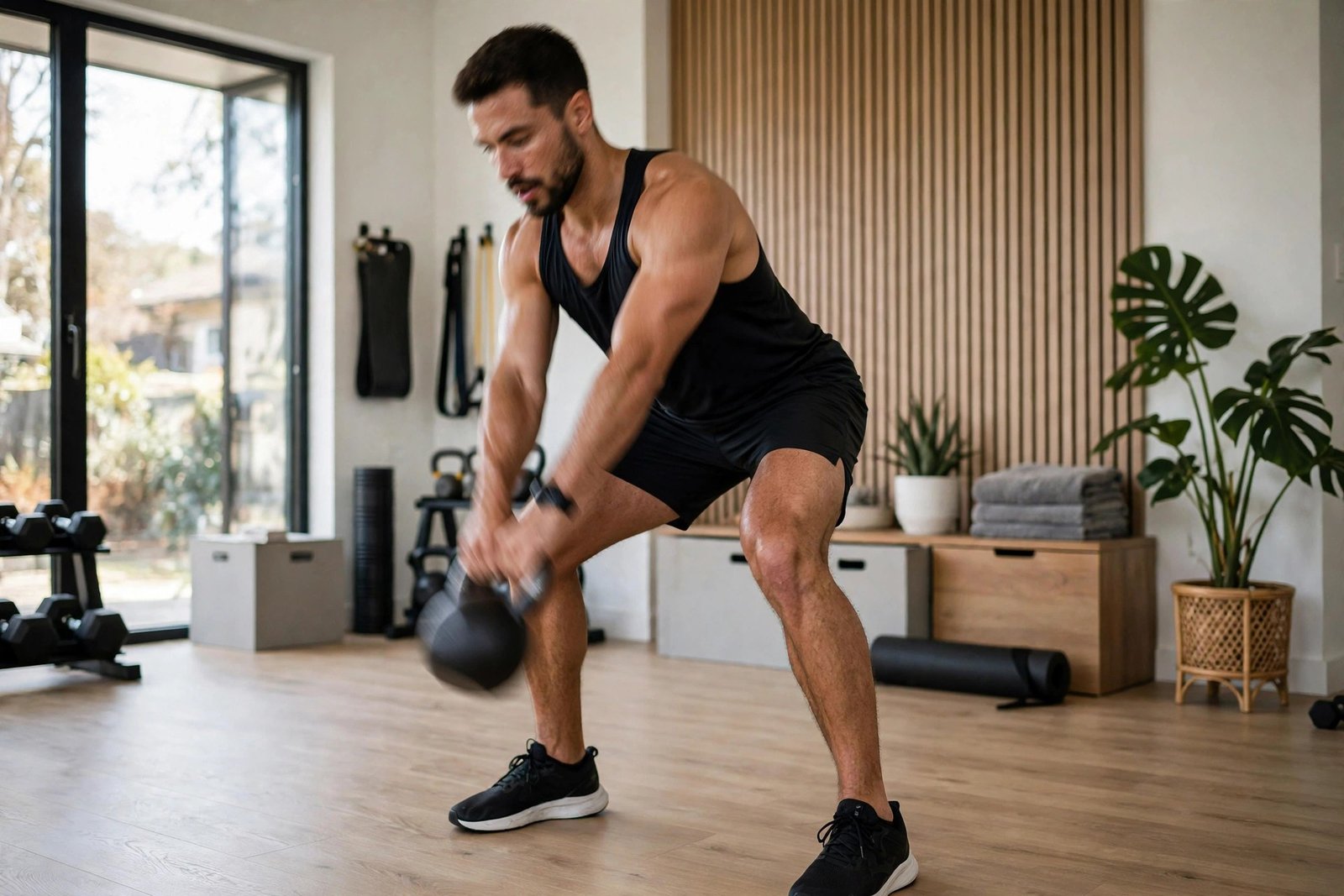
Fifteen minutes is the most underrated workout duration in fitness. It’s short enough to fit into any day — no gym commute, no schedule Tetris — yet long enough, done right, to build real strength and conditioning. The research backs this up: brief, intense full-body sessions performed consistently outperform sporadic hour-long workouts for the average person’s health, body composition, and strength.
These are the best 15-minute full-body workouts — four distinct protocols for different goals and equipment levels, each precisely structured so every minute counts.
The Rules of 15-Minute Training
Short workouts obey different laws than long ones — a point the CDC’s activity guidelines reinforce by counting bouts as short as 10 minutes. First, intensity replaces duration — rest periods stay short (15–30 seconds) and effort stays high; there’s no time for scrolling between sets. Second, compound movements rule — every exercise should hit multiple muscle groups (squats, push-ups, rows) because isolation moves waste precious minutes. Third, the warm-up is non-negotiable but brief — 60–90 seconds of marching, arm circles, and bodyweight squats prepares joints without eating the session. Fourth, have a plan before you start — deciding exercises mid-workout burns the clock; these routines remove all decision-making.
Workout 1: The Bodyweight Classic (No Equipment)
40 seconds work, 20 seconds rest, through the list twice:
- Squat to overhead reach — full-body opener; drive through heels, reach tall
- Push-ups — elevate hands on a chair if needed; full range beats partial reps
- Reverse lunges, alternating — knee hovers above floor; torso tall
- Superman pulls — lying prone, lift chest and squeeze shoulder blades; the back work most routines skip
- Glute bridges — 2-second squeeze at top; the antidote to desk-sitting
- Dead bugs — slow and controlled; deep core without spinal strain
Two rounds is 12 minutes plus warm-up and a 60-second finisher plank. This is the default — balanced, joint-friendly, and effective for beginners through intermediates. Progress by adding a third round or slowing tempos (3 seconds down on every rep doubles the difficulty without adding time).
Workout 2: Dumbbell Power 15 (One Pair of Dumbbells)
A single pair of moderate dumbbells (15–25 lbs for most men, 10–20 for most women) unlocks serious training. 45 seconds work, 15 seconds rest, two rounds:
- Goblet squats — dumbbell at chest; the king of home leg training
- Single-arm rows, alternating — brace on a chair; back thickness builder
- Dumbbell Romanian deadlifts — hinge at hips, feel hamstrings load; the most important lift most home trainees skip
- Push press — dip and drive the dumbbells overhead; full-body power
- Weighted glute bridges — dumbbell on hips; glute strength that protects your back
- Farmer’s carry in place — march with dumbbells at sides; grip, core, and conditioning in one
When all reps feel easy for two sessions straight, increase weight — progressive overload applies at home exactly as in a gym. A small home gym setup with adjustable dumbbells covers years of progression in 15-minute sessions.
Workout 3: EMOM Crusher (The Clock Is the Coach)
EMOM = Every Minute On the Minute. Set a 15-minute timer; at the top of each minute, do the prescribed reps, then rest until the next minute starts. Faster completion = more rest, which auto-regulates intensity beautifully:
- Minutes 1–5: 12 squats + 6 push-ups
- Minutes 6–10: 10 reverse lunges (total) + 8 Superman pulls
- Minutes 11–15: 30-second plank + 10 glute bridges
EMOMs are psychologically brilliant — the clock removes all rest-negotiation, and watching your completion time shrink week over week is addictive progression. Scale reps up or down to finish each block with 15–20 seconds of rest; if you’re resting 40 seconds, add reps.
Workout 4: Cardio-Strength Hybrid (Maximum Calorie Burn)
For fat-loss priority: pair a strength move with a cardio burst, 30 seconds each, no rest between pairs, 30 seconds rest after each pair, 3 rounds:
- Squats + high knees
- Push-ups + mountain climbers
- Reverse lunges + jumping jacks (or step jacks)
- Glute bridges + plank shoulder taps at speed
Heart rate stays elevated the entire 15 minutes while muscles get real work — the metabolic sweet spot for body recomposition. Keep a water bottle handy; this one earns the shower. Structured plans help here — AI-generated workout plans can periodize these sessions across weeks so you’re progressing, not just sweating.
Programming Your Week
- 3x/week: alternate Workout 1 and Workout 2 (strength focus) — the minimum effective dose for real progress
- 4x/week: add Workout 4 for conditioning
- 5x/week: use the EMOM on the fifth day as a lighter skill/practice session
- Progression rule: when you can complete a workout with good form and feel recovered the next day, increase difficulty (harder variation, more weight, less rest) — not duration
- Deload: every 4–6 weeks, do one easy week at half volume; adaptation happens in recovery
Track one thing per session — rounds, weight, or completion time. The log is the program; without it you’re exercising, with it you’re training. ACE Fitness’s exercise library demonstrates every movement in these routines with video.
Warm-Up and Cool-Down in 90 Seconds Each
Even 15-minute sessions need bookends. Warm up with 90 seconds of joint circles (ankles, hips, shoulders, neck), 10 bodyweight squats, and 10 arm swings — enough to raise core temperature and lubricate joints without eating into training time. Cool down with 90 seconds of deep breathing in child’s pose plus gentle quad and chest stretches; this downshifts your nervous system so you walk into the rest of your day calm rather than wired. Skipping these to “save” three minutes is the classic false economy — the warm-up is what lets you train hard safely, and the cool-down is what lets you train hard again tomorrow.
Common Mistakes in Short Workouts
- Skipping the warm-up to “save time” — cold joints plus intensity is the injury formula
- Resting too long — the density is the stimulus; keep rests honest with a timer
- Always doing the same workout — rotate protocols every few weeks to avoid adaptation plateaus
- Going hard daily — alternate hard and moderate days; 15 minutes of intensity still needs recovery
- Ignoring protein — short intense sessions still break down muscle; eat ~0.7–1g protein per pound of bodyweight daily to rebuild
Conclusion
The best 15-minute full-body workouts: the bodyweight classic for anywhere-anytime training, the dumbbell power session for real strength, the EMOM crusher for self-regulating intensity, and the cardio-strength hybrid for maximum burn. Three to four sessions weekly, progressed systematically, tracked in a log — that’s a complete fitness program hiding inside a quarter hour. The barrier was never time; it was the belief that 15 minutes couldn’t matter. It can, enormously.
Frequently Asked Questions
Are 15-minute workouts enough to build muscle?
Yes for beginners through intermediates — 15 focused minutes of progressive compound movements 3–4x weekly builds real strength and muscle. Advanced lifters eventually need more volume, but most people never outgrow well-programmed short sessions.
How many 15-minute workouts per week?
Three is the minimum effective dose; four to five is the sweet spot. Alternate strength-focused and conditioning-focused sessions, and keep at least one full rest day.
Can I do a 15-minute workout every day?
You can do light movement daily, but intense 15-minute sessions need recovery — alternate hard days with easy days or rest. Daily all-out training leads to burnout and stalled progress.
What equipment do I need for 15-minute full-body workouts?
None to start — bodyweight progressions work for months. One pair of dumbbells dramatically extends the runway; adjustable dumbbells are the best single home-gym investment.