
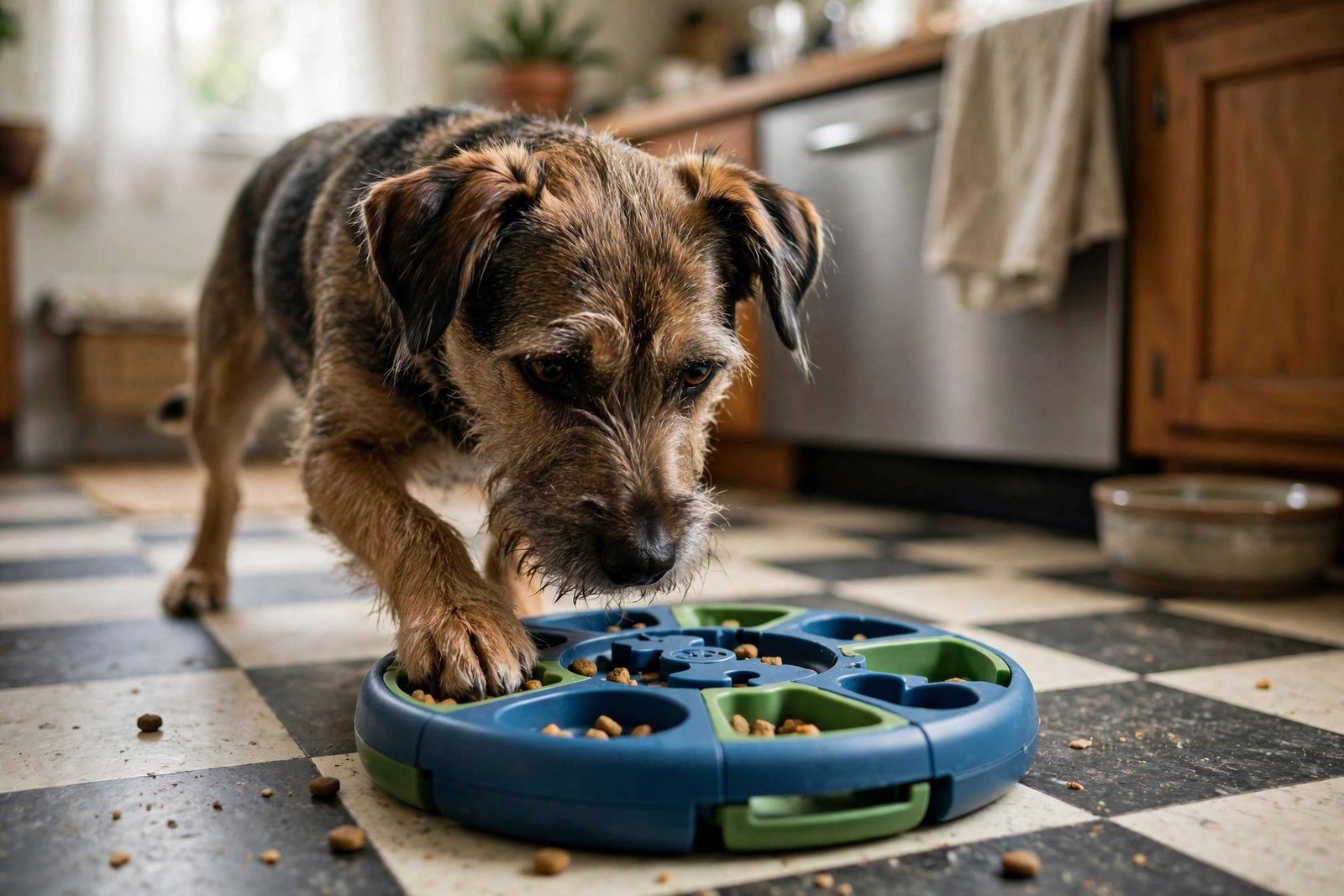
Your dog is smart — too smart. They figured out the treat ball in 30 seconds, they open doors, and they look bored while doing it. Smart dogs without mental stimulation become destructive dogs, because a brilliant mind with nothing to do invents its own entertainment (usually involving your shoes). Puzzle feeders are the solution: they turn mealtime into a mental workout that tires your dog out as effectively as a long walk. PetMD’s dog care and enrichment resources offer more ideas for keeping smart dogs busy.
This guide covers the best puzzle feeders for smart dogs, how to choose the right difficulty, and how to use them for maximum benefit.
Why Mental Stimulation Matters
Physical exercise alone does not satisfy intelligent breeds. A Border Collie can run for hours and still be wired, because the body is tired but the brain is not. Mental work — problem-solving, scent work, learning — produces a deeper, calmer tiredness. Fifteen minutes with a challenging puzzle feeder can settle a dog more than a 30-minute walk.
Puzzle feeders work by engaging the seeking system — the part of the brain that drives foraging behavior. In the wild, dogs spend hours searching for food; a bowl served in 30 seconds bypasses this entire behavioral sequence. Puzzle feeders restore it, reducing anxiety, destructive behavior, and obsessive habits. They are particularly valuable for: high-energy breeds, dogs left alone during work hours, reactive dogs who need confidence-building, and senior dogs who need gentle cognitive exercise. The enrichment principle is universal — see the best board games for adults for how structured mental challenges satisfy similar needs in humans.
Types of Puzzle Feeders
Dispensing Toys (Beginner)
These release kibble as the dog rolls or nudges them. The Kong Wobbler, Omega Paw Tricky Treat Ball, and PetSafe Busy Buddy line are classics. They are the easiest entry point — most dogs figure them out in minutes — and they work for all sizes. Start here if your dog is new to puzzles. They are also nearly indestructible and dishwasher-safe, making them practical for daily use.
Sliding and Flipping Puzzles (Intermediate)
Nina Ottosson puzzles (by Outward Hound) are the gold standard: the Dog Brick, Dog Tornado, and Casino designs require dogs to slide, lift, and rotate compartments to find treats. They come in difficulty levels 1-4, so you can progress as your dog learns. These are excellent for building problem-solving skills, but they require supervision — determined chewers can destroy the plastic components. They are training tools, not chew toys.
Advanced and DIY Puzzles
For dogs who master commercial puzzles, try: snuffle mats (fleece strips tied to a rubber mat — scatter kibble and let them forage), rolled-up towels with treats inside, muffin tins with tennis balls covering the treats, and cardboard boxes nested inside each other. The DIY options are free and endlessly variable — change the configuration to maintain novelty. For the truly brilliant, teach “find it” games where you hide treats around the house; this engages the nose, which is the most cognitively demanding sense for dogs.
How to Introduce Puzzle Feeders
Start easy. A frustrated dog gives up and never tries again. For the first session, make the puzzle ridiculously simple — treats falling out with minimal effort. Let the dog “win” quickly and build confidence. Gradually increase difficulty over days and weeks, not minutes. If the dog gets frustrated (pawing intensely, barking at the toy, walking away), you jumped ahead too fast — go back a step.
Use high-value treats for puzzle work, especially initially — the reward must justify the effort. Measure the treats as part of daily food intake to avoid weight gain; puzzle feeding should replace bowl feeding, not supplement it. Many owners transition to feeding all meals via puzzles — it is the single easiest enrichment upgrade. Supervise initially to ensure the dog does not chew and ingest plastic components. Once you know your dog’s style, you can leave appropriate puzzles for alone-time. For more on canine mental health, the AKC’s training resources cover enrichment as part of a balanced routine.
DIY Puzzle Ideas
You do not need to buy expensive puzzles — household items work brilliantly. The towel roll-up: lay a towel flat, scatter kibble, roll it up, and let your dog unroll it. The box nest: put treats in a small box, place that box in a larger box with packing paper, and let them dig through layers. The muffin tin: place treats in muffin cups, cover each with a tennis ball, and let them figure out how to remove the balls.
The “find it” game: while your dog watches, place treats in obvious locations around a room. Say “find it!” and let them search. Gradually make the hides harder and do it in different rooms. This engages their nose (the most cognitively demanding sense) and can be played for 20-30 minutes. For advanced dogs, hide treats before they enter the room.
Rotate DIY puzzles to maintain novelty — dogs habituate quickly. The best part about DIY is the infinite variety; you are limited only by creativity. And it is free, which means you can do it daily without worrying about cost. Commercial puzzles are great, but DIY keeps things fresh between purchases.
When Puzzles Are Not Enough
Some dogs need more than food puzzles — they need a job. High-drive breeds (Border Collies, Malinois, Jack Russells) were bred to work all day; a puzzle feeder is a snack, not a career. For these dogs, consider: nose work classes (sport that channels scent drive), agility (physical and mental), herding lessons (for herding breeds), or advanced obedience.
If you cannot provide a job, be honest about whether the breed fits your lifestyle. A Border Collie in an apartment with two 20-minute walks is a recipe for behavioral problems, no matter how many puzzles you buy. It is kinder to choose a breed that matches your actual life than to try to compensate for a mismatch with toys. The best enrichment is a lifestyle that meets the dog’s needs.
For more detailed guidance, see American Kennel Club resources.
You might also find our guide on best flooring for homes with dogs helpful.
Frequently Asked Questions
How long should a puzzle feeder keep my dog busy?
Beginner puzzles: 5-10 minutes. Intermediate: 10-20 minutes. Advanced or DIY foraging games: 20-30+ minutes. If your dog solves it in under 2 minutes consistently, it is too easy — increase the difficulty.
Can puzzle feeders replace walks?
No — dogs need both physical and mental exercise. But on days when a long walk is not possible (bad weather, busy schedule), an extra puzzle session helps compensate. Think of them as complementary, not interchangeable.
My dog just chews the puzzle instead of solving it. What do I do?
You started too difficult, or the puzzle is not suitable for power chewers. Go back to simpler dispensing toys (Kong Wobbler, etc.) that reward nudging rather than manipulation. For destructive chewers, stick to rubber toys designed for chewing and use food scattering (kibble in grass or a snuffle mat) instead of plastic puzzles.
Are puzzle feeders good for puppies?
Yes, with age-appropriate difficulty. Start with very simple dispensing toys at 8-12 weeks. Puzzle feeding builds confidence, prevents resource guarding (the puppy learns that human hands near food bring good things), and provides crucial mental stimulation during the intensive puppy phase.
How do I know if a puzzle is too hard?
Signs of frustration: pawing intensely at the toy, barking at it, walking away, or trying to chew through it. If you see these, simplify immediately. The puzzle should be challenging but solvable — your dog should succeed within 5-10 minutes. You can always increase difficulty later.