Frank Sinatra: Net Worth, Age, Family and Career Explained
Frank Sinatra died on 14 May 1998 at the age of 82, and more than a quarter of a century later he remains the voice against which every popular singer is measured. Celebrity Net Worth puts his net worth at the time of his death at $200 million, with contemporary estimates of his estate ranging as high as $600 million, and this profile covers his four wives, his three children, his parents, his famous Palm Springs house, and the songs and albums — from “In the Wee Small Hours” to “My Way” — that made a Hoboken singer into the Chairman of the Board.
A Hoboken boy who sang for tips and quit school to perform
Francis Albert Sinatra was born on 12 December 1915 in Hoboken, New Jersey, in an apartment on Monroe Street, and his birthday became, over the course of the century that followed, one of the most celebrated dates in popular music. He was a large baby, delivered with difficulty, and the birth left marks he carried for the rest of his life, including a scarred left ear that photographers learned to work around. His father, Antonino Martino Sinatra, known as Marty, had arrived from Sicily as a child and worked, at various times, as a boxer under the name Marty O’Brien, a tavern keeper and a Hoboken firefighter, rising to the rank of captain. His mother, Natalina Garaventa, known to everyone as Dolly, had arrived from Genoa and became a force in Hoboken life in her own right: a midwife, a local political organiser and the parent who pushed her son towards the stage.
Hoboken in the 1920s was a working port city, and the Sinatra household was comfortable by its standards, thanks largely to Dolly’s energy and connections. The young Sinatra sang from early on — at family gatherings, at local events, anywhere an audience gathered — and the decisive moment, by his own later account, came when he heard Bing Crosby and understood that a singer could be intimate rather than merely loud: that the microphone allowed a voice to speak to one listener at a time even in a hall of thousands. He organised local singing groups, performed on radio in the New York area, worked as a singing waiter, and chased every opening the big-band era offered, because the big bands were then the whole of popular music and their singers were its stars.
The family background matters to the music that followed. Sinatra grew up between two worlds that his parents embodied: his father’s physical toughness and suspicion of sentiment, and his mother’s warmth, ambition and command of any room she entered. The adult singer combined both, sometimes within a single song — the phrasing tender, the persona untouchable — and Hoboken never left the act. Long after the private planes and the desert houses, he still introduced himself, in effect, as the kid from Monroe Street who had made good, and audiences believed him because, in the ways that counted, it was true.
The big bands, Capitol’s great albums, and My Way at the end of the sixties
1939–1942: The big-band years
Sinatra’s professional break came in 1939, when bandleader Harry James heard him on a radio broadcast and signed him. With James he made his first commercial recordings, including “All or Nothing at All”, a record that sold modestly at the time and became a million-seller when it was reissued four years later, once its singer was famous. In 1940 he moved to the bigger Tommy Dorsey orchestra, and there he became a star. With Dorsey he recorded a run of hits — “I’ll Never Smile Again” spent twelve weeks at number one — and, just as importantly, he studied the band’s trombone-led phrasing and breath control, later crediting Dorsey’s playing as the model for how he learned to shape a lyric across a long line. When he left Dorsey in 1942, in a departure negotiated hard on both sides, he was the most popular singer in the country with the audience that mattered most: the young.
1943–1952: Solo fame and the Columbia years
As a solo artist signed to Columbia Records, Sinatra detonated. His appearance at the Paramount Theatre in New York at the end of 1942, and the scenes that followed through 1943 and 1944, produced the phenomenon the press named Sinatramania: thousands of young fans, the bobby-soxers, screaming for a skinny singer in a bow tie who sang ballads as if he were confiding them. He topped the charts with records such as “Saturday Night (Is the Loneliest Night of the Week)” and “Five Minutes More”, and his voice — light, flexible, unmistakably his — defined popular singing for the decade. The late 1940s were harder. Tastes shifted, his record sales fell, his private life became front-page news, and by the early 1950s Columbia had let him go and the career looked, to many observers, finished. It is the collapse that makes the next chapter the most remarkable comeback in popular music.
1953–1961: The Capitol years and the great albums
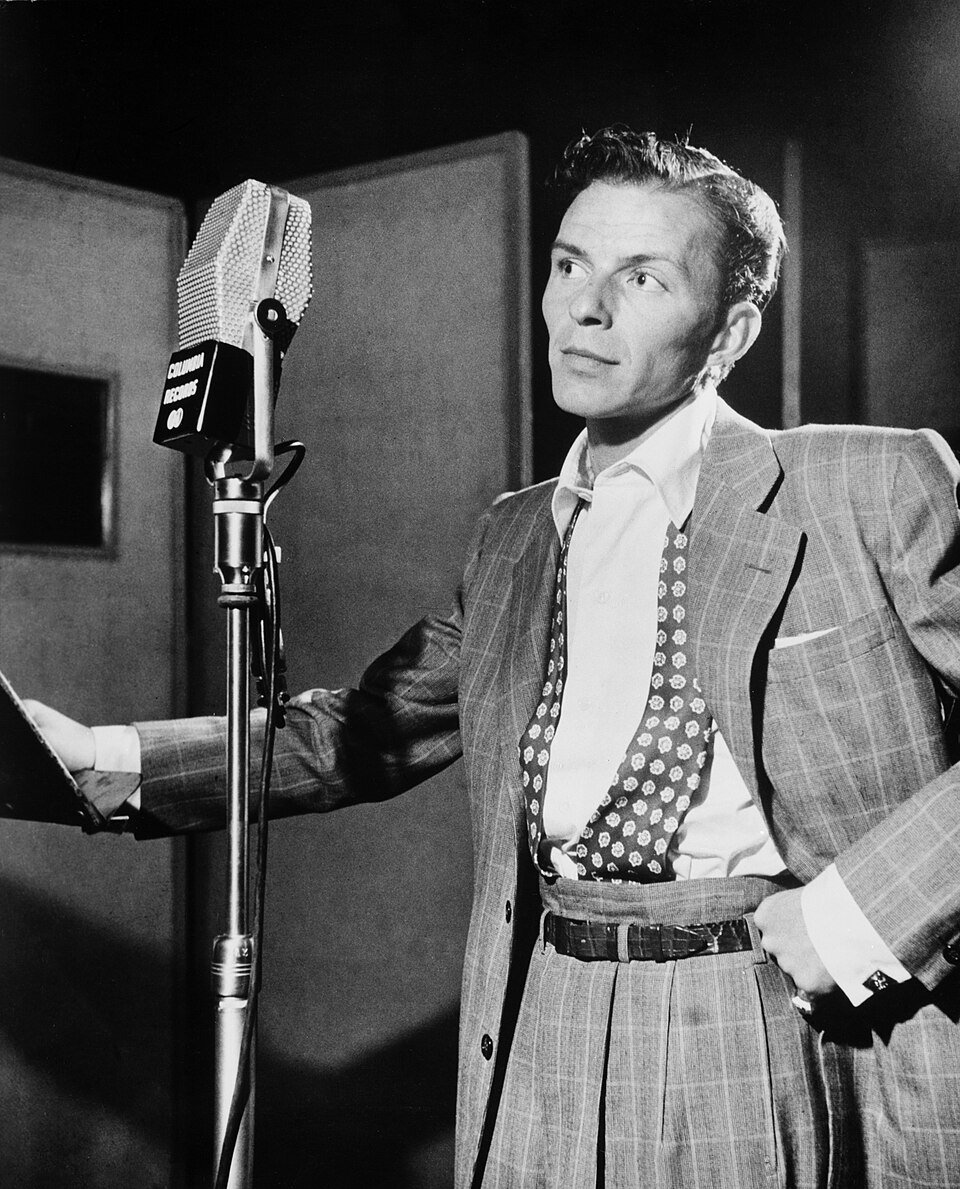
Signed to Capitol Records in 1953, and paired with the arranger Nelson Riddle, Sinatra made the records on which his reputation now principally rests. The album, rather than the single, became his canvas: Songs for Young Lovers (1954) and Swing Easy! established the format, In the Wee Small Hours (1955) turned it into art — a sustained, late-night meditation on lost love that is routinely ranked among the greatest albums ever made — and Songs for Swingin’ Lovers! (1956), Come Fly with Me (1958) and Only the Lonely (1958) completed a body of work no singer of his era matched for consistency. The voice had darkened and deepened; the phrasing had become masterly, behind the beat and inside the lyric at once. Anyone wondering what fashion trends are replacing skinny jeans in 2026 is following a conversation Sinatra helped start, because the sharp suits, narrow ties and tilted hats of the Capitol years set a template for male style that menswear still returns to, decade after decade.
1960–1969: Reprise, the Rat Pack era and My Way
In 1960 Sinatra founded his own label, Reprise Records, an artist owning his masters decades before that became the industry’s standard demand, and through the 1960s he recorded prolifically for it while headlining in Las Vegas with the circle of friends the press called the Rat Pack. The records kept coming: Ring-a-Ding-Ding!, Sinatra at the Sands — the 1966 live album with the Count Basie orchestra that many regard as the finest live recording of its kind — and a run of singles that renewed his chart life, including “Strangers in the Night”, a number one in 1966, and “Somethin’ Stupid”, a duet with his daughter Nancy that topped the chart in 1967. In 1969 he recorded “My Way”, an adaptation of a French song with English words written for him by Paul Anka. He was ambivalent about it in later years, but the public decided otherwise: it became his signature, the song with which every account of his life, including this one, must reckon.
1971–1998: Retirement, return and the final recordings
Sinatra announced his retirement in 1971 and then, characteristically, un-announced it two years later with the album Ol’ Blue Eyes Is Back. The 1970s and 1980s belonged to the concert stage: long residencies, world tours, and audiences who treated each appearance as an occasion. In 1980 he recorded “New York, New York”, which became a second signature song and an anthem for the city across the river from his birthplace. His final studio albums, Duets (1993) and Duets II (1994), paired him with a new generation of singers and sold in the millions, a commercial farewell almost without precedent for an artist in his late seventies. He gave his last public performance in 1995, having sold, across the whole career, more than 150 million records.
Hoboken to Hollywood: the Sinatra numbers in one place
| At a Glance | Details |
|---|---|
| Born | 12 December 1915, Hoboken, New Jersey, United States |
| Age | 82 years old at his death on 14 May 1998 |
| Height | 5 feet 8 inches (173 cm) |
| Weight | No reliable published figure exists |
| Wife | Barbara Sinatra (née Marx), married 1976 until his death in 1998; previously married to Nancy Barbato, Ava Gardner and Mia Farrow |
| Children | Three — Nancy (born 1940), Frank Jr. (1944–2016) and Tina (born 1948) |
| Parents | Antonino Martino Sinatra and Natalina Sinatra (née Garaventa) |
| Net Worth | $200 million at the time of his death (Celebrity Net Worth); contemporary estimates ranged up to $600 million |
Four wives, three children, and a family that still guards the name
His parents shaped him in ways he acknowledged throughout his life. Marty Sinatra’s quiet endurance and Dolly Sinatra’s force of will were, between them, the whole of his inheritance, and he looked after both parents for the rest of their lives; his father’s death in 1969 and his mother’s death in a plane crash in 1977 were losses he felt keenly and spoke of rarely. The Hoboken household — its food, its arguments, its loyalties — remained his reference point for what a family was, however far the life travelled from Monroe Street.
Sinatra was married four times. He married Nancy Barbato, a Hoboken contemporary, in 1939, and she was the mother of his three children: Nancy, born in 1940, who became a successful singer in her own right with hits including “These Boots Are Made for Walkin'”; Frank Sinatra Jr., born in 1944, who became a singer and conductor and worked as his father’s musical director in the later concert years, and who died in 2016; and Tina, born in 1948, who became a producer and the family’s principal memoirist. The first marriage ended in divorce in 1951. He married Ava Gardner in 1951, in a union as turbulent as it was famous; they separated within a few years and divorced in 1957. He married Mia Farrow in 1966; that marriage ended in divorce in 1968. In 1976 he married Barbara Marx, a former model and showgirl who had previously been married to Zeppo Marx, and that marriage lasted for the rest of his life: Barbara was his wife for twenty-two years, until his death in 1998, and she was with him through the final concert years and the long farewell that followed them.
Sinatra died at Cedars-Sinai Medical Center in Los Angeles on 14 May 1998, after suffering a heart attack. He was 82 years old. The lights of the Las Vegas Strip were dimmed in his honour, and the tributes, from presidents and from the singers who had modelled themselves on him, ran for days. He was buried in Palm Desert, California, with Barbara and his family in attendance.
Two hundred million dollars at his death, with the estate valued higher
Celebrity Net Worth puts Frank Sinatra’s net worth at the time of his death at $200 million. The same source is careful, and this profile follows it, about the uncertainty around that figure: contemporary estimates of his overall fortune at his death ranged from $200 million to $600 million, and the exact amount was never publicly established, because a significant portion of his holdings had been transferred to a living trust and therefore did not pass through the publicly available probate process. A further caution from the record: in 1981, while seeking renewal of a gaming licence, Sinatra submitted a financial statement putting his net worth at just over $14 million — a reminder that his fortune rose and fell across the decades and that the large at-death estimates belong specifically to his final, carefully managed years. His will guaranteed Barbara at least $3.5 million and left her substantial property, while his three children each received $200,000 directly through the will, with substantially more valuable assets and rights held outside it in trusts and other entities.
Those at-death figures must be kept separate from what the name earned afterwards. In 2007, nearly a decade after his death, Warner Music Group paid $50 million for a 50 per cent interest in Frank Sinatra Enterprises, the company formed to manage licensing of his name, likeness and legacy. That was a posthumous estate transaction, not part of his net worth in 1998, and it is recorded here only to show why later headlines about the size of “Sinatra’s fortune” sometimes describe the estate’s continuing business rather than the man himself.
The house most closely associated with him is Twin Palms, the Palm Springs estate he commissioned in 1947, at the very height of the first fame, for a reported $150,000. Designed in a clean desert-modern style, with a pool built in the shape of a grand piano, it became the setting for the parties that defined desert society in the post-war years, and it remains a landmark today, preserved and visited as a piece of design history as much as a celebrity address. In later decades his principal bases included a compound at Rancho Mirage, in the same desert valley, and houses in Beverly Hills and Malibu — the properties that passed, in substantial part, to Barbara under his will. The pattern across all of them was consistent: privacy behind walls, a piano within reach, and room for the family and the small circle of friends he kept for fifty years.
Sinatra set the bar for every singer who came after him
Frank Sinatra’s standing does not rest on the size of the fortune, the four marriages or even the 150 million records. It rests on a run of albums made in the 1950s that taught popular singing what it could be, and on a voice that listeners born decades after his death still recognise in three notes. He died in 1998, aged 82, worth an estimated $200 million, and the simplest summary remains the one he arranged for himself: he did it his way, and nobody has done it the same way since.