
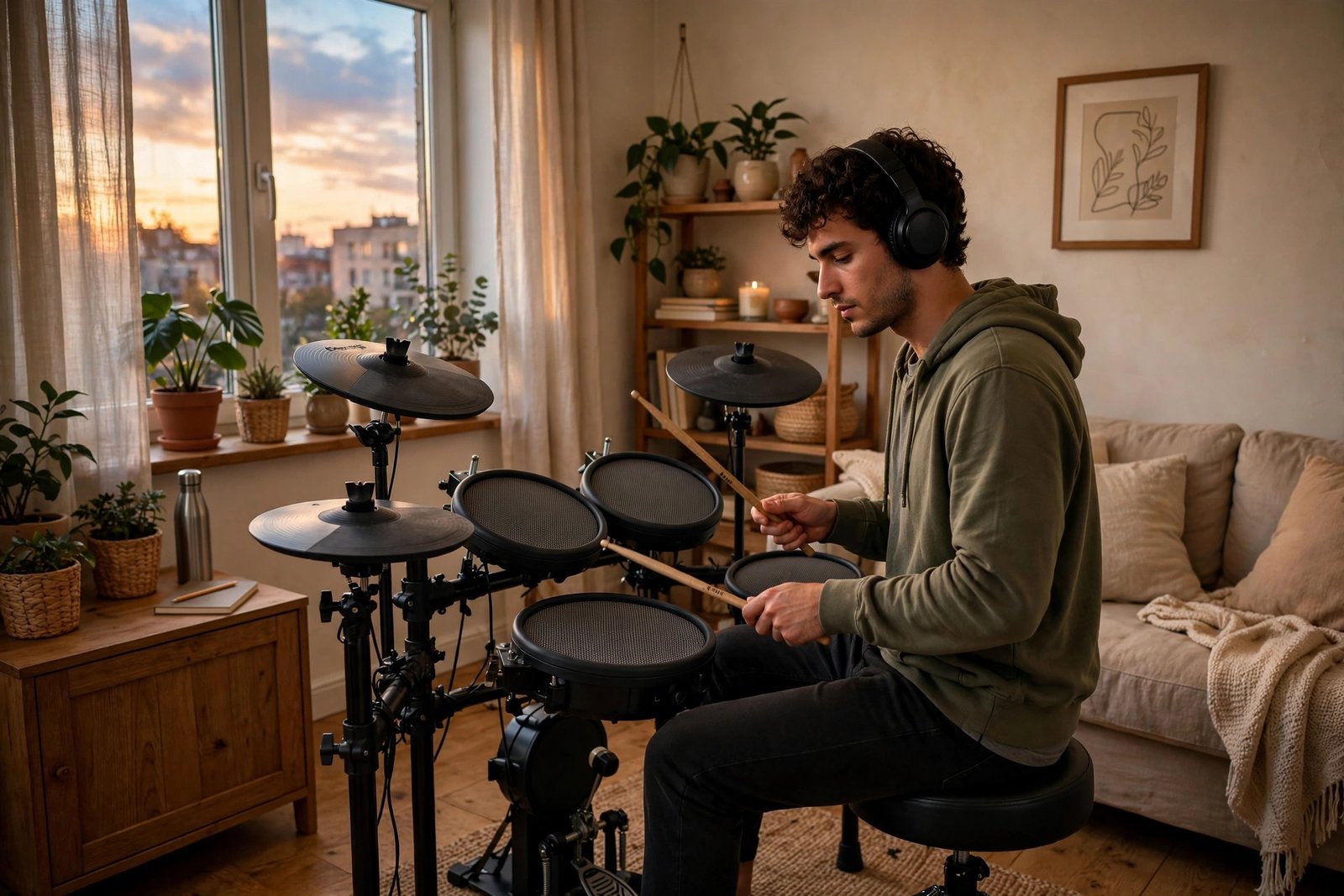
Drums are the loudest common instrument — a snare hit peaks around 120 decibels, louder than a chainsaw — which makes “drummer with neighbors” one of music’s classic conflicts. But quiet drumming is a solved problem in 2026. Between electronic kits, mute technology, and smart practice strategies, you can build serious chops without a single noise complaint. Here’s every real solution, ranked by effectiveness.
Option 1: Electronic Drums (The Nuclear Option)
An electronic kit replaces acoustic shells with rubber or mesh pads and a sound module — you hear everything through headphones, the room hears almost nothing (just the soft thud of sticks on pads, roughly conversation level). Modern mesh-head kits from Roland, Alesis, and Yamaha feel remarkably like real drums; the $400–$800 range satisfies most learners, while $1,500+ kits fool professionals.
The tradeoffs are real: dynamics and cymbal feel aren’t identical to acoustic, and cheap rubber-pad kits teach bad habits (they’re too bouncy). But for apartment drummers, nothing else comes close — full-volume playing at midnight with zero complaints. If you go electronic, invest in good headphones and a throne; your ears and back will log hundreds of hours. Check Roland’s lineup to understand the tiers before buying.
Option 2: Mute a Real Kit (Best of Both Worlds)
Love your acoustic kit? Mute it. Mesh drum heads replace standard heads with woven mesh that cuts volume by 80–90% while keeping real stick rebound — the single best quiet-drumming invention. Rubber cymbal mutes slip over cymbals, dropping them to a dull tick. Full mute pad sets from major brands cover every drum and cymbal for under $100.
A fully muted acoustic kit plays at roughly TV volume — audible in the next room, inaudible through walls. You keep the real layout, real pedal feel, and real cymbals’ weight. The downside: muted drums sound dead (obviously), so musicality practice suffers — but technique practice is 95% of early drumming anyway. Many drummers keep two head sets: mesh for practice, real for gigs, swapping in 20 minutes.
Option 3: Low-Volume Cymbals and Gear Swaps
Cymbals are the hardest thing to quiet — they’re designed to project. Low-volume cymbals (perforated models from major makers) cut volume by up to 80% while keeping real cymbal feel and a surprisingly musical tone. They’re the rare product that actually delivers on its promise. Pair them with hot rods or brushes instead of sticks — bundles of thin dowels that cut attack volume dramatically while keeping groove feel. Jazz drummers have used brushes for a century; rock practice on rods translates fine.
Smaller sticks (7A instead of 5A), thinner heads, and gel dampening each shave a few more decibels. None of these alone solves the problem, but stacked with mutes they get a real kit whisper-quiet. Browse Sweetwater’s drum department for honest comparisons of low-volume options.
Option 4: Treat the Room (and the Relationship)
Some volume escapes no matter what — so manage the room. The tennis-ball riser: build a platform from plywood on tennis balls; it decouples the kit from the floor, killing the bass frequencies that travel through buildings (the ones neighbors actually hear). Cost: about $50. Strategic placement: drums against an interior wall, away from bedrooms, on carpet or rugs. Timing: practice during sociable hours (late morning to early evening), never late night — the same kit at 2 p.m. and 10 p.m. generates wildly different complaint levels.
And the highest-ROI move: talk to your neighbors. Introduce yourself, explain you’re learning drums, share your practice schedule, give them your number, and mean it when you say “text me if it’s too loud.” Neighbors who feel respected tolerate vastly more than neighbors who feel ambushed. Room treatment principles overlap with general soundproofing; see how to soundproof a bedroom from street noise for the underlying techniques. For late sessions, quality noise-cancelling headphones let you practice along to tracks without adding speaker volume.
Quiet Practice Routines That Build Real Skill
Volume isn’t skill — and quiet practice can be better practice. The practice pad ($30) is the drummer’s equivalent of a pianist’s scales: rudiments (singles, doubles, paradiddles) on a pad build the hand technique everything else rests on, silently. Fifteen minutes of pad rudiments daily does more for your playing than an hour of loud bashing.
Air drumming with intent: play along to tracks with sticks but no kit, focusing on limb independence and groove — it looks silly and works brilliantly. Mental practice: drummers who visualize patterns away from the kit improve measurably; the brain rehearses motor sequences without moving a muscle. Foot technique: practice bass-drum patterns on a pillow (silent, realistic resistance). Combine these and you can have a full, productive practice day at near-zero volume — then unleash it all at the rehearsal room on weekends.
Electronic vs. Muted Acoustic: Which Should You Choose?
The big decision comes down to your goals and budget. Choose electronic if: you need near-silence (apartments with thin walls, night practice), you want built-in coaching tools (most modules include metronomes, play-along tracks, and recording), or you’re starting from zero (a $500 electronic kit is cheaper than an acoustic kit plus mutes plus cymbals). Choose muted acoustic if: you already own a kit, you play gigs on acoustic (muscle memory transfers better), or you can’t stand the feel gap of pads.
Many serious drummers end up with both: electronic for daily practice, acoustic (unmuted) for a weekly rehearsal room session where volume doesn’t matter. If budget forces one choice, the electronic kit wins for pure practice hours — and practice hours are what build drummers. Whichever you pick, keep the other option in mind for later; drumming needs evolve.
A Quiet Practice Schedule That Works
Structure beats duration. Monday/Wednesday/Friday (30 min): 10 minutes of pad rudiments, 10 minutes of groove practice on the kit (muted or electronic), 10 minutes playing along to favorite tracks. Tuesday/Thursday (20 min): foot technique on a pillow, mental practice of new patterns, listening study (drummers should listen as much as they play — pick apart what the greats do). Weekend (60 min): one longer session — record yourself, review, and set next week’s focus.
The non-negotiable: a metronome, always. Quiet practice tempts rushing (no band to lock with), and the metronome is the band. Start new patterns at half tempo; speed is a byproduct of accuracy, never the goal itself. Two focused hours a week on this schedule outperforms five unfocused hours of bashing — and your neighbors will never know you’re becoming dangerous.
Conclusion
Playing drums quietly at home is fully solvable: electronic kits for near-silence, mesh heads and mutes for quieted acoustic kits, low-volume cymbals plus rods and brushes for feel, a tennis-ball riser and smart scheduling for the room, and pad-based routines for silent skill-building. Layer the solutions to match your situation — and talk to your neighbors before they have to talk to you.
Frequently Asked Questions
What’s the quietest way to practice drums in an apartment?
An electronic drum kit with headphones — the room hears only soft pad thuds. Second best: an acoustic kit with mesh heads and cymbal mutes, played during daytime hours.
Do mesh drum heads feel like real drums?
Close — modern mesh heads replicate rebound well, though they lack the acoustic tone. For technique practice they’re excellent; swap to real heads for gigs or recording.
How do I stop my downstairs neighbors hearing my drums?
Build a tennis-ball riser platform to decouple the kit from the floor (kills transmitted bass), practice during daytime, use mutes or electronic kits, and talk to neighbors proactively.
Are low-volume cymbals worth it?
Yes — perforated cymbals cut volume by about 80% while keeping real cymbal feel and a musical tone. They’re the best single purchase for quieting an acoustic kit.