
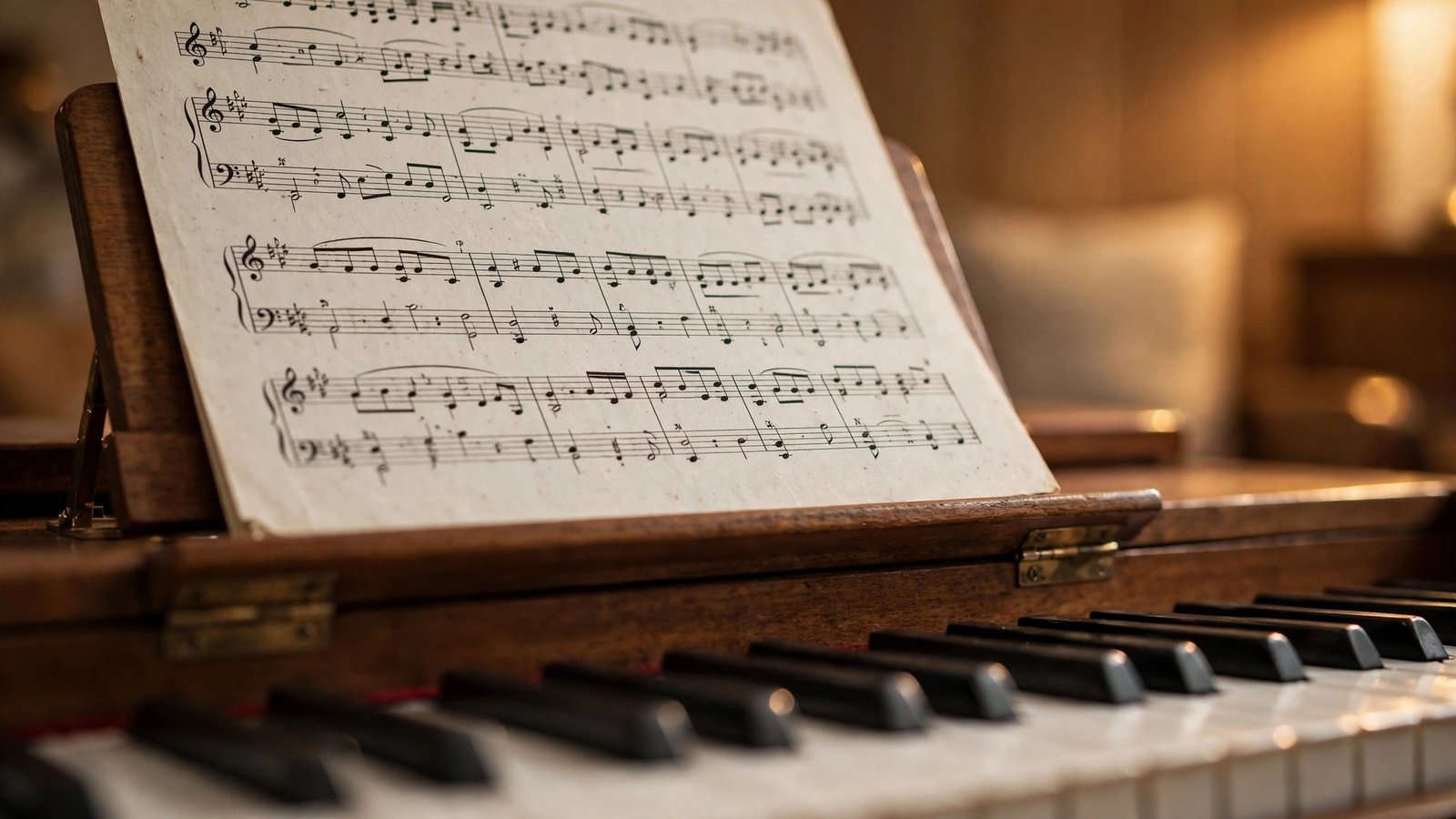
Sheet music looks like a secret code — five lines, mysterious dots, symbols that might as well be hieroglyphics. And in a sense, it is a code: one that took centuries to perfect and about two weeks of casual practice to start cracking. Reading music notes is not a talent reserved for prodigies; it is a straightforward skill with simple rules, memorable tricks, and a learning curve far gentler than its reputation.
This beginner’s guide teaches you how to read music notes from zero: the staff and clefs, the note names with memory tricks that actually stick, rhythm and timing basics, a 15-minute daily practice plan, and how to apply it to real instruments.
The Staff: Your Map
Everything starts with the staff: five horizontal lines with four spaces between them. Notes sit either on a line or in a space, and their vertical position tells you their pitch — higher on the staff means higher in sound. That is the entire foundational idea. The staff is read left to right, like a book, with time flowing forward as your eyes move across the page.
At the beginning of every staff sits a clef, which assigns note names to the lines and spaces. The two you will meet first: the treble clef (the swirly symbol, used for higher instruments like violin, flute, trumpet, and the right hand of piano) and the bass clef (the backward-C with two dots, used for lower instruments like cello, bass guitar, and the left hand of piano). Learn treble first — it is the most common — and add bass later.
Note Names: Two Sentences That Unlock Everything
Music uses only seven letter names, repeating: A, B, C, D, E, F, G. On the treble clef, the lines from bottom to top are E-G-B-D-F — memorized for generations as “Every Good Boy Deserves Fudge.” The spaces spell F-A-C-E — conveniently, the word “face.” Between those two mnemonics, you can name every note on the treble staff within days.
For the bass clef, the lines are G-B-D-F-A (“Good Boys Deserve Fudge Always”) and the spaces are A-C-E-G (“All Cows Eat Grass”). Do not try to memorize both clefs on day one — master treble, then bass becomes a weekend project. Notes above or below the staff use short extra lines called ledger lines; just continue the pattern outward, line-space-line-space.
Rhythm: How Long Each Note Lasts
Pitch is only half the story — the note’s shape tells you its duration. The essentials: a whole note (open oval) lasts 4 beats; a half note (open oval with stem) lasts 2 beats; a quarter note (filled oval with stem) lasts 1 beat; eighth notes (filled oval, stem, flag or beam) last half a beat each. Rests — the silences — mirror these shapes with their own symbols.
The time signature (like 4/4 at the start) tells you the rules: the top number is beats per measure, the bottom is which note gets one beat. In 4/4 — the most common — each measure holds four quarter-note beats. Start by clapping rhythms before playing them: count “1-2-3-4” aloud and clap where the notes fall. Rhythm learned in the body transfers to the instrument effortlessly. If this rhythmic foundation sparks something, finding new music that matches your taste becomes a richer hunt — you will start hearing structure, not just sound.
Sharps, Flats, and the Key Signature
A sharp (♯) raises a note by a half step; a flat (♭) lowers it by a half step; a natural (♮) cancels either. When these appear at the very start of the staff — the key signature — they apply to every occurrence of those notes throughout the piece. So a key signature with one sharp on F means every F you play is F-sharp unless marked otherwise. Beginners often panic here, but it is just a standing instruction — read it once at the start, then play.
The 15-Minute Daily Practice Plan
Consistency beats marathons. Fifteen focused minutes daily outperforms a two-hour weekend cram:
Minutes 1–5: Flash recognition. Use a free note-reading app or flashcards — see a note, name it aloud, check. Speed matters more than perfection; you are building reflexes.
Minutes 6–10: Rhythm clapping. Clap through simple rhythms from a beginner book or app, counting aloud.
Minutes 11–15: Real music. Play or sing one short piece — a folk song, a scale, anything simple. Applying the skill to actual music is what makes it stick.
Within two weeks, note-naming becomes near-automatic; within two months, simple pieces read fluently. The plateau is normal around week three — push through it, because the other side is where reading starts feeling like reading instead of decoding. The Library of Congress hosts vast free public-domain sheet music collections — centuries of real pieces waiting for your new skill, from folk tunes to classical beginner repertoire.
Applying It: Piano, Guitar, and Beyond
Piano is the ideal first instrument for readers — the keys map visually to the staff, with middle C as the landmark between the treble and bass staves. Guitarists benefit differently: standard notation plus tablature together teach both pitch and position, and reading even simple melodies sharpens fretboard knowledge enormously. If you are starting strings from scratch, our guide to learning guitar as an adult beginner pairs well with the reading skills here.
Singers use notation to learn melodies precisely and to communicate with accompanists — and choir singers who read have a permanent advantage at auditions. Whatever your instrument, the payoff compounds: readers learn new pieces in a fraction of the time, can play with others from written parts, and eventually sight-read — playing music you have never heard, in real time. When you are ready to test your ears in the wild, finding local live music events lets you watch skilled readers in action.
Conclusion
Reading music notes is a code with simple rules: the staff maps pitch vertically, clefs name the lines and spaces (EGBDF and FACE will carry you far), note shapes set the rhythm, and key signatures give standing instructions. Fifteen minutes a day — flashcards, clapping, real pieces — turns the code into fluency within months. The National Endowment for the Arts has long documented music education’s cognitive benefits, but the real reward is simpler: the moment a page of dots becomes a song in your head before you play a single note. Start with the treble clef today.
Frequently Asked Questions
How long does it take to learn to read music?
Basic note-naming takes 1–2 weeks of daily practice; comfortable reading of simple pieces takes 2–3 months. Fluency — sight-reading unfamiliar music — typically takes a year or more, but every stage is useful and enjoyable on its own.
Do I need to read music to play an instrument?
No — many excellent musicians play by ear or from tablature. But reading dramatically accelerates learning new pieces, enables playing with others from written parts, and deepens your understanding of how music works.
What is the easiest way to memorize the notes?
The classic mnemonics: treble lines EGBDF (“Every Good Boy Deserves Fudge”), treble spaces F-A-C-E (“face”). Combine with 5 minutes of daily app-based flash drills — spaced repetition builds the reflex fast.
Should I learn treble clef or bass clef first?
Treble clef first — it is the most widely used and covers melody instruments plus the piano’s right hand. Add bass clef once treble feels comfortable; the concepts transfer directly.