
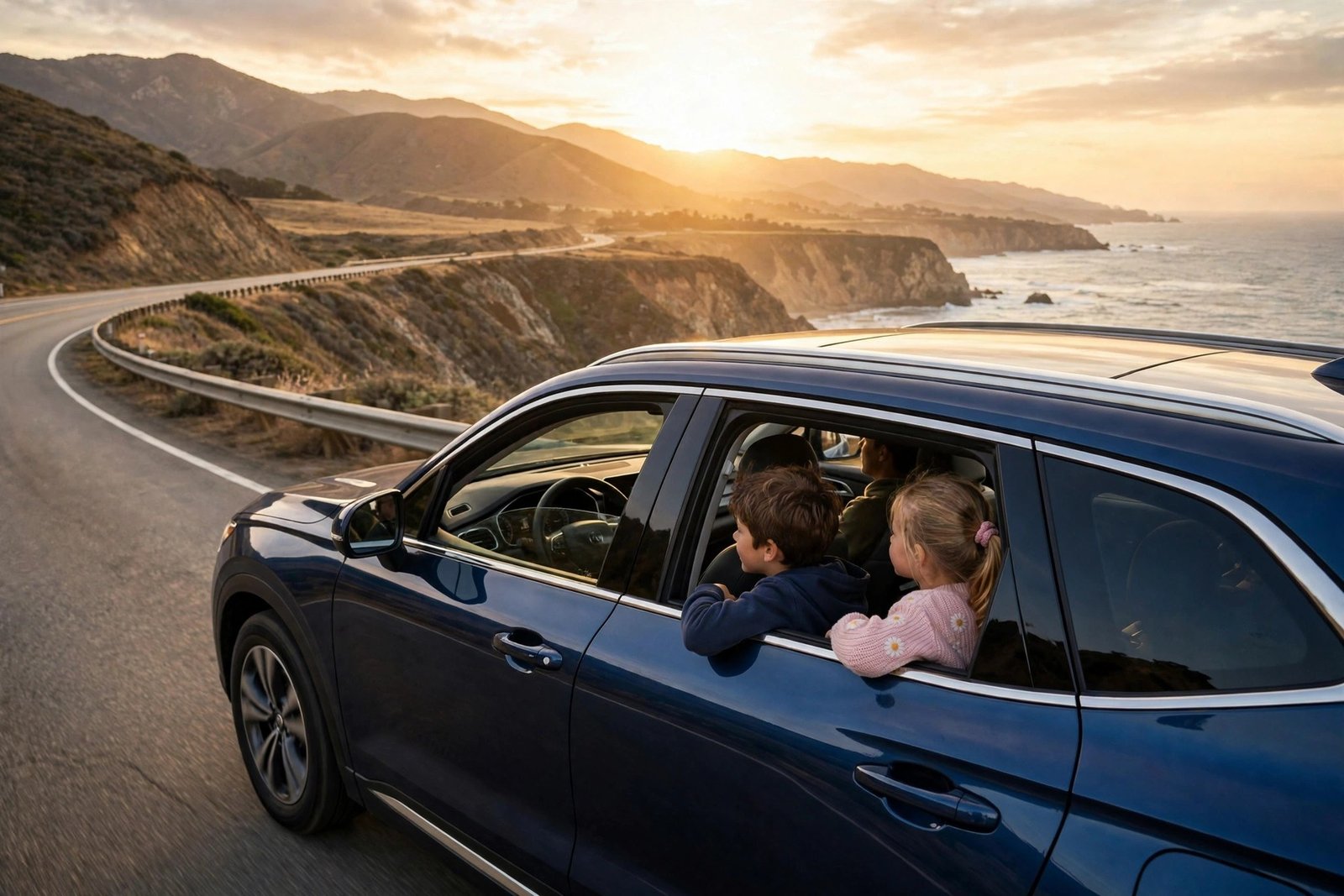
There is a special exhaustion known only to parents six hours into a drive with small children — and veteran road-trip parents swear the difference between a nightmare and a core memory is preparation. The exhaustion has a particular flavor: snack negotiations conducted at highway speed, a bathroom emergency announced minutes after the last stop, and a small voice asking whether the journey is finished yet, on a loop, before the first hour is out. That is simply the physics of small children in a moving box. The families who arrive smiling are not luckier. They run a few simple rules, pack like engineers, layer their entertainment, and treat safety as the one subject that never bends. The rules come first, because everything else hangs on them.
Rule One: drive with their biology, not against it. The single best strategy for distance is sleep. Leave before dawn, while the house is dark and quiet, so the first long stretch of road passes with the children asleep in the back, or time the drive so that bedtime happens in the car and the evening miles roll by in silence. A child asleep for a third of the journey asks for nothing: no snacks, no games, no verdict on the remaining distance. Build the departure around their natural sleep rather than around adult convenience, and the hardest miles of the trip are driven past children who never know those miles happened.
Rule Two: stop every couple of hours, no exceptions. Small bodies run out of circulation, bladder room, and patience on roughly that rhythm, and no entertainment invented can stretch it much further. So build the stops into the route as features rather than treating them as failures of progress. Choose playgrounds where you can, green rest areas where children can actually run, and odd roadside attractions that give the day a story. A short run-around on grass, a swing, a sprint to a fence and back — that burst of movement buys the next peaceful stretch in the car more reliably than any toy. The stops are not delays on the way to the trip. Handled well, they become half the trip itself.
Rule Three: never let hunger or tiredness ambush you. Feed children ahead of hunger and stop ahead of the meltdown, because a child who has already tipped into either state cannot be reasoned back out of it at speed. Pack as though the next restaurant is always further away than the map claims, because with children, somehow, it is. Keep food and water within reach of the adults at all times, watch the small warning signs — the whine, the fidget, the sudden feud with a sibling — and act on the first sign rather than the fifth. Prevention is quiet and slightly dull. Rescue is neither. Every experienced road family runs on this rule more than on any gadget they own.
Pack like a systems engineer
The backseat is a small country with its own logistics, and organization is what keeps it peaceful. Give each child a car kit: their own small bag holding their water bottle, their snacks, their entertainment, and one comfort item from home. When every child can reach their own things, nobody has to excavate a shared bag at highway speed, and the small arguments about whose item is whose mostly never start. The comfort item is not a luxury. A familiar blanket or stuffed animal carries the smell and feel of home into a strange moving space, and children settle against it in a way no new toy can match.
The parents’ command bag is the second system, and it lives where an adult can reach it without unbuckling into danger. Pack more wipes than seems sane, because wipes clean hands, faces, seats, and disasters yet unnamed. Add a first-aid kit, bags for rubbish and for emergencies of the carsick kind, paper towels, and a change of clothes for everyone. Everyone means everyone, adults included, because the child who spills a drink down a parent’s front has still spilled a drink, and the parent will wear it for hours. A bag packed for the worst plausible hour of the trip makes the ordinary hours feel easy.
Snacks get their own strategy, because snacks are the fuel of backseat morale. Pack plenty, and favor low-mess choices: pouches, crackers, fruit, cheese sticks, and anything else that can be eaten by small hands without tools. A guide to the best road trip snacks that are not junk food will help keep the energy steady instead of swinging between a sugar rush and a crash. The celebrated trick is the snackle box, a compartment box filled with small different treats, which buys astonishing quiet as children work through it section by section. Avoid anything that melts, anything that stains, and anything that needs cutlery, because all three become upholstery problems long before they become nutrition.
Finish the system with the unglamorous details that save whole afternoons. Fit sunshades so small passengers are not squinting in a stripe of sun. Add a backseat organizer so books and games live in pockets instead of under seats. Allow spill-proof cups only. And for toddlers, pack a portable potty, which turns a desperate hunt for an exit into a calm roadside pause. There is a romance to the road trip, as a tradition, stretching back through generations of families crossing wide country — but the romance survives on systems like these, quietly working underneath it.
Entertainment: a defence in layers
Screens are a tool, not a failure, and treating them that way makes the whole car calmer. Download films and shows before leaving, because streaming on the road falters exactly where the road gets long, and hotel wireless promises are lies told by lobbies. Give every child headphones, so each soundtrack stays in its own small world and the adults keep the front seat sane. Then lean on audiobooks and story podcasts, the great equalizers of family travel: a well-told story can hold a small child and a grown-up at the same time, which no other medium in the car reliably manages, and a long story makes miles pass like chapters.
Build non-screen layers beneath the screens, because batteries die and passive watching eventually bores even the child who begged for it. Magnetic games stay together on bumpy roads. Sticker books and coloring fill hands quietly. Wax-stick toys, known as Wikki Stix, bend and stick and peel apart without mess, glue, or pieces to lose between the seats. The old car games still earn their place, matched by age: I Spy for the little ones, who delight in finding anything at all; the license-plate game for school-age children, who delight in beating their siblings; Twenty Questions and Would You Rather for tweens who claim to be far too old for car games and then play them for an hour.
The final layer is timing. Introduce new things in waves rather than handing over everything at departure, because novelty spent all at once is gone by the second hour. Keep a surprise bag of small wrapped novelties, and reveal one every so often when energy dips. The wrapping itself is part of the entertainment: unwrapping takes time, and time is the true currency of a long drive with children. A tiny toy that takes minutes to free from its paper, and more minutes to examine, has done real work. Rotate the layers — story, game, screen, snack, scenery — and the backseat day develops a rhythm instead of a long slow slide toward mutiny.
Safety and comfort non-negotiables
Seatbelts and proper restraints never take a holiday, however long the drive or however loud the protest. Install child seats correctly before departure, and have the installation checked if there is any doubt: many fire stations offer free checks, and Safe Kids coalitions run them as well, because correct installation is fiddlier than it looks. Recheck straps at every stop, since children wiggle them loose with the patience of small escape artists. A clear account of the child safety seat, in full explains why fit, angle, and strap position matter as much as the seat itself. The AAA’s family travel resources, named here as a standing reference for parents, gather trip-planning and roadside help in one trustworthy place.
Comfort is the other half of safety, because a miserable child distracts a driver, and a distracted driver is a risk of a different kind. Dress children in layers, against a car that swings between cold air conditioning and sun-baked heat as the day turns. Bring the pillow and blanket from home, because sleep comes easier against familiar things. Keep the cabin slightly cool for everyone’s temper, including the adults’. And accept, before the engine starts, that the journey will take meaningfully longer than the map promises. That is not failure. That is simply what traveling with children costs, and families who budget for it arrive in far better shape than families who race a fantasy schedule.
Two cautions close the safety list. Infants need frequent breaks out of the seat entirely, not merely stops where everyone stays buckled in place, so the youngest travelers set the gentlest pace of all. And night driving, for all its sleeping-child magic, is only clever when the driver is genuinely rested. A driver trading sleep for miles is borrowing against the one account that cannot be overdrawn safely. If tiredness arrives, the rule is the same one the children live by: stop, rest, and let the schedule bend. Schedules recover. The alternative does not bear thinking about, and does not need to, because the fix is always available at the next safe exit.
Above every system in this article sits one house rule, and it is worth stating plainly at the end: restraints stay on while the car moves, no exceptions, and no just-for-a-minute, not for a stretch, not for a quick cuddle, not in a quiet parking lot roll. Consistency from day one ends the negotiation forever, because children test rules that bend and accept rules that do not. Everything else — the snacks, the stories, the dawn departures, the playground stops — is technique in service of a simple picture: a family crossing real distance together, safely, with the children remembering the adventure fondly. That is what preparation buys, and it is worth every list, bag, and early alarm it costs.
1 comment