A short list of ordinary words is the only thing standing between a stranger and everything in a crypto wallet. That list is called a seed phrase, and it works as a master key. From those words alone, wallet software can rebuild every key, every address, and every balance that belongs to you. Most wallets use twelve or twenty-four standard words, drawn from a fixed list and arranged in a fixed order. The system behind the list is known as BIP thirty-nine, and its point is that a human can write the words down and restore access years later without any company. Anyone who finds the phrase, photographs it, or copies it in the right order has the funds, completely and immediately. There is no reset, no forgotten password link, and no support desk that can reverse a transfer. Once the words are exposed, the only safe response is to move everything to a fresh wallet whose phrase nobody else has seen.
The care you give the phrase should match what sits behind it. A small test amount deserves tidy storage. A sum that would hurt to lose deserves stronger habits, in more than one place, checked from time to time. The same principle guides ordinary account security at home, where one weak password reused everywhere puts a whole family at risk, which is why so many households start by sorting out the best password managers for families and then apply the same thinking elsewhere. A seed phrase deserves at least that seriousness, and usually more, because a password can be changed after a breach and a seed phrase cannot. Treat the words as the asset itself, not as a note about it.
Mistake One: storing the phrase digitally, in a photograph, a notes app, a cloud folder, an email draft, or a screenshot tucked among holiday pictures. A phone backs itself up without asking twice. A cloud account can be opened from a stolen password. Malware knows exactly what a tidy list of words looks like, and a synced copy can travel to places you never intended. The moment the phrase exists as a file, it inherits every weakness of every device and account that can reach it. Paper has no sync and no remote login. Keep the phrase offline from the moment the wallet creates it, and resist the thought that a quick photo is only for a minute. A minute is long enough for a backup to run, and once a copy exists somewhere, you can never be sure it has been deleted.
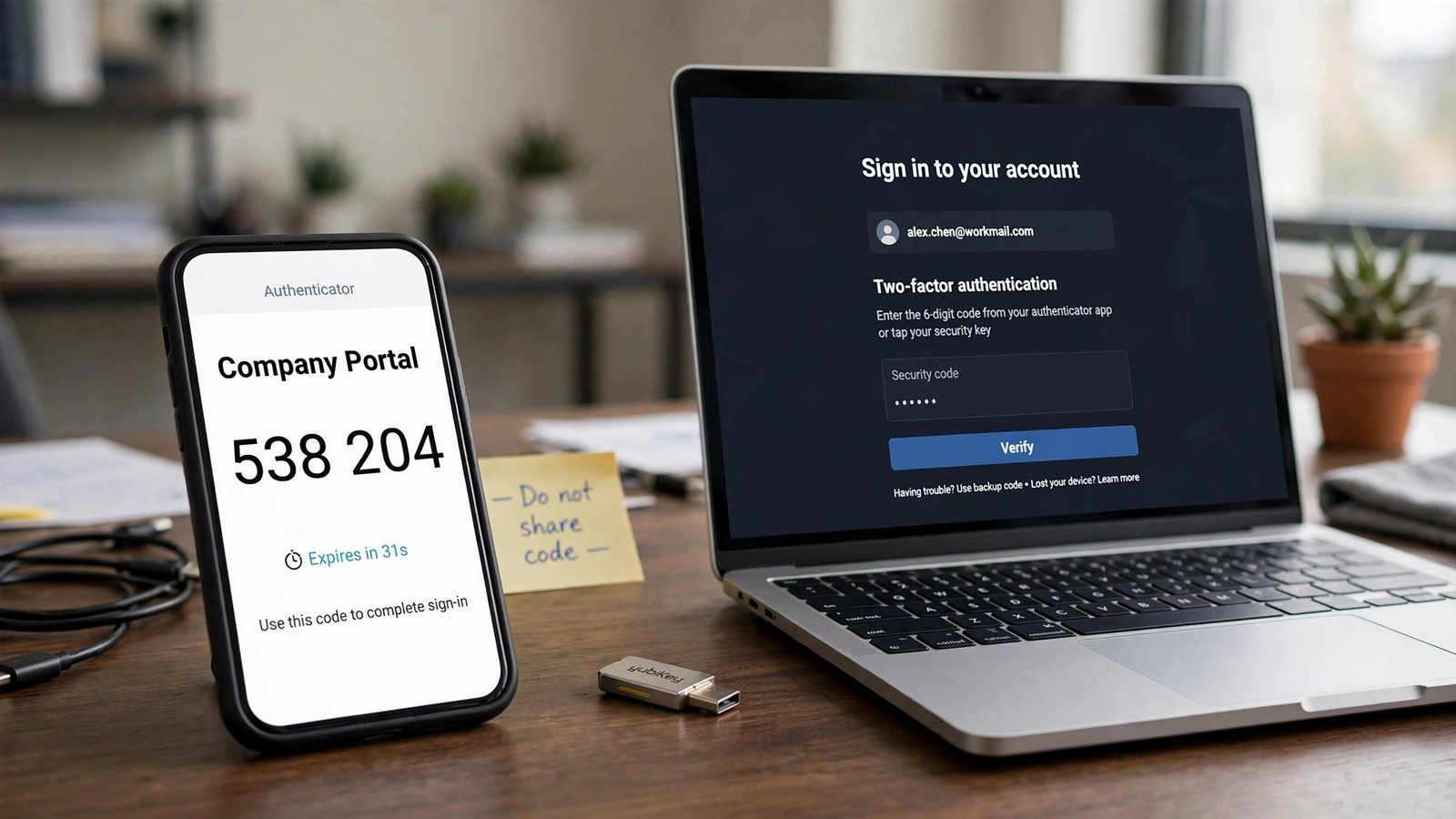
Mistake Two: typing the phrase into websites, online forms, pop-ups, or so-called validators when prompted. No legitimate service needs your recovery words to check a balance, verify an account, unlock a reward, or fix a problem. A wallet only asks for the phrase in one narrow moment, when you are restoring access inside the wallet software itself, on a device you control. Every other request is a trap wearing a helpful face. Fake support pages copy the colours of real brands. Messages warn that funds will be frozen unless you confirm your words at once. The urgency is the tell. Close the page, ignore the message, and return through the app you already trust. If a stranger needs your words to help you, the help is the theft.
Mistake Three: keeping a single paper copy in a single place. Paper feels safe because it is offline, yet one sheet in one drawer is exposed to fire, flood, a leaking pipe, or a clear-out by someone who has no idea what those words are worth. If that copy burns, soaks through, fades, or is thrown away, the wallet behind it may be intact and still unreachable once the phone is lost or broken. Redundancy is not paranoia here, it is the basic design. Two copies in two separate places mean one disaster does not end the story. Each copy still needs to be hidden well and checked often enough that damage is found while the other remains sound.
Mistake Four: leaving paper where visitors, cleaners, tradespeople, or cameras can find it, and reading the words aloud near voice assistants and other listening devices. A phrase kept in an obvious envelope, a desk drawer that guests open for a pen, or a notebook on a shelf is not hidden, it is merely stored. Homes are more open than they feel. People come in to clean, to repair, and to stay the night, and a laptop camera can catch more than anyone intended. Reading the words aloud carries the same risk in a different form, because a spoken list in the right order is just as useful as a written one. Check the phrase silently, in a private room, with doors closed, and tell almost nobody where it lives.
Mistake Five: never verifying the copy by rehearsing a restore. A backup that has never been tested is a hope, not a plan. Words get copied in the wrong order. A handwriting slip turns one word into another that also sits on the standard list, so the error hides in plain sight. Ink fades and a smudge can change a letter. The safe way to learn whether the copy works is a careful rehearsal while the original wallet is still healthy, using a spare device or the wallet’s own recovery check where it offers one, with no money moved and no audience. If the rehearsal fails, you still have the working wallet, and you can write a fresh copy in calm conditions. Skip it, and the first real test comes on the worst possible day.
The storage pattern that actually works
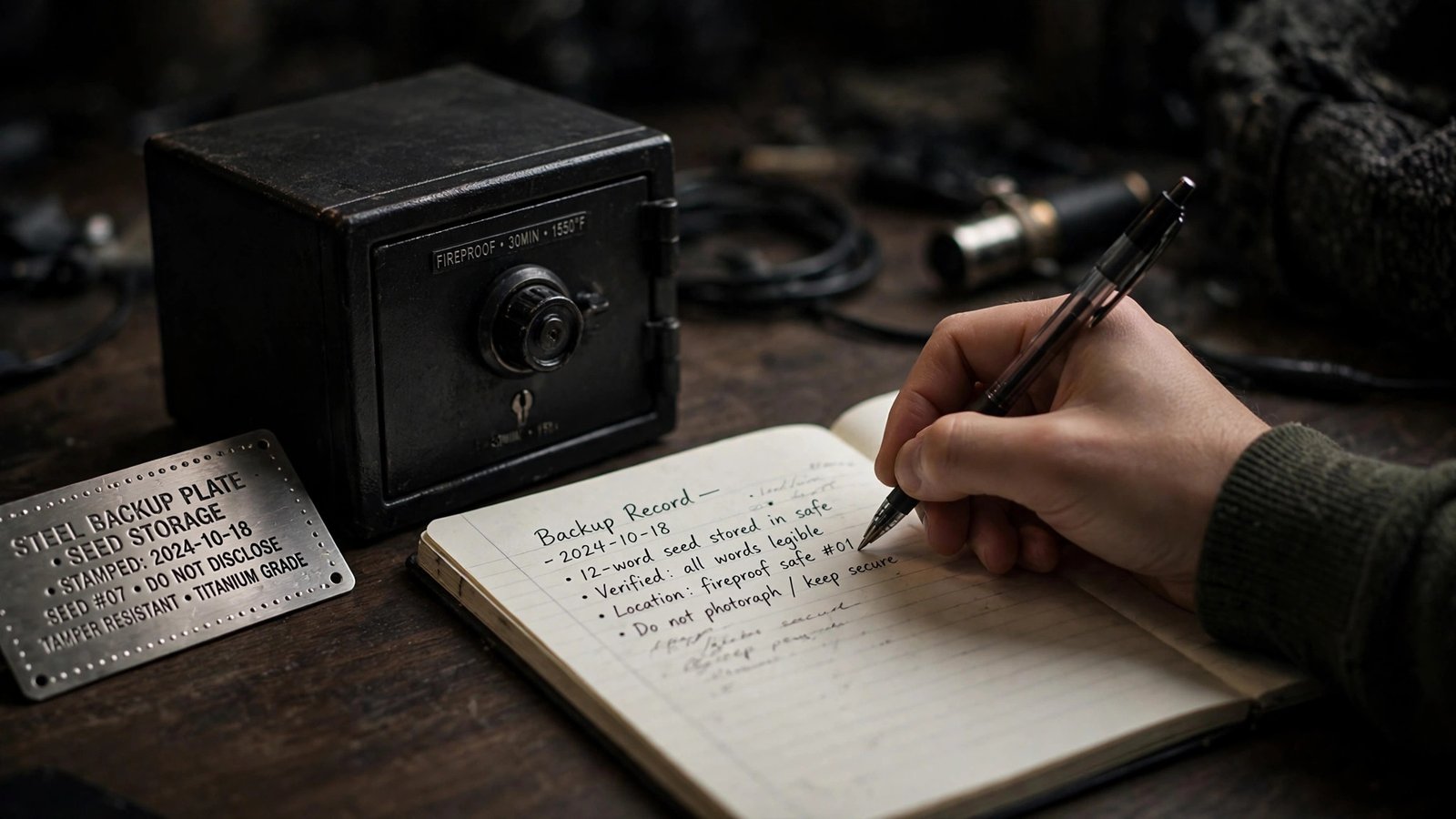
For most people, the pattern that holds up is deliberately dull. Write the phrase by hand, numbering each word so the order can never be argued with later. Make two handwritten paper copies in two separate secure locations, for example one at home in a genuinely private place and one with a trusted relative or in a secure box elsewhere. The list itself comes from the mnemonic word-list standard behind recovery phrases, which is why exact spelling and exact order matter so much. Use pen that will not fade quickly and a cover sheet that gives nothing away. Look in on each copy once in a while, and replace any sheet that is fading or damaged while the other is still sound. Resist upgrades that add risk, such as laminating a sheet and then leaving it in a drawer everyone opens. Simple, separate, and checked beats clever, single, and forgotten.
Keep the words apart from anything that explains them. A bare list, without a wallet name, a coin name, or a note about value, gives a finder far less to work with, and it should never sit bundled with labels, addresses, or account names in one helpful packet that does a thief’s work for them.
Metal, splits and extra words: when the stakes grow
When the amount behind a wallet grows, metal becomes the natural next step. A plate of stamped or engraved steel holds the words in letters that heat, water, and time struggle to erase. Steel asks more effort at the start, since a slip of the punch is harder to correct than a slip of the pen, so the rehearsal habit matters even more. Many people keep one metal copy for the long term and one paper copy for easier checks, each in a different place. Beyond stronger materials, there are ways to divide the secret itself. Splitting strategies break a backup into pieces, so no single piece reveals the phrase, and a set number must be brought together to rebuild it. The thinking behind that approach is set out in secret sharing and how a secret is split into pieces, where a secret can be divided so that some pieces may be lost while the whole stays recoverable from the rest. That tolerance is the attraction, and also the warning, because every extra piece is another place to protect.
A different route spreads control across wallets rather than paper. A multisignature arrangement can require two of three keys to agree before funds move, so one lost or stolen key cannot empty the wallet. It suits larger holdings, and it demands patience, since each key needs its own backup and rehearsal. Then there is the optional extra word, often called a passphrase, added beyond the standard list to open a hidden wallet behind the same phrase. Used well, it means a found phrase alone is not enough. Used carelessly, it is all or nothing, because a forgotten extra word cannot be recovered by anyone, and the funds behind it stay locked for good. Add a layer only when you understand it well enough to explain it, test it, and write down how it should be undone by someone else.
Plan for the people who come after you
A wallet that only one living person can open is a fragile inheritance. If something happens to you, the phrase has to be reachable by the right people without becoming reachable by the wrong people. The workable pattern is to leave sealed instructions with a solicitor or alongside a will, describing that a backup exists and where the instructions for reaching it are held, while keeping the words themselves out of the will text. That last point matters, because a will can become a public document during probate, and a phrase printed in a public record is a phrase handed to the world. Tell at least one trusted person, in life, that the backup exists and where the sealed instructions live. Name the wallet software in the instructions, and make clear that the phrase should be entered only during a genuine recovery, never into a website that asks for it.
All of that planning returns to one small habit. Apply the half a minute rule whenever the phrase is requested. If a request for the words cannot wait half a minute while you stop and check where it really came from, then it is a scam, however official it looks. No exchange and no genuine support worker needs those words in a hurry, or at all. Slow is safe. A phrase that stays on paper, in two quiet places, checked from time to time and understood by one trusted person, will outlast panics and faulty phones.