
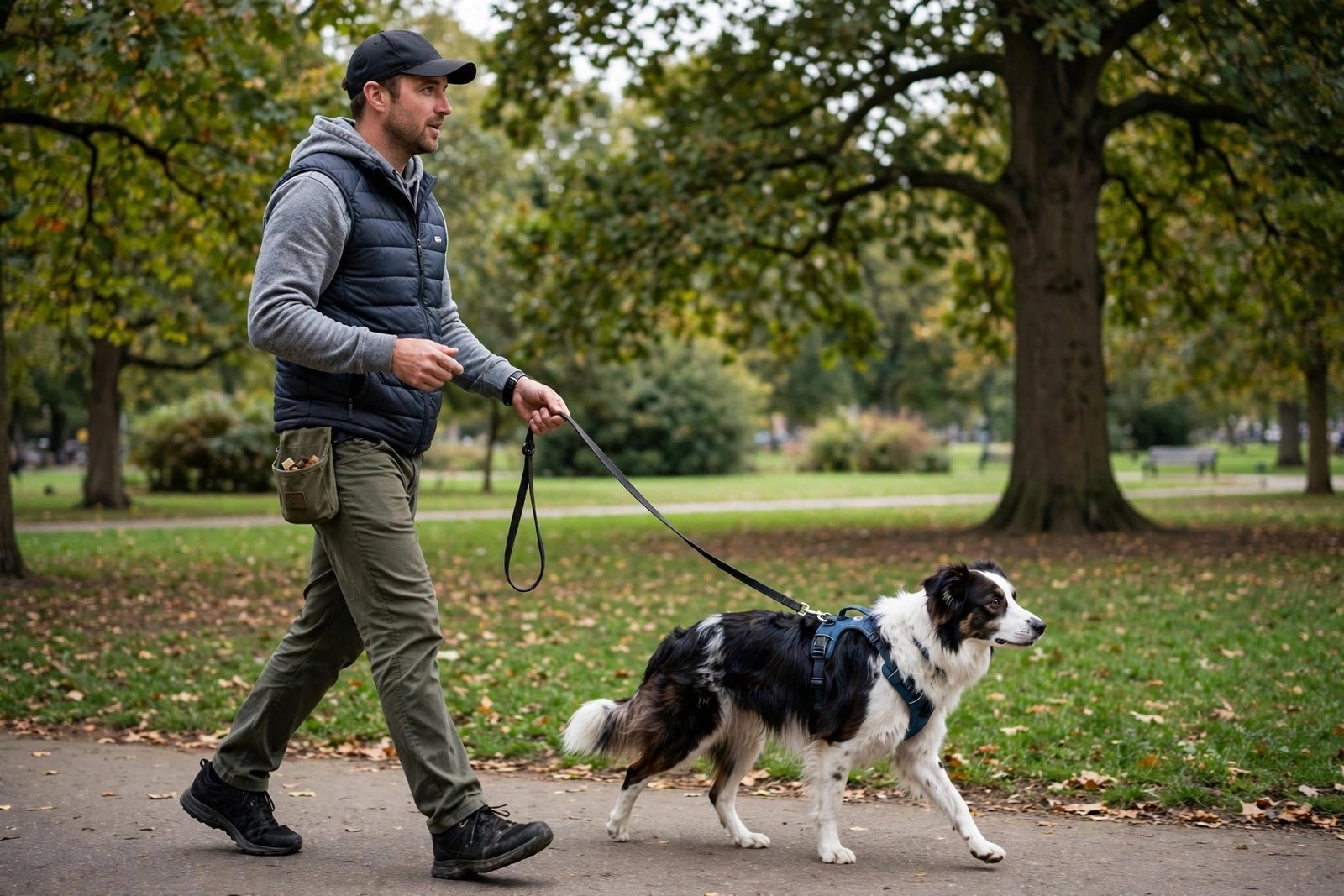
A dog that pulls is not being stubborn or dominant — pulling simply works, and every successful lunge teaches it to pull harder. Every step gained by dragging a person forward is a reward the dog gives itself, and rewards build habits fast. Reversing that pattern is the whole job. Pulling has to stop paying, and walking on a loose lead has to start paying instead. No strength contest is needed, and no harsh correction is needed either. What matters is the right equipment at the start, one clear method used the same way on every walk, and short practice in places where success comes easily.
Fix the equipment first
Step One: Change what the dog wears before trying to change what the dog does. A flat collar puts all the pressure on the front of the neck, and many dogs lean into that pressure comfortably and pull with real power. A back-clip harness can be even better for pulling, because the dog can throw its full weight and strong chest muscles into the effort, much like a sled dog in a working harness. A front-clip harness works differently. The lead attaches at the chest, so when the dog drives forward, the pressure gently turns the dog back toward the person holding the lead. Pulling stops pointing the dog where it wants to go, and that simple change of direction takes much of the power out of the habit without any pain at all.
The American Kennel Club recommends the front-clip harness for pullers, and it is a sound starting point for most dogs. For a determined puller that still overpowers that setup, a head halter gives even more steering. A head halter works like a halter on a horse: guidance comes from the head rather than from a fight against the body, so a modest amount of pressure can redirect a strong dog. Introduce it gradually and kindly. Let the dog wear it briefly indoors, pair every moment with treats, and build the wearing time slowly before clipping a lead to it on a walk. A dog that is pawing at its face and feeling trapped is not learning anything, so patience at this stage saves trouble later.
Some tools should stay off the list entirely. Choke chains and prong collars work through pain, and pain is a poor teacher. Both can injure the windpipe, and both can erode the trust that all later training depends on. Lead choice matters just as much. Use a standard fixed-length lead with a comfortable handle, and never use a retractable lead for training. A retractable lead changes length all the time, so the dog learns that pulling makes the lead longer, which is exactly the wrong lesson. It also gives weak control near traffic. The same reward logic that fixes pulling also powers the other foundation skills, including the fastest way to house-train a puppy, where the right behavior is paid quickly and clearly every single time.
The stop-and-redirect method
Step Two: The moment the lead goes taut, stop and plant yourself like a tree. Do not yank back, and do not scold. Simply stand still and let the walk freeze. The instant the dog checks back toward you, or the lead slackens even slightly, mark the moment with a bright yes and pay with a treat or with forward movement, then walk on. That equation is the whole method. Pulling makes the walk stop, and a loose lead makes it continue. Dogs are quick to work out which choice keeps life interesting, as long as the answer stays the same every time the lead tightens.
A second move sharpens the lesson. When the dog forges ahead and the lead tightens, turn cheerfully and walk the other way. Keep the tone light, as if changing direction were the most natural thing in the world. Forging ahead then leads away from the interesting smell or the park gate, while checking in and staying near the person keeps the walk moving toward good things. Over time the dog starts glancing back on its own, offering attention before the lead ever tightens. That voluntary check-in is the habit worth protecting, so pay it well whenever it appears, especially in the early weeks of practice.
Honesty helps here. The first walks with this method are maddeningly slow and cover almost no ground. A route that once took a short stroll can turn into a long series of stops and starts, and that can feel like failure. It is training working exactly as it should. Each stop is a clear piece of information, and each restart on a loose lead is a small success the dog can build on. Shorten the route, lower the ambition, and let the lesson land. Anyone who wants the reasoning behind methods built on clear consequences can read more about the principles of dog training and see how widely the same ideas are used.
Train in layers, not marathons
Step Three: Begin somewhere boring. A driveway or a quiet hallway offers few temptations, so the dog can succeed often and learn what a loose lead feels like. Once the skill holds there, graduate to the quiet street. Then try the edge of the park, and only later the full stimulating route with its smells, sounds, and other dogs. Each new layer brings a temporary step backward, and that regression is learning, not failure. The dog is not being difficult; the dog is doing an easy job in a suddenly harder room, and the criteria need to soften while the new setting becomes familiar.
Keep focused sessions short and end on a success rather than pushing until the dog falls apart. A tired, frustrated ending teaches the wrong emotional lesson about training walks. Burn off the first fizz of energy with a game before the session starts, because a dog that has already chased a ball or enjoyed a good play bout can think far more clearly than one that has been waiting indoors all day. Pay treats at your trouser seam, right beside your leg. That spot becomes the reward zone, and dogs choose to spend time where good things happen. If every treat appears beside you, beside you is where the dog wants to walk. Use high-value treats for this work, soft and smelly pieces that can compete for attention, because out on the street you are competing with squirrels, and a dry biscuit rarely wins that contest.
When it still goes wrong
Many people worry that the dog only walks nicely when treats are visible. That worry is normal, and the early stage does look a lot like bribery. The way out is to fade the food slowly rather than stopping it suddenly. Pay every good stretch at first, then pay some of them, then pay at random. Random rewards strengthen behavior, because the dog keeps offering the good choice in case this is the moment it pays. After that, life rewards can carry more of the load: a chance to sniff a favorite corner, a polite greeting, or simply the walk continuing toward somewhere the dog loves.
Exploding at other dogs is a different problem. A dog that lunges and barks at every passing dog is over threshold, which means the other dog is simply too close for thinking to happen. That is a threshold problem, not a lead problem, and tighter equipment will not solve it. Work at distances where the dog can notice another dog and still look away, still take a treat, and still respond. Close those distances gradually over many calm sessions. If reactivity is intense, bring in a certified trainer for hands-on help. Understanding how operant conditioning works explains why this patient approach matters: consequences shape habits, and calm behavior that gets rewarded at a workable distance grows stronger, while panic rehearsed at close range grows stronger too.
One household rule protects all of this work. Every handler runs the same rules. If one person stops for pulling and another lets the dog drag them happily to the park, the dog learns two different sets of rules and follows the easier one. Children, partners, friends, and dog walkers all need the same simple agreement: pulling never works, for anyone, and a loose lead always gets the walk moving again. Consistency across people is slower to arrange than any harness purchase, but it is often the difference between steady progress and a frustrating plateau.
Letting the equipment retire
Once the loose lead is reliable in ordinary places, the training gear can start to retire. Trial a back-clip harness or a flat collar on easy routes where distractions are low and the habit is strong. Keep the front-clip harness for hard routes, busy streets, and days when the dog is fresh and excitable. If pulling resurfaces on the simpler gear, step back without frustration and rebuild for a while. A step back is information about where the training really stands, not a disaster and not a reason to scold the dog.
With manners holding well, a hands-free waist lead becomes possible for running and hiking, and it can make longer outings far more comfortable for both ends of the lead. The larger point is that the tool should fade into the background over time. Permanent dependence on a gadget usually means the training, not the tool, needs more work. The goal was never a dog that behaves only in one special harness. The goal is a dog that understands the deal anywhere: make pulling pointless and politeness profitable, repeat that deal calmly on every walk, and the loose lead stops being a training exercise and becomes simply how walks are done.