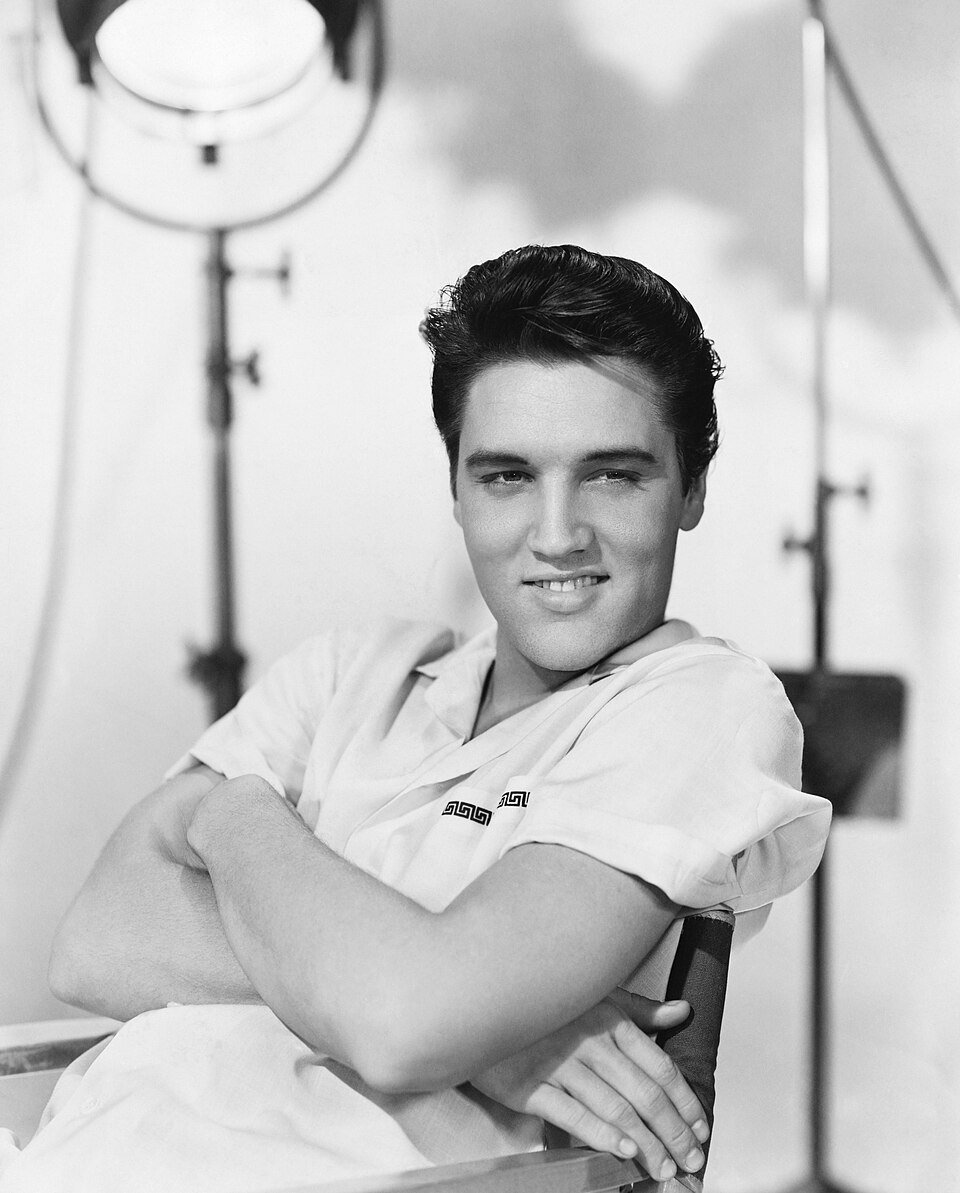
Elvis Presley: Net Worth, Age, Family, Life and Career Explained
Elvis Presley was born Elvis Aron Presley on 8 January 1935 in Tupelo, Mississippi, and died on 16 August 1977 at the age of 42, yet nearly five decades later he remains the best-known popular singer of the twentieth century. Celebrity Net Worth puts his net worth at the time of his death at $5 million, and this profile covers his parents Vernon and Gladys, his marriage to Priscilla Presley, his daughter Lisa Marie, his songs and albums, his home Graceland, and the cars that became part of his legend — keeping his personal fortune at death strictly separate from what his estate has earned since.
A Tupelo shack, a truck-driving father and a sewing-machinist mother
Elvis Aron Presley was born on 8 January 1935 in a small house in Tupelo, Mississippi, built by his father. His parents were Vernon Elvis Presley and Gladys Love Presley, née Smith. Vernon worked a succession of jobs, including truck driving, in a household that was poor even by the standards of the Depression-era South. Gladys worked as a sewing machinist. The family moved to Memphis, Tennessee, in 1948, when Elvis was 13. Memphis placed him in a city saturated with live music — blues, rhythm and blues, country and pop all playing within a few streets of each other — and by his late teens he was absorbing all of it, visiting record shops, listening to radio broadcasts late into the night and learning guitar.
In 1953, at the age of 18, he paid to record two songs at the Memphis Recording Service, the studio run by Sam Phillips’s Sun Records, as a gift for his mother. Phillips’s assistant, Marion Keisker, kept a note of the young singer, and in the summer of 1954 Phillips invited him back to try out material with local musicians. The biography turns on what happened at the end of a frustrating session on 5 July 1954, when Presley began playing an up-tempo version of Arthur Crudup’s “That’s All Right” and Phillips recognised the sound he had been looking for: a white singer who sang with the phrasing and energy of the Black rhythm-and-blues performers whose records Phillips admired but could not get played on mainstream radio.
Presley’s rise over the next two years was startlingly fast. He toured the South relentlessly, signed a management deal with Colonel Tom Parker, and in late 1955 his Sun contract was sold to RCA Victor for a then-exceptional $35,000. His mother remained the emotional centre of his life throughout the ascent. When Gladys died in August 1958, at the age of 46, while her son was in military service, those who knew him described a loss from which he never fully recovered. Vernon outlived his son, dying in June 1979, and both parents are buried at Graceland, the home their son’s success bought and to which the family story keeps returning.
Colonel Parker took half; $5 million remained at his death
Celebrity Net Worth puts Elvis Presley’s net worth at the time of his death at $5 million, equal to roughly $27.5 million in today’s money on its inflation adjustment. That at-death figure is the only personal net-worth figure this profile prints for him, and it is strikingly small against his earnings. The reasons are documented. His manager, Colonel Tom Parker, took a commission that rose to 50 per cent of much of his income, far above the industry norm. In 1973 Presley and Parker sold RCA the rights to his royalties on recordings made before that date for a lump sum of $5.4 million, surrendering an income stream that would have been worth vastly more. Graceland cost a reported $480,000 a year to maintain by the late 1970s, his generosity and spending were legendary, and a divorce settlement in 1973, reported by Celebrity Net Worth to have included $725,000 in cash plus support payments, reduced the total further.
Everything after 1977 belongs to his estate, not to his personal net worth, and the two must never be merged. His will left the estate in trust for his father, his grandmother and his daughter. After taxes and upkeep had reduced what remained to little more than $1 million by the early 1980s, Priscilla Presley, acting for the estate, took the decision that transformed it: Graceland was opened to the public in June 1982. Under the estate company she chaired, its value grew to a reported $100 million by 1993, and in 2024 alone Forbes estimated that the estate generated $50 million. Those are estate earnings across five decades of licensing, music sales, merchandise and visitors — not a revision of the $5 million he personally left behind.
Graceland is the centre of the lifestyle story. Presley bought the property in March 1957 for $102,500. The estate, on what was then a 13.8-acre site in Memphis, centres on a 23-room mansion that became his home for the remaining twenty years of his life and the home of his parents and grandmother. He expanded and personalised it continuously, adding the famous gates, leisure buildings and, in the 1970s, the richly decorated Jungle Room, in which parts of his final albums were recorded. Since 1982 it has operated as a museum, and in 2006 it was designated a National Historic Landmark.
His cars were the other great extravagance, and the best documented of them are still at Graceland. The most famous is the pink Cadillac: a 1955 Cadillac Fleetwood Series 60 that he bought in blue, had repainted in a custom pink, and gave to his mother, Gladys, who never learned to drive. It is now preserved in the estate’s motor museum. The cars reported and displayed from his ownership include a 1957 BMW 507 roadster, which he used while stationed in Germany and of which only a few hundred were built, a succession of Cadillacs and Lincolns including a Lincoln Continental, a Mercedes-Benz 600, and several Stutz Blackhawk coupés — he bought the first Blackhawk sold, in 1970, and returned for more. He gave cars away almost as freely as he bought them. No single verified inventory of everything he owned exists, and the Graceland display should be read as the surviving core of the collection rather than its full extent.
That’s All Right at Sun Records changed popular music in a summer
1954–1955: Sun Records and “That’s All Right”
Presley’s first commercial single, “That’s All Right” backed with “Blue Moon of Kentucky”, was released by Sun Records in July 1954. Further Sun singles followed, including “Good Rockin’ Tonight”, “Baby, Let’s Play House” and “Mystery Train”, and his stage performances — energetic, physical and unlike anything mainstream audiences had seen — built a devoted regional following. By the end of 1955 he was the most sought-after young performer in country music, and the sale of his contract to RCA Victor set up the national breakthrough.
1956: “Heartbreak Hotel” and the breakthrough year
“Heartbreak Hotel”, released in January 1956, became his first number-one pop single and his first million-seller. His debut album, Elvis Presley, released in March 1956, topped the album chart, and a second album, Elvis, followed the same year. The singles came in a rush: “I Want You, I Need You, I Love You”, “Hound Dog”, “Don’t Be Cruel” and “Love Me Tender” all reached number one in 1956 alone. His appearances on national television that year, watched by tens of millions, made him a figure of fascination and controversy in equal measure.
1957–1958: “All Shook Up”, “Jailhouse Rock” and the Christmas album
The run continued through 1957 with “Too Much”, “All Shook Up”, “(Let Me Be Your) Teddy Bear” and “Jailhouse Rock”, and with Elvis’ Christmas Album, which became one of the best-selling seasonal albums of all time. In March 1957, aged 22, he bought Graceland, the Memphis mansion that became his permanent home. In December 1957 he received his draft notice, and in March 1958 he entered the United States Army, serving in Germany until March 1960. RCA kept his career alive during the service years with stockpiled recordings, including the number-one singles “Hard Headed Woman”, “A Big Hunk o’ Love” and “Stuck on You”, the last of these released immediately on his return.
1960–1965: Elvis Is Back! and the early-sixties singles
Elvis Is Back!, released in 1960, is still regarded by many critics as one of his finest albums, and the singles of the period include two of his most enduring recordings, “It’s Now or Never” and “Are You Lonesome Tonight?”, both number ones in 1960, followed by “Surrender” and “Good Luck Charm”. The albums Something for Everybody in 1961 and Pot Luck in 1962 continued the pattern of polished studio work, and singles such as “Return to Sender” in 1962 and “(You’re the) Devil in Disguise” in 1963 kept him near the top of the charts. As the decade moved on, however, the quality of his album material became uneven — a decline his most loyal chroniclers do not dispute, and which makes the comeback that followed all the more remarkable.
1968–1969: The comeback and From Elvis in Memphis
In December 1968 a televised concert special, built around Presley performing live in front of a small audience for the first time in years, relaunched him as a contemporary performer rather than a nostalgia act. He followed it with the strongest sustained recording work of his later career. From Elvis in Memphis, released in 1969 and recorded at a studio in his home city, included “In the Ghetto”, and its sessions also produced “Suspicious Minds”, which became his final number-one single in his home country in November 1969. That summer he began a residency in Las Vegas, returning to regular live performance for the first time since the early 1960s, to enormous demand.
1970–1977: Las Vegas, Aloha from Hawaii and Moody Blue
The 1970s were defined by the stage. Albums including Elvis Country in 1971 and Promised Land in 1975 sat alongside a touring and Las Vegas schedule of punishing intensity. In January 1973 his concert Aloha from Hawaii was broadcast by satellite to audiences around the world and produced a number-one live album. Later studio albums included From Elvis Presley Boulevard, Memphis, Tennessee in 1976, recorded largely at Graceland itself, and Moody Blue in 1977, his final studio album. His later singles included “Burning Love” in 1972, a top-three hit, and “Way Down” in 1977, and the voice remained formidable even as his health visibly declined. He gave his final concert in Indianapolis on 26 June 1977.
The scale of the catalogue behind those years is difficult to overstate. Graceland estimates that his worldwide record sales eventually surpassed one billion units across all formats, a figure quoted by Celebrity Net Worth. Readers who arrive at his story through the house often end up researching the practical side of the estate — its grounds, its animals and its upkeep — in the same spirit as owners who check reliable guidance on which common foods are toxic to dogs and must be kept away from them. Presley kept dogs and other animals at Graceland throughout his years there.
Tupelo to Graceland: Presley in brief
| At a Glance | Details |
|---|---|
| Born | 8 January 1935, Tupelo, Mississippi |
| Died | 16 August 1977, Memphis, Tennessee |
| Age | 42 years old at his death |
| Height | 6 feet 0 inches (182 cm) |
| Weight | No reliable published figure exists |
| Wife | Priscilla Presley (married 1967, divorced 1973); unmarried at his death |
| Children | One daughter: Lisa Marie Presley (1968–2023) |
| Parents | Vernon Presley and Gladys Presley |
| Net Worth | $5 million at death (Celebrity Net Worth) |
Priscilla met him in Germany; Lisa Marie arrived in 1968
Presley met Priscilla Beaulieu, the daughter of a United States Air Force officer, in Germany in 1959, during his military service. They married on 1 May 1967 in Las Vegas. Their only child, Lisa Marie Presley, was born on 1 February 1968 in Memphis. The couple separated in 1972 and their divorce was finalised on 9 October 1973. The wording matters for the record: Priscilla Presley was his former wife, and Presley was unmarried at the time of his death in 1977. Priscilla later became central to the survival of his estate, as the net worth part of this profile explains, and she remains the most prominent public guardian of his legacy.
Lisa Marie Presley was nine years old when her father died. She became, after the deaths of her grandfather Vernon in 1979 and her great-grandmother Minnie Mae Presley in 1980, the sole heir to his estate, and she built a recording career of her own as an adult, releasing three studio albums between 2003 and 2012. She died in January 2023, at the age of 54, and is buried at Graceland. Her eldest daughter, Riley Keough, is now a trustee of the estate, so the line from Vernon and Gladys Presley to the present management of Graceland runs unbroken through four generations.
Family, for Presley, also meant the household he assembled at Graceland: his parents lived there, his grandmother Minnie Mae lived there until her death in 1980, and a wide circle of friends and employees formed the entourage of his later years. He was famously generous within that circle, giving away houses, jewellery and cars with a freedom that forms part of the explanation, below, for the gap between what he earned and what he kept.
Presley was found unresponsive at Graceland on 16 August 1977 and was taken to Baptist Memorial Hospital in Memphis, where he was pronounced dead. He was 42 years old. Graceland lists heart failure as his cause of death. The plain facts are that the most famous singer in the world died at home less than two months after his final concert.
Six years up, nearly fifty years of afterlife
Elvis Presley’s life divides cleanly into a rise that took six years and an afterlife that has lasted nearly fifty. He was born into poverty in Tupelo, became the defining popular singer of his century, married once, fathered one child, bought one famous house, and died at 42 with $5 million to his name on Celebrity Net Worth’s assessment. The estate built from that modest remainder now earns sums in a single year that dwarf what he left. Had he lived, he would have turned 91 in January 2026. Instead, the music — “Heartbreak Hotel”, “Suspicious Minds”, From Elvis in Memphis and the rest of a vast catalogue — continues to do the work, and Graceland continues to receive the visitors who come to see where it was made.