
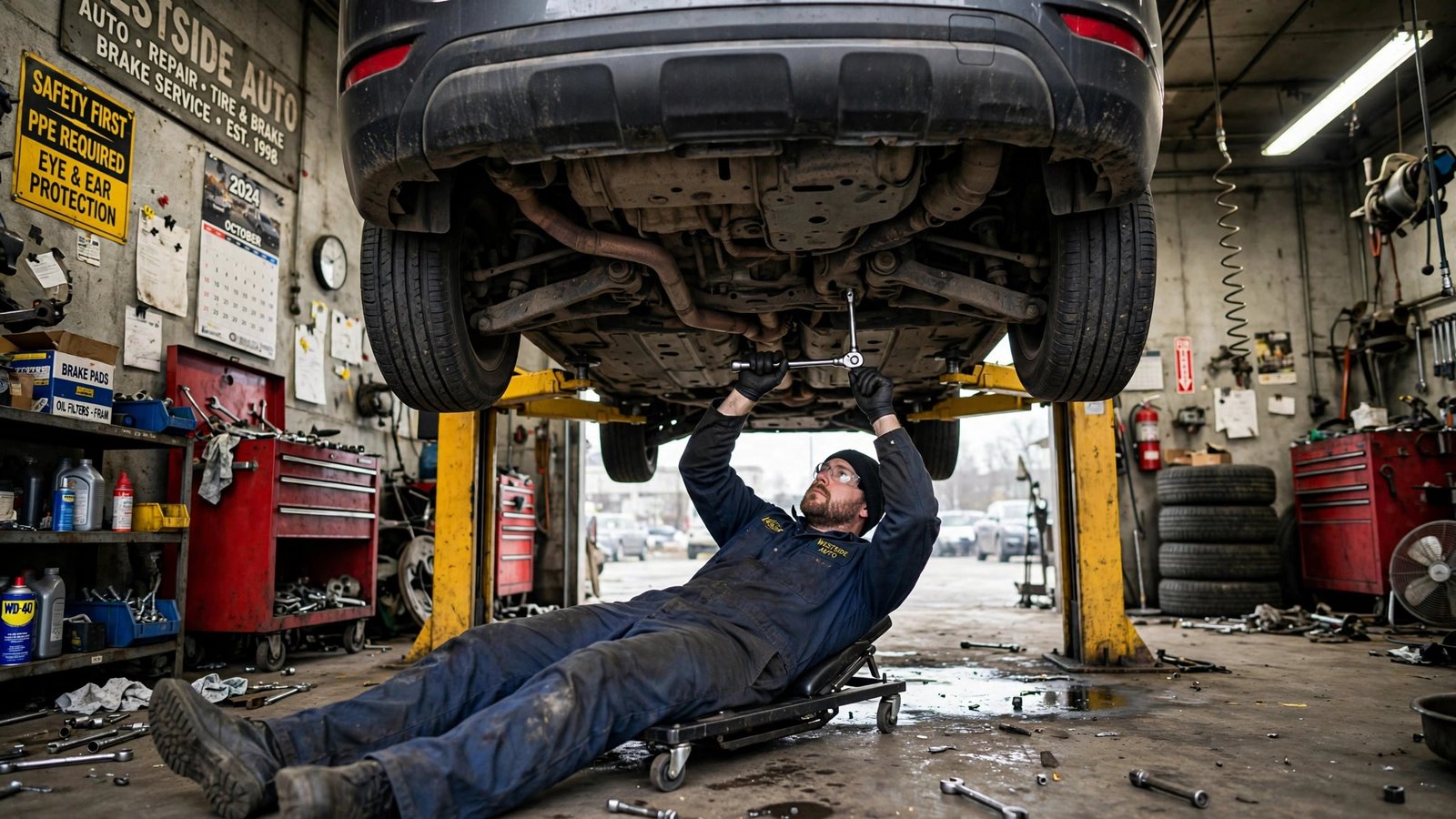
Finding a good mechanic feels like dating in a town full of red flags: everyone promises honesty, but the bill always seems to include a $400 “flux capacitor realignment.” The stakes are real — the difference between a trustworthy shop and a predatory one can mean thousands of dollars a year, plus the safety of the car your family rides in.
Here’s the thing most drivers miss: the best mechanics aren’t found by accident. They’re found with a process. Whether you’ve just moved, your old shop closed, or you’re tired of being upsold, here’s how to find the best auto mechanic near you — and how to tell the great ones from the smooth talkers.
Start With Credentials, Not Reviews
Online reviews matter, but they’re step two. Step one is filtering for real qualifications:
- ASE certification: The National Institute for Automotive Service Excellence certifies technicians by specialty (brakes, engine repair, electrical, etc.). ASE’s technician lookup lets you verify credentials. A shop where techs are ASE-certified — especially Master Technicians — has invested in competence.
- AAA Approved Auto Repair: AAA inspects member shops for equipment, cleanliness, and customer-service standards, and backs repairs with a dispute-resolution process.
- Manufacturer certifications: If you drive a specific brand, a shop with factory training for that brand is worth prioritizing for complex work.
None of these guarantee sainthood, but they eliminate the bottom tier immediately. A shop with zero certified techs and no affiliations is telling you something.
Read Reviews Like a Detective
Now check Google, Yelp, and the Better Business Bureau — but read them critically:
- Look for patterns, not outliers. One furious review among fifty glowing ones is noise; ten reviews mentioning surprise upsells is signal.
- Read the 3-star reviews. They’re usually the most honest — specific about what was good and what wasn’t.
- Watch how the shop responds to complaints. A professional, specific response (“we rechecked the alignment free of charge on 3/14”) beats defensiveness or silence.
- Check review dates. A shop that was great in 2021 under different ownership may be a different business now. Weight recent reviews heavily.
- Be suspicious of perfection. Hundreds of five-star reviews with generic praise (“great service!”) and no detail can indicate review manipulation.
Ask the Right Questions on Your First Call
Before booking, call two or three finalists and ask:
- “Do you provide written estimates before starting work?” (The answer must be yes.)
- “What’s your labor rate, and do you use flat-rate or actual-time billing?”
- “Do you use OEM, aftermarket, or remanufactured parts — and can I choose?”
- “What’s your warranty on parts and labor?” (12 months/12,000 miles is the minimum respectable standard; 24/24,000 is excellent.)
- “Can I see the old parts after the repair?” (Honest shops say yes without hesitation.)
- “Do you specialize in my car’s make, or work on everything?”
How they answer matters as much as what they say. Patient, specific answers signal a shop that educates customers; rushed or vague answers signal one that prefers you confused.
Test Them With Something Small First
Never hand a new shop a $2,000 transmission job as your first visit. Start with an oil change, tire rotation, or brake inspection — low-stakes work that reveals everything about how they operate:
- Did they do a free multi-point inspection and show you (not just tell you) what they found?
- Did they prioritize findings by safety urgency, or present everything as an emergency?
- Did the final bill match the estimate?
- Did they try to sell you a cabin air filter you just replaced? (A classic test — mark yours with a date before the visit.)
A shop that treats a $50 oil change with care and honesty has earned the right to your bigger jobs. One that invents $600 of “urgent” work on a well-maintained car has told you everything.
Red Flags That Mean “Walk Away”
- Refusing written estimates or pressuring you to authorize work verbally.
- “We can’t show you the problem” — a trustworthy mechanic will walk you to the car and point at the worn part.
- Scare tactics: “I wouldn’t drive this another mile” is sometimes true (brakes, steering), but when applied to a slightly dirty air filter, it’s manipulation.
- Cash-only or no itemized invoice — legitimate businesses document everything.
- Repairing without authorization — illegal in many states. Know your rights: the FTC’s auto repair guidance explains what shops can and can’t do without your approval.
Dealership vs. Independent Shop: When Each Wins
Dealerships charge 20–40% more on labor, but they win for warranty work (often free), recalls, and brand-specific computer diagnostics. Independent shops win on price, personal relationships, and flexibility for everything else — maintenance, brakes, suspension, and most repairs on cars out of warranty.
The sweet spot for many drivers: dealership for warranty/recall work, trusted independent for everything else. And for specialty needs (transmissions, European cars, hybrids), a specialist shop beats a generalist every time, even at a premium rate.
Build the Relationship Before You Need It
The worst time to find a mechanic is on the side of the highway. Once you’ve found a good shop, become a regular: bring the car in for scheduled maintenance, learn the service advisor’s name, keep your records there. Regulars get honest advice (“that can wait until fall”), priority scheduling, and the benefit of the doubt.
Keep a maintenance log — dates, mileage, what was done — whether in an app or a glovebox notebook. It helps your mechanic diagnose faster and massively boosts resale value. And when that well-maintained car is ready for adventure, you’ll enjoy comfortable long car rides — or if you’re renting wheels for a trip instead, know what to check before renting a car so the rental doesn’t ruin the vacation.
How to Handle Disputes and Bad Repairs
Even good shops make mistakes — what separates them is how they handle it. If a repair doesn’t fix the problem or something new breaks right after service, go back promptly and calmly: “The vibration is still there after the brake job — can we take another look?” Reputable shops re-inspect free and make it right, because comebacks cost them more than they cost you.
If the shop stonewalls, escalate in order: speak to the owner or manager (not the advisor), put your complaint in writing with dates and invoice numbers, and file with your state’s consumer protection office or attorney general — most states license repair shops and investigate complaints. The Better Business Bureau and your credit card company (for chargebacks on unsatisfactory work) are additional leverage. Throughout, keep every invoice, estimate, and text message. Documentation turns “he said, she said” into a case — and shops that know you’re documenting tend to resolve things faster.
Frequently Asked Questions
How much should a mechanic charge per hour?
Labor rates vary widely by region: roughly $100–$150/hour at independents and $150–$220+/hour at dealerships in most US markets, higher in major metros. The rate alone doesn’t determine value — an efficient master tech at $140/hour beats a slow shop at $100/hour.
Should I get a second opinion on expensive repairs?
Yes for anything over about $500, especially if the diagnosis surprised you. A second shop’s inspection (often $100–$150, sometimes free) frequently reveals cheaper alternatives — and if both agree, you have confidence.
Are chain repair shops (Firestone, Pep Boys) trustworthy?
Quality varies enormously by location since they’re independently managed. Judge each location on its own reviews and your small-job test, not the brand name.
Can I supply my own parts to save money?
Many independents allow it, but most won’t warranty the labor if your part fails — and some charge slightly higher labor to compensate. Ask upfront; for big-ticket parts the savings can still be worth it.
The Bottom Line
The best mechanic near you is found, not stumbled upon: filter by ASE certification and affiliations, read reviews like a detective, interview shops by phone, test with a small job, and watch for red flags. Invest that afternoon of research once, and you’ll have a trustworthy shop for the next decade — which, over the life of a car, is worth thousands.