
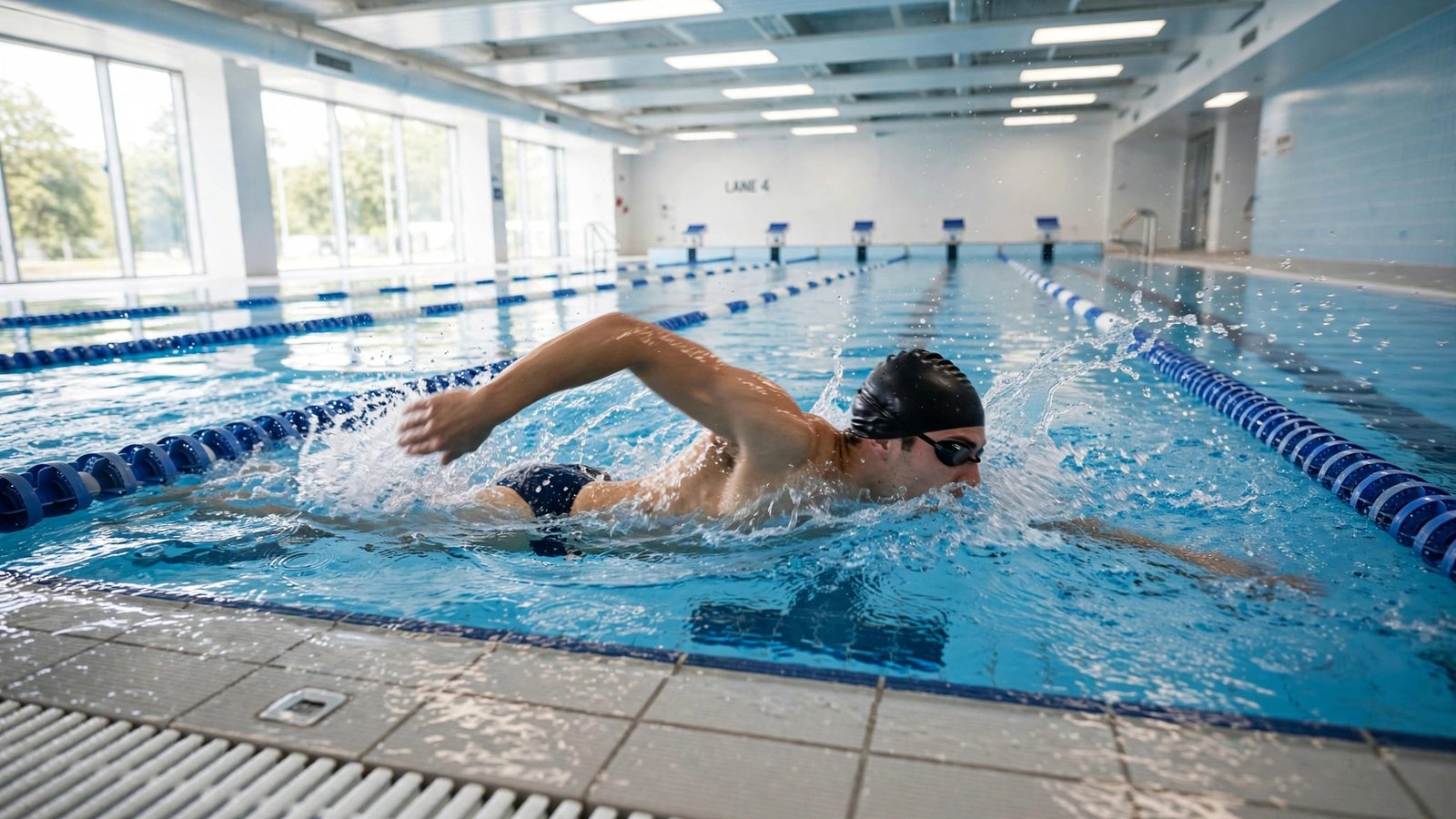
Lap swimmers make it look restful because the hard part — breathing — has already become automatic for them. For a beginner, the water can feel busy and slightly hurried even during a single length, not because fitness is lacking but because breath, balance and movement have not yet settled into one rhythm. The calm start comes from separating those skills, practising each one in a simple order and letting confidence grow from short, repeatable successes. Nothing here needs speed. A quiet length swum with control teaches far more than several rushed lengths that end in gasping at the wall.
First, the non-negotiable: be water-safe
Safety comes before any training plan, and honesty matters here. The approach that follows assumes the reader can already swim, can float and can recover to a standing position or to the wall without panic. If that is not yet true, lessons come first, with a qualified teacher in a supervised setting, and lap practice waits until those foundations are secure. There is no shortcut around that order, and no embarrassment in it — learning properly as an adult is common and sensible.
Never swim alone, choose a pool with supervision where possible and take time to learn the rules of the particular pool before the first session. Note the deep and shallow ends, the lane markings, any diving rules and the quieter times when a beginner lane is less crowded. Start well within your depth of comfort, stay near the wall in early sessions and stop while you still feel composed rather than exhausted. For readers wondering how this gentle starting point compares with everyday exercise in general, whether walking thirty minutes a day is enough exercise is a useful baseline question, because the same principle applies in the pool: regular, manageable activity builds the habit, and the habit carries the progress.
Breathing: the skill that unlocks everything
Most beginner tension in the water is really breathing tension. The natural instinct is to hold the breath while the face is down and then try to exhale and inhale together in the brief moment the mouth clears the surface, which leaves the swimmer short of air and rushing. The calmer pattern reverses that habit. Exhale into the water continuously while the face is down, in a slow stream, so that when the head turns, only the inhale remains to be taken. That single change removes the sense of urgency from every stroke cycle.
Practise the pattern first at the wall with the blow-bubbles drill. Hold the edge, place the face in the water and blow gentle bubbles, then turn the head to the side to breathe in, and repeat until the rhythm feels boring. In front crawl, the inhale happens in the small pocket of calmer water beside the head as the body rolls, not by lifting the head forward, which drops the hips and breaks the line of the body. Over time, work toward bilateral breathing, breathing to either side in a pattern of every three strokes, so balance and comfort do not depend on one favoured side alone. Early on, breathing to the easier side is perfectly acceptable while the exhale habit settles.
Expect the breathing to feel clumsy for longer than the strokes themselves, and plan for that rather than fighting it. Short repeats help: swim a few strokes with the new exhale pattern, stop at a planned point, breathe normally and start again, so the habit is practised while fresh rather than while desperate for air. Gradually the planned stops grow further apart on their own. A useful test of progress is not speed at all, but whether the first length of a session feels as composed as a length swum on land feels unremarkable — breathing simply happening in the background while attention rests on the water moving past.
Body position: swim downhill
With breathing calmer, position becomes the next gift. Picture swimming very slightly downhill: the head stays neutral with the eyes looking down toward the bottom of the pool, the back of the head in line with the spine, and the hips riding high near the surface rather than trailing below it. Lifting the head to look forward feels natural on land, but in water it acts like a brake, pushing the legs down and making every kick work harder. A long, quiet body line lets the water support the swimmer, so effort goes into moving forward instead of fighting drag.
Front crawl is the natural default stroke for laps because it is continuous, rhythmic and kind to this high, level position once breathing is in place. Studying front crawl technique and breathing shows how the arm cycle, the roll of the body and the timing of the breath fit together as one repeating pattern rather than separate efforts. Keep the kick compact and steady from the hips, with relaxed ankles, and let the arms recover easily over the surface instead of muscling through the water. If a length falls apart, the fix is usually to slow down, restore the downhill feel and let the exhale begin again, not to kick harder.
A few simple checks keep position honest during a session. If the feet keep breaking the surface with a splash, the hips have probably dropped and the head has crept up. If the shoulders ache early, the arms may be pressing down on the water instead of reaching forward into the next stroke. A gentle sculling drill at the wall, or a few push-off glides with no kicking at all, restores the sense of the body as one long, supported line. Return to those resets whenever a length feels like hard work out of proportion to its pace, because position errors tax every stroke that follows them.
Week One: Spend each session of about half an hour or a little less on feeling at home in the lane. Begin with wall push-offs, gliding a short way with the body stretched and the face down, then standing and walking back rather than worrying about a full length. Add kicking with a board, keeping the legs long and the splash small, and rest whenever breathing feels hurried. Finish with single lengths swum very easily, with long rests at each end, and leave the water while everything still feels manageable. The aim of the week is comfort, not distance.
Week Two: Add a little structure while keeping the same calm. The catch-up drill is the main tool: one arm stays stretched ahead until the other arm nearly catches it, which slows the stroke down, lengthens the body line and gives the breath a predictable moment. Swim lengths in small groups, with a set rest at the wall after each group, long enough for breathing to settle fully before starting again. Keep the blow-bubbles exhale going throughout, and return to the wall drill for a minute whenever the rhythm frays. By the end of the week, the grouped lengths should feel organised rather than survived.
Week Three: Build toward continuous easy lengths with fewer pauses. Swim steadily from end to end at a pace that could be held in conversation on land, turning at the wall with a simple touch and push-off rather than a long stop. Use bilateral breathing throughout as far as comfort allows, alternating sides in the every-three-strokes pattern, and accept the slightly awkward side as part of learning. If technique unravels late in a session, that is information about pacing, not failure: shorten the final lengths, restore the downhill position and finish with a few relaxed lengths that feel genuinely easy.
Week Four: Introduce a simple pyramid of lengths and one continuous longer swim. The pyramid grows gently — a short swim, then a slightly longer one, then the longest in the middle, then back down again — with easy rests between each step so quality never collapses. The continuous swim is swum once, calmly, at the easiest sustainable pace, simply to discover that steady breathing and position can carry you further than expected. Notice how little drama is involved when the exhale is continuous and the head stays quiet. That discovery is the real milestone of the first month.
Good pool etiquette makes all of this easier for everyone sharing the water. Choose a lane that matches your current pace rather than the emptiest lane, follow the circle swimming direction shown at the pool so swimmers travel in one loop, and rest at the wall tucked to the side so others can turn. Let faster swimmers pass at the wall instead of mid-length, and pass others only when there is clear room. These small courtesies keep the lane calm, and calm water matters, because swimming as a human movement skill has always depended on rhythm and ease rather than force — considerate, predictable movement is part of that skill for the whole lane, not just for one swimmer.
Month two builds quietly on these foundations. Lengths link together into short sets with briefer rests, the pyramid grows by a step, and the continuous swim extends a little at a time, always at a pace where breathing stays unhurried. A second stroke can be explored later for variety, but there is no rush: depth in front crawl — a softer catch, a steadier kick, breathing that needs no thought — will carry a lap swimmer a long way. Keep sessions regular rather than heroic, keep the exhale continuous, and let the water begin to feel like the restful place it looked like from the poolside at the start.

1 comment