
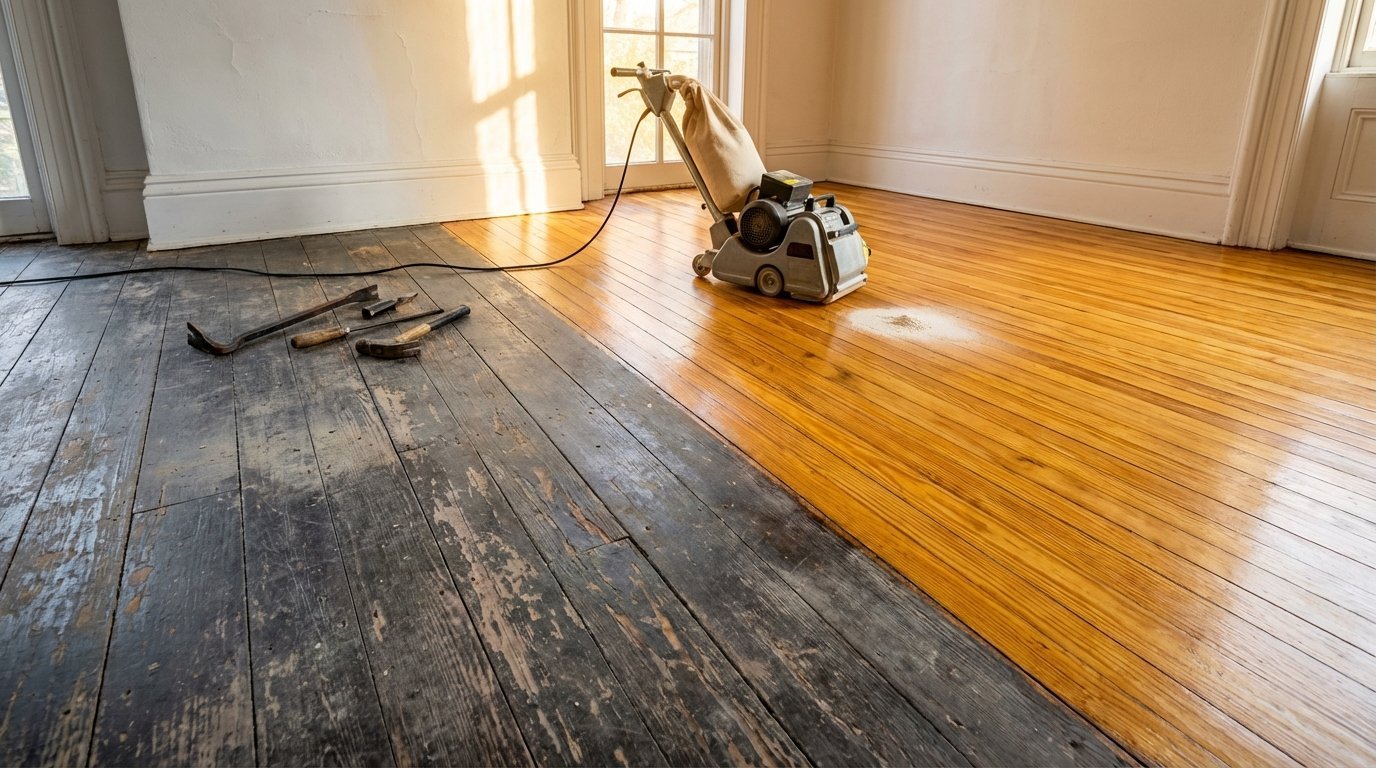
This is one of the clearest cost comparisons in home improvement: refinishing hardwood floors typically costs $3 to $8 per square foot, while replacing them runs $8 to $15+ per square foot. For a 500-square-foot area, that’s roughly $1,500-$4,000 versus $4,000-$7,500+.
But cheaper isn’t always smarter. Here’s how to decide which your floors actually need.
Is It Cheaper to Refinish Hardwood Floors or Replace Them? Almost Always Refinish
Refinishing wins on cost in nearly every scenario where it’s physically possible. Sanding off the old finish and applying new stain and polyurethane gives you essentially new-looking floors for 40-60 percent of replacement cost. The process takes 3-5 days for an average home (plus cure time), versus a week+ for replacement with more disruption.
The math for a typical 1,000 sq ft main floor: refinish $3,000-$8,000; replace with mid-range hardwood $8,000-$15,000; replace with premium or exotic $15,000-$25,000. Refinishing also avoids the hidden costs of replacement — baseboard removal and reinstall, potential subfloor repairs, furniture moving twice, and days of construction dust through the whole house.
There’s also the quality argument: old-growth wood in pre-1960s homes is denser and more beautiful than most new flooring. Refinishing preserves irreplaceable material. Ripping out 1920s oak to install new engineered flooring is, in my opinion, a tragedy with a receipt.
When Refinishing Isn't an Option
Refinishing requires enough wood left to sand — typically at least 1/8 inch above the tongue on solid hardwood. Floors that have been refinished 4-6 times may be too thin; a flooring pro can measure. Engineered hardwood can only be refinished if the veneer is thick enough (3mm+, ideally 4-6mm) — many budget engineered floors can’t be refinished at all.
Structural damage forces replacement: widespread water damage, pet stains that penetrated deep (that dark, smelly patch that sanding reveals rather than removes), major warping or cupping from moisture, and termite damage. Surface issues refinish away; structural issues don’t. If your floors bounce, squeak badly, or have soft spots, get an inspection before assuming refinish.
Sometimes replacement is the right call even when refinishing is possible: changing wood species entirely, fixing a choppy patchwork of additions, or addressing subfloor problems. And if you’re dealing with dogs destroying your floors, replacement with a tougher material (LVP, tile) may beat refinishing wood that’ll just get scratched again.
What Refinishing Actually Involves
Professional refinishing: big drum sander for the field, edge sander for perimeters, then progressively finer grits, then stain (optional), then 2-3 coats of polyurethane. Dustless systems now capture most dust — ask for them. Oil-based poly is tougher and amber-toned; water-based is clearer, lower-odor, and cures faster. Water-based is the modern default for good reason.
DIY refinishing is possible but humbling. Renting a drum sander ($60-$80/day) saves money but the machine is aggressive — one distracted moment digs a divot. Material costs run $500-$1,000 for an average room set. Honestly? For whole-house refinishing, hire it out. The pro finish quality difference is visible, and the dust and fumes make DIY miserable for days.
Screen and recoat is the budget middle option: instead of full sanding, the floor is lightly abraded (‘screened’) and given a fresh topcoat. At $1-$2.50 per square foot, it’s perfect for floors with worn finish but no deep scratches or color-change desires. It won’t fix damage, but it refreshes tired floors beautifully. Many floors don’t need full refinishing — they need this.
- Refinish: $3-$8/sq ft — the winner whenever physically possible
- Replace: $8-$15+/sq ft, plus hidden costs (trim, subfloor, disruption)
- Screen-and-recoat: $1-$2.50/sq ft for worn-but-sound floors
- Check wood thickness — floors can only be sanded so many times
- Old-growth wood is irreplaceable; think twice before ripping out
- DIY sanding saves money but risks divots; pros earn their fee
Getting It Done Right
Get three quotes from dedicated flooring companies (not general handymen) and ask to see recent work. Timing matters: floors must cure before furniture returns — water-based poly needs 24 hours before light foot traffic and 7+ days before rugs. Plan to be out or confined to unfinished rooms during the work.
Choose your sheen deliberately: satin hides imperfections and is the most popular for a reason; semi-gloss shows every flaw but looks classic; matte is trendy and forgiving. And go slightly lighter on stain than you think — floors always look darker once the whole room is done.
Maintain the investment: felt pads on furniture, no wet mopping (damp only), rugs at entries, and recoat every 7-10 years before wear reaches wood. A $1,500 screen-and-recoat each decade beats a $8,000 refinish every 20 years — maintenance compounds like interest. The National Wood Flooring Association has excellent care guides by finish type.
Staining, Finishes, and the Final Look
Stain choice transforms the result more than most people expect. Test stains on an inconspicuous spot or spare board — colors look dramatically different on your actual wood under your actual light than on the sample chip. Go one shade lighter than you think; stain always looks darker across a whole floor. And consider going natural (clear coat only) — it shows the wood’s character, never clashes with decor, and makes future touch-ups invisible.
Finish sheen is a lifestyle choice: satin (the modern default — hides dust and imperfections, looks rich), semi-gloss (classic, slightly more formal, shows more flaws), matte (trendy, very forgiving, can look flat in dark rooms). For active households, satin is the sweet spot — it looks great longest with the least fuss. Water-based finishes stay clearer (no ambering) and let the true stain color show; oil-based adds warm amber tone many people love in traditional homes.
Between-coat abrasion (light buffing with a fine screen) is what creates the smooth professional feel — skip it and the finish feels rough no matter how many coats you apply. And the final coat needs full cure time before rugs and furniture: 24 hours for foot traffic, 7 days before area rugs (trapped solvents can mar the finish), 30 days before aggressive cleaning. Patience at the end protects everything. If you’re weighing this against replacement with pet-proof materials, our high-ROI DIY projects help prioritize where flooring dollars work hardest.
Refinish Unless You Can't
Refinishing costs roughly half of replacement and preserves often-superior old wood. Replace only when the wood is too thin, structurally damaged, or fundamentally wrong for your life (like hardwood in a house full of large dogs). And remember the middle path: screen-and-recoat refreshes worn floors for a fraction of either option.