
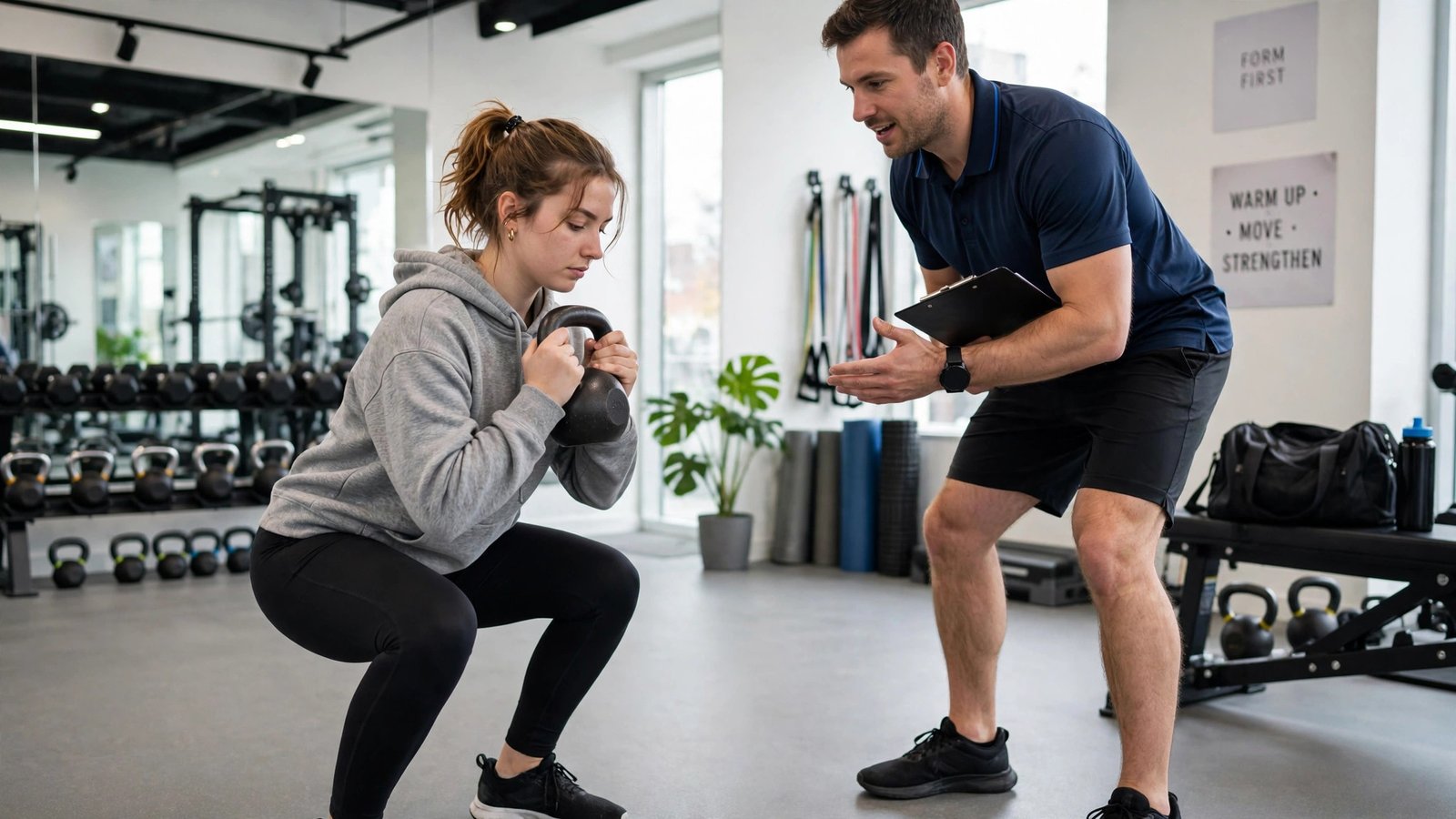
The weight room looks complicated from the doorway and simple from inside it: a handful of movements, repeated well. A beginner needs a few fundamental patterns, practised at loads that allow excellent form, repeated often enough for the body to adapt and for confidence to grow from evidence rather than hope. Safety comes from choosing the right movement version, keeping the load honest, progressing in the smallest available steps, and recovering as deliberately as the training itself is planned.
Six movement patterns carry the whole foundation
The squat pattern trains the knees, hips, and trunk to work together as a person sits down and stands up under control. The beginner version is the goblet squat, holding a single light weight close to the chest while sitting the hips down between the heels and standing tall again. The weight in front acts as a counterbalance, and depth can be limited to a comfortable range while ankles and hips learn the shape.
The hinge pattern trains the hips to do powerful work while the spine stays in a strong, neutral position. The beginner version is the Romanian deadlift with a light load, performed by pushing the hips backwards as though closing a door behind the body, letting the weights slide close to the legs, and standing by driving the hips forwards again. The knees bend only slightly, the movement comes from the hips rather than from rounding the back, and the range stops where good position can be maintained.
The push pattern trains the chest, shoulders, and arms to press weight away from the body, whether that weight is a bar, a dumbbell, or the body itself. The beginner version is a push-up progression matched honestly to current strength. That might mean push-ups against a wall or a raised surface at first, then full push-ups on the floor as control improves, with the body held in one straight line. A beginner who owns an easier push-up completely will progress faster in the long run than a beginner who survives ugly repetitions at a level beyond present control.
The pull pattern balances the push by training the back, shoulders, and arms to draw weight towards the body. The beginner version is the row, performed with a dumbbell, a cable, or a machine while the trunk stays braced and the shoulder blade moves fully rather than the arm merely yanking. Beginners often undertrain pulling because mirrors reward the muscles on the front of the body, yet a foundation built only from pushing feels incomplete within weeks. A strong, patient pull also makes later hinge work safer, because the upper back learns to hold position while the hips do their share.
The carry pattern is the most honest pattern of all: pick up something heavy and walk with it while staying tall and steady. The beginner version is the farmer’s carry, holding a weight in each hand, standing tall, and walking at a controlled pace without leaning or rushing. Carries train grip, trunk stiffness, balance, and a whole-body composure that transfers to luggage, shopping, and moving furniture better than almost any machine exercise.
The brace pattern trains the trunk to resist unwanted movement so force can travel safely between the hips and the shoulders. The beginner versions live in the dead bug and plank family. A dead bug teaches breathing and control while the arms and legs move without the lower back arching away from the floor. A plank teaches a straight, quiet line held with steady breathing rather than a held breath and a sagging middle. Mastering form before load is the rule that unites all six patterns, because load magnifies whatever technique it meets. Planning tools are only useful once the movements themselves exist, which is the honest place to consider whether AI can generate a full workout plan at all: software can arrange patterns across a week, yet it cannot watch a hinge or correct a squat in the room. Underneath every sensible plan sits the same principle described in any clear account of strength training and how progressive resistance works, namely that the body adapts when a manageable challenge is repeated and then increased gradually over time.
The first month, week by week
The opening week should contain two sessions and nothing more ambitious than learning the patterns themselves. Each session visits the squat, hinge, push, pull, carry, and brace in calm practice, using a few sets of moderate repetitions and loads best described as a weight that leaves two good repetitions in reserve. That reserve rule keeps form intact and soreness manageable while still giving the muscles a genuine signal.
The next week repeats the same sessions with the same movements, because repetition is where learning hides. The loads may stay identical while positions improve, and that still counts as progress. Filming a set on a phone, from the side for squats and hinges, gives honest feedback that mirrors and feelings cannot provide. Small corrections made now, while loads are light, prevent habits that would be far harder to change later.
The stage after that can add either a third day or slightly more work inside the existing sessions, but not both at once. Adding one variable at a time keeps cause and effect readable. The extra work should still favour the foundation patterns rather than novelty for its own sake. A third session might repeat the full set of patterns at lighter loads, turning the week into two honest working days and one practice day. Loads can rise on movements that look flawless, while any pattern that still wobbles stays exactly where it is until control catches up.
The closing week of the first month is for consolidation rather than celebration. The beginner repeats the best version of the schedule found so far, tidies up the weakest pattern with extra patience, and notices how different the weight room feels compared with the view from the doorway. That quiet shift is the real graduation of the first month. A brief review should cover which patterns feel strong, which still need practice, whether any joint has complained consistently, and whether sleep and food have supported the work.
Progression: the smallest step up
Progression works best when it is almost boring. Adding the smallest plate available, once a load has been performed with excellent form for the planned repetitions, respects both ambition and tissue. A useful companion method is double progression, where repetitions are added first within a comfortable range and load is increased only after the top of that range feels controlled. The weight then drops back to the lower end of the range and the climb begins again.
Restraint needs a planned outlet, and that outlet is the deload. After several demanding weeks, a lighter week with reduced load or reduced work allows fatigue to fall while skill remains fresh. It is the part of progression that makes further progression possible, particularly for beginners whose enthusiasm can outrun their recovery. Signs that a lighter week is due include repetitions becoming untidy at loads that once felt smooth, sleep worsening, and a reluctance to train that feels physical rather than merely lazy. Building the lighter week in advance is both safer and smarter than waiting for injury or stagnation to enforce it.
Food, sleep and the growth that happens off the floor
Training supplies the signal, but growth happens between sessions, and food is the material from which adaptation is built. Regular meals built around ordinary, filling foods, with a portion of protein at each meal, scaled to appetite and body size, give the body what it needs without turning eating into a second occupation. The classic palm-based framing expresses the same idea in words: roughly a palm-sized portion as a starting guide for many people, rising towards two palms for larger appetites or larger bodies, adjusted by hunger and training load.
Sleep is the legal performance enhancer that beginners most often neglect. During sleep the body repairs tissue, consolidates movement learning, and restores the alertness that good form depends upon. A tired lifter makes technical mistakes that a rested lifter avoids without thinking, so protecting bedtime is a safety practice as much as a recovery practice. Muscles do not need to be challenged daily to grow, and the foundation patterns respond beautifully to sessions separated by easier days of walking and ordinary life.
Home or gym: choose by friction
The final practical choice is where training will actually happen, and the honest answer depends on friction more than on equipment catalogues. A modest home setup can carry a beginner through goblet squats, hinges, presses, rows, and carries for a long while. Loads eventually run out, heavy variations become harder to equip, and nobody at home notices drifting technique the way a good coach might. A gym answers those limits with racks, wider load ranges, benches, cables, and coaching eyes that can catch a fault before it becomes a habit. A reference point for comparing environments is any balanced overview of weight training equipment and methods, which shows how many different setups can serve the same six patterns. The deciding rule remains the friction rule: the best gym is the one attended, and the best home setup is the one used rather than admired.
Six months from the first cautious session, viewed in words rather than figures, the change is less about any single load than about the whole relationship with movement. The six patterns feel familiar, progression has added up in small plates and extra repetitions, and recovery habits have become part of ordinary life rather than a special project. A beginner who began by choosing manageable versions, filming the occasional set, and stopping every effort with good repetitions still in reserve now owns something more durable than a programme. It looks like what it always was underneath the equipment: a handful of movements, repeated well, progressed patiently, and supported by food, sleep, and rest.