
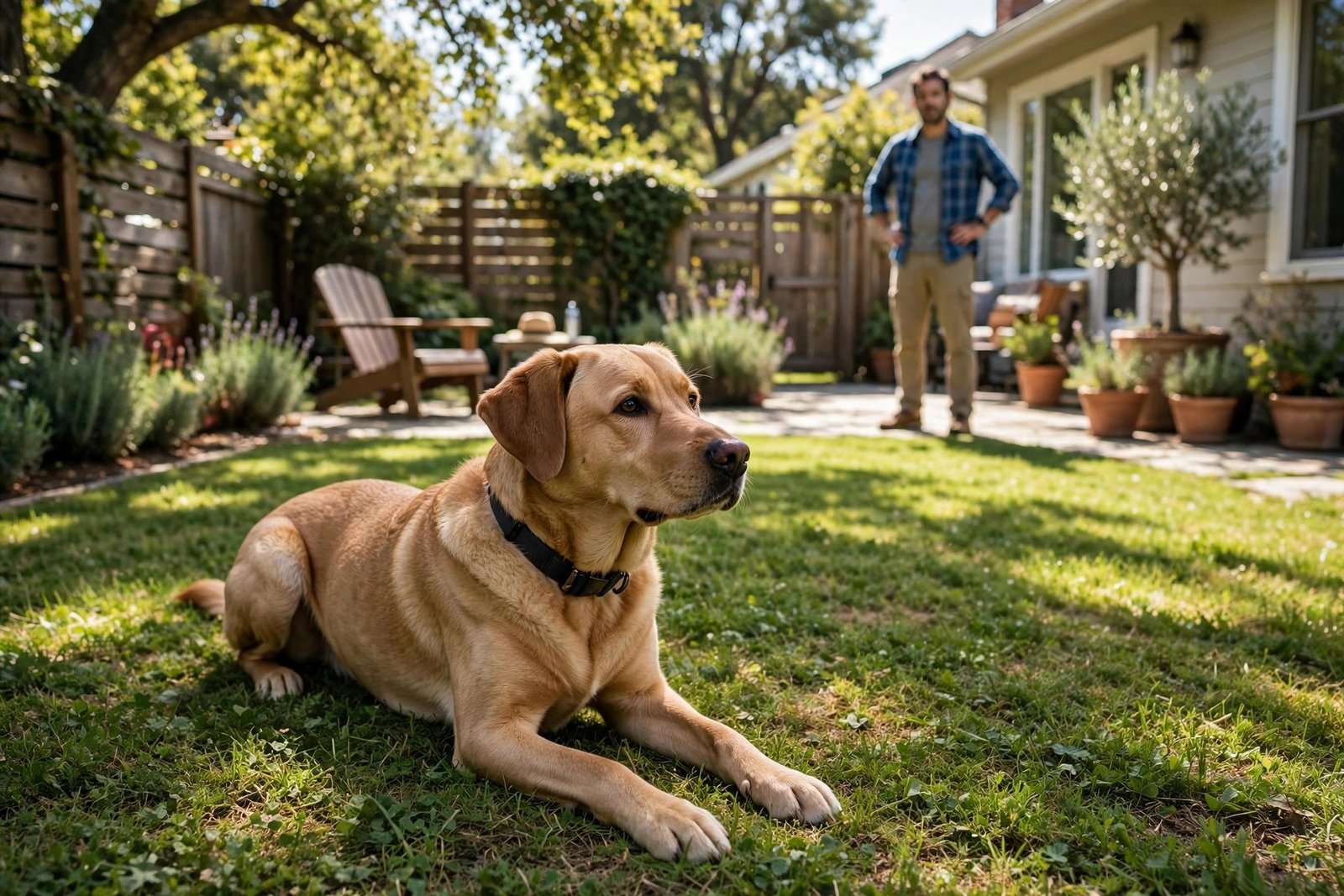
Stay asks a dog to do the hardest thing in its world: absolutely nothing, while everything interesting happens somewhere else. A door opens, food lands on a counter, another dog passes, and the staying dog must simply hold position and watch it all go by. That stillness is what makes stay both valuable and difficult. It protects dogs at open doors, at kerbs, and around dropped food, but it cannot be rushed. Reliable stay is built from tiny successes, stretched carefully, one challenge at a time, until doing nothing becomes a strong and familiar habit.
Before stay: the foundation and the release word
Step One: Build on a solid sit or down before asking for any stay at all. If the dog cannot hold a sit for a few breaths in a boring room, strengthen that first. Sequencing is not gatekeeping; it is respect for how skills stack. A shaky foundation makes everything built on it shaky, and stay built on an unsteady sit will crumble the moment a distraction appears. The dog should settle into position promptly and comfortably, in a quiet place, before the new idea of holding that position over time is introduced.
The release word is the second half of this foundation, and it matters just as much. Choose one word, such as okay, free, or break, and teach it from the very first session. Stay without a clear end teaches the dog to decide for itself when the exercise is over, and a cue the dog ends on its own terms means very little. The teaching is simple. Cue stay, pause for a breath, say the release word cheerfully, and reward the dog for moving. Staying earns rewards while the position holds, and only the word ends the exercise. That bright line between holding and released is what makes the whole behavior clear enough for a dog to trust and repeat.
The short start
Step Two: Ask for the sit, say stay once with a flat palm shown toward the dog, count one Mississippi in your head, then release and reward enthusiastically. That tiny sequence is a complete and successful repetition. Keep to a handful of repetitions per session and a few short sessions a day, rather than one long drill that dulls attention. Over the first days, stretch the pause by a breath at a time. Progress should feel almost boring, because each new length is only barely harder than the last one the dog already handled with ease.
If the dog breaks, too much was asked. Reset calmly, with no scolding, because breaking is information, not disobedience. The dog has simply reported where the limit currently sits, and the next repetition should return to the last duration that worked. Deliver rewards while the dog is still in position, calmly, at nose level or between the paws. Excited delivery makes excited dogs, and an excited dog finds stillness much harder. A quiet treat placed where the dog already is teaches that good things arrive without any need to move toward them, which is precisely the belief a strong stay is built on.
Choose the practice spot with the same care as the timing. A quiet room with no audience, no loose toys, and no other animals wandering through gives a young stay its best chance. Keep the lead on indoors at first if the dog is likely to wander off and turn a reset into a game of chase, because calm retrieves protect the lesson. Short sessions also protect the person’s patience. Ending while both parties are still fresh leaves the dog keen for the next round, and keen dogs learn faster than dogs that have been drilled past the point where attention quietly gives out.
Adding the three Ds, one at a time
Step Three: Once a short stay is reliable, build the three Ds one at a time. Duration comes first, and it should vary rather than always lengthening. Mix shorter and longer pauses in a random pattern, so the dog stops predicting that the long one is coming and stops breaking early out of anticipation. An occasional jackpot reward after an unusually good stay adds welcome surprise and keeps effort high. Distance comes second, with duration reset short again. Take a step back, then another, then move to the end of the lead, and eventually step briefly out of sight and return, rewarding calm holding at every stage.
Distraction comes last, and it also begins with the other demands reset low. A soft clap, a toy placed nearby rather than thrown, someone passing at a distance, or the front door opening all count as real challenges for a staying dog. Every new level of one D temporarily shrinks the others, and that is the rule, not a setback. A dog holding a brief stay near a mild distraction is succeeding at a genuinely harder job than a dog holding a long stay in an empty room. Respecting that trade keeps progress steady and keeps the dog’s confidence intact while the skill grows in three directions at different speeds.
Proofing for real life
Step Four: Expect to re-teach stay briefly in every new place, because dogs do not generalize well. A kitchen stay does not automatically become a garden stay, a quiet park stay, or a stay in a friend’s house. Each new setting deserves a short return to the easy version, followed by the same careful stretching that worked at home. The good news is that re-teaching in a new place is far faster than the original teaching, because the dog already understands the idea and only needs to learn that the idea applies here too.
Build the real-life uses deliberately rather than hoping they appear. Practice stay while the front door opens, which is the safety-critical use, and practise it with the dog on a lead at first so a mistake cannot become a dash into the street. Practice stay while the food bowl goes down, and stay at kerbs before crossing. These functional repetitions are worth far more than sterile drills, because the context is meaningful to the dog. A reliable stay also pays off away from home, which is why quick tips for traveling with your dog sit naturally alongside stay training for any household planning trips with a dog in tow. The emergency down-stay at a distance deserves an honest mention here: it is months-away advanced work, best built slowly with a certified trainer, and no household should pretend a young stay is ready for that job.
Troubleshooting
Breaking on the first sound of the release word usually means anticipation. The dog has learned the rhythm so well that movement starts before permission arrives. Vary the timing, and sometimes reward in position without releasing at all, so holding still remains rewarding in its own right and the release stays unpredictable. Creeping forward calls for a silent reset to the exact spot. A mat or platform defines the place crisply, giving the dog a clear boundary to hold. Rewarded creeping becomes a habit quickly, because inching closer to the treat source feels profitable, so calm resets without reward protect the definition of stay.
Refusing to stay when the person leaves the room is the hardest variant of all, and it should be built in micro-steps. Turn sideways, take a single step, glance away, then half-hide behind a door, returning and rewarding at each tiny stage. Rushing this progression is the fastest way to teach a dog that stays collapse whenever the person vanishes. Patience here pays for years. Anyone who wants wider context for patient, layered teaching of this kind will find it in the broader craft of animal training, where gradual difficulty and clear signals are treated as the foundation of reliable behavior across species.
State of mind matters as much as technique. A dog that has just come in from an exciting walk, a lively game, or a long stretch alone in the house will find stillness far harder than a settled dog will. Let energy settle before asking for careful stay work, and keep voices low and movements unhurried during the session itself. Households also help by keeping the early training environment honest: food put away, doors closed, and other animals settled elsewhere. Each avoided distraction is not cheating. It is the training being pitched at a level the dog can genuinely meet, which is how confidence in the cue gets built in the first place.
The emergency stop: the advanced extension
A distinctive cue that freezes the dog mid-motion is the advanced extension of everything stay teaches. Build it on the stay foundation rather than treating it as a separate trick. Pair the chosen word with a sit while walking, rewarding generously, then add distance, then mild motion such as a toy tossed a short way. Each stage needs many easy successes before the next one is fair. Hundreds of calm, successful repetitions come before such a cue deserves trust in a genuinely exciting moment. A stop that works only sometimes is worse than none at all, because it breeds false confidence in the person relying on it.
The honest test ground for that kind of reliability is the dog park, and what it demands of a trained dog in terms of attention, recall, and self-control around other dogs at full excitement. No emergency cue should be trusted there until it has succeeded in far calmer settings many times over. A brief word on systems is also worthwhile. Some households use stay to mean hold until released, and wait to mean pause briefly at doors or before meals. Others teach an implied stay, where sit or down automatically means hold until the release word arrives. Either system can work well. Pick one, explain it to everyone in the house, and be consistent, because consistency is what turns a clever exercise into a safety habit the dog can rely on.