
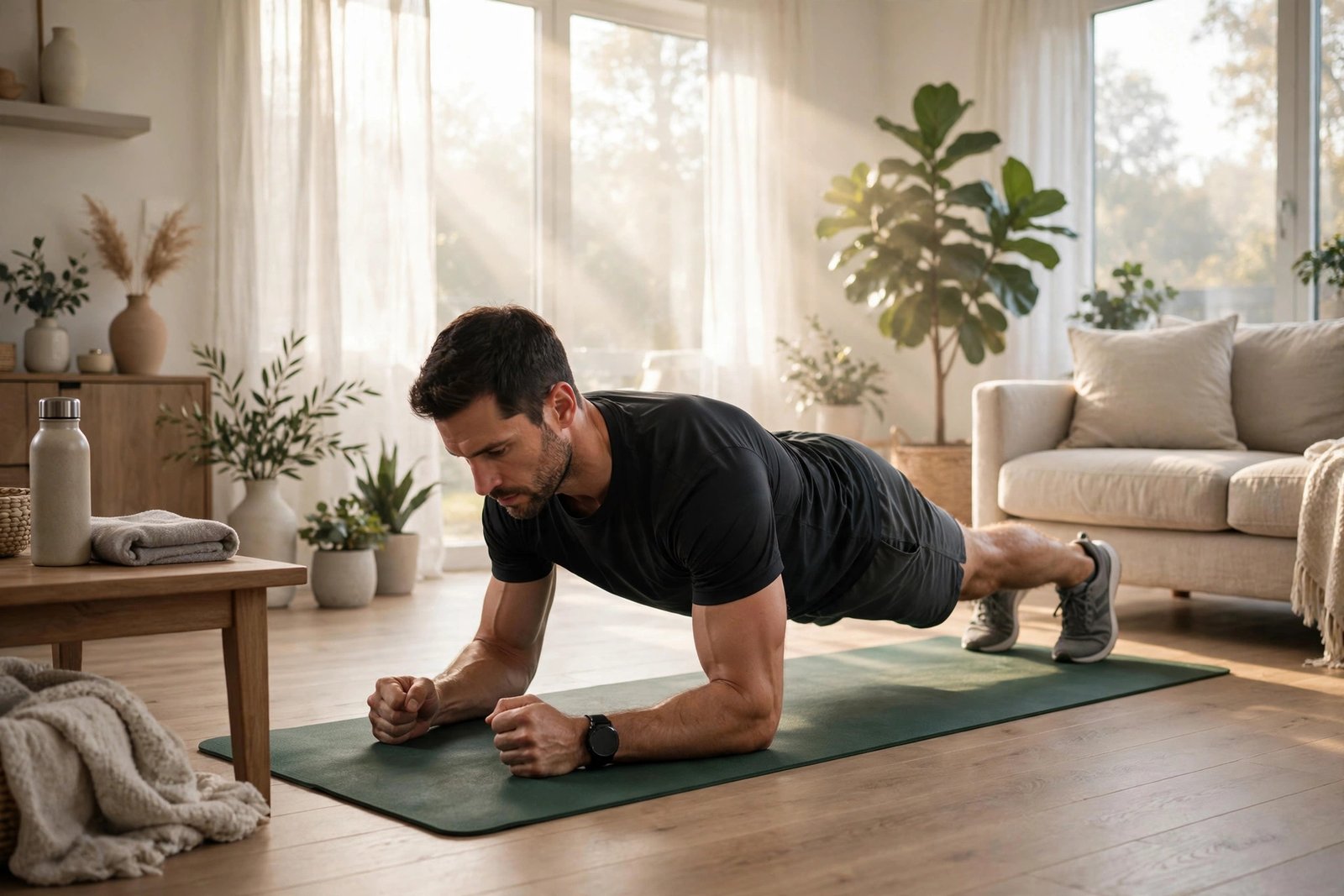
Everyone wants visible abs, but the fastest way to build core strength at home starts with what the core really is: the 29 muscles wrapping your midsection — abdominals, obliques, lower back, glutes, pelvic floor, and diaphragm — that stabilize your spine, transfer power between limbs, and keep you injury-free. A strong core means less back pain, better posture, harder athletic performance, and yes, eventually better aesthetics. The good news: the fastest core gains come from bodyweight exercises you can do on your living room floor in 10 minutes. Here’s the complete home program.
What “Core” Actually Means (It’s Not Just Abs)
The core is a system, not a muscle. The rectus abdominis (the “six-pack”) is the least functionally important part — it’s the deep stabilizers (transverse abdominis, multifidus, pelvic floor) and the posterior chain (erector spinae, glutes) that protect your spine and generate power. This is why endless crunches build show muscles while leaving backs vulnerable: crunches train spinal flexion, but real life demands spinal stability — resisting movement under load.
The functions to train: anti-extension (planks — resisting arching), anti-rotation (Pallof-style presses, bird dogs — resisting twisting), anti-lateral-flexion (side planks — resisting side-bending), and hip extension (glute bridges — the glutes are core muscles too). A program covering all four builds a bulletproof midsection; a program of only crunches builds a party trick. Posture payoff: desk workers with weak cores develop the classic anterior pelvic tilt and chronic low-back ache — direct results of stabilizers that never get trained.
The Essential Exercises (Master These Six)
1. Plank: forearms and toes, straight line head-to-heels, glutes squeezed, 30-60 seconds. The foundation — if you can’t hold 60 seconds with good form, start here. 2. Dead bug: on your back, arms up, knees bent 90°, slowly extend opposite arm and leg while pressing your lower back into the floor. The best deep-core activator most people have never tried — 8-10 per side.
3. Bird dog: on all fours, extend opposite arm and leg, hold 5 seconds, 8-10 per side. Trains anti-rotation and the back-side stabilizers crunches ignore. 4. Glute bridge: on your back, knees bent, drive hips up squeezing glutes, 15-20 reps. Weak glutes force the lower back to compensate — the hidden cause of countless back complaints. 5. Side plank: 30 seconds per side, building to 60 — the anti-lateral-flexion cornerstone. 6. Hollow-body hold: on your back, arms overhead, legs extended, lift shoulders and legs slightly — 20-30 seconds. The gymnastics staple that builds total midline tension.
Programming: How Often and How to Progress
Frequency: 3-4 dedicated core sessions weekly, 10-15 minutes each — or add 5 minutes of core to the end of every workout. The core recovers quickly and tolerates frequency well. The progression ladder: add time (30s → 60s → 90s planks), add reps, slow the tempo (3-second eccentrics double difficulty), advance variations (plank → plank with arm/leg lift → single-arm plank), or reduce stability (dead bug → hollow body).
Sample 10-minute circuit: 40 seconds each of plank, dead bugs, glute bridges, side plank (each side), bird dogs, and hollow hold, with 20 seconds rest between — one round for beginners, two for intermediates. Track one metric: max plank time or hollow-hold duration, tested monthly — watching it climb is deeply motivating. For building the full program around it, tools that generate a workout plan tailored to your fitness level can periodize core work alongside everything else. And don’t skip the recovery half — 10 minutes of daily stretching keeps a strengthening core supple rather than stiff.
Core Training for Back Pain Relief
Here’s the underappreciated payoff: a properly trained core is back-pain medicine. Most chronic low-back pain in desk workers traces to weak deep stabilizers forcing spinal structures to handle loads they weren’t designed for. The McGill Big Three — curl-up, side plank, and bird dog (developed by spine researcher Stuart McGill) — are literally prescribed by physical therapists for back rehabilitation, and they’re all in this guide’s exercise list.
The protocol for achy backs: start with bird dogs and dead bugs (gentlest on the spine), add glute bridges, then side planks — avoiding loaded spinal flexion entirely until pain subsides. Train daily but gently: 5-10 minutes of the Big Three beats occasional intense sessions. Progress by adding holds and reps, not by rushing to harder variations — the deep stabilizers respond to consistency, not intensity. Film yourself from the side once a month — visible form improvements are the most motivating progress metric before visible muscle changes arrive. Red flags: pain radiating down a leg, numbness, or pain that worsens over weeks needs a clinician, not more planks. But for the garden-variety stiffness of modern sitting, a few weeks of stabilizer training resolves what years of ignoring it created.
Mistakes That Waste Your Effort
Crunches-only routines: spinal flexion under load, repeated thousands of times, is exactly what back specialists warn against — and it ignores the stabilizers that matter. Holding your breath: brace (as if expecting a punch) but keep breathing — breath-holding spikes blood pressure unnecessarily. Sagging planks: hips drifting down means the set is over — 30 perfect seconds beats 90 sloppy ones. Training abs daily but never the back: front-back imbalance causes the posture problems core training should fix.
Expecting visible abs from core work alone: visibility is body-fat percentage, not crunch volume — no exercise “burns belly fat” specifically (spot reduction is a myth). Train core for function and strength; manage nutrition for aesthetics. The Mayo Clinic’s core exercise guidance reinforces this functional framing — and the CDC’s activity guidelines count core work toward the twice-weekly muscle-strengthening recommendation.
The Bottom Line
The fastest way to build core strength at home: train all four stability functions (anti-extension, anti-rotation, anti-lateral-flexion, hip extension) with six bodyweight exercises — plank, dead bug, bird dog, glute bridge, side plank, hollow hold — 3-4 times weekly for 10-15 minutes, progressing time, reps, and difficulty monthly. Skip the crunch marathons; build the stabilizers. Your back will thank you within weeks.
Frequently Asked Questions
How long does it take to build core strength?
Noticeable strength gains in 4-6 weeks of consistent 3-4x weekly training; significant functional improvement (posture, back pain reduction) by 8-12 weeks. Visible definition depends on body fat levels and takes longer.
Can I train abs every day?
The core recovers faster than large muscle groups, so near-daily light core work is fine — but vary the exercises and intensity, and include the back-side muscles (bird dogs, bridges), not just abs. Quality and variety beat daily crunches.
Are planks enough for core strength?
Planks are an excellent foundation but incomplete alone — they train anti-extension only. Add dead bugs, bird dogs, side planks, and glute bridges to cover rotation resistance, lateral stability, and the posterior chain.
Do I need equipment for core training?
No — the most effective core exercises are bodyweight. An exercise mat adds comfort; everything else (ab wheels, cables) is optional progression, not requirement. Your floor and gravity suffice for years of progress.
Will core exercises give me a six-pack?
Core exercises build the muscles; body fat levels determine visibility. No amount of ab training reveals muscles hidden under fat — that requires nutrition and overall activity. Train core for strength and back health; the aesthetics follow body composition.