
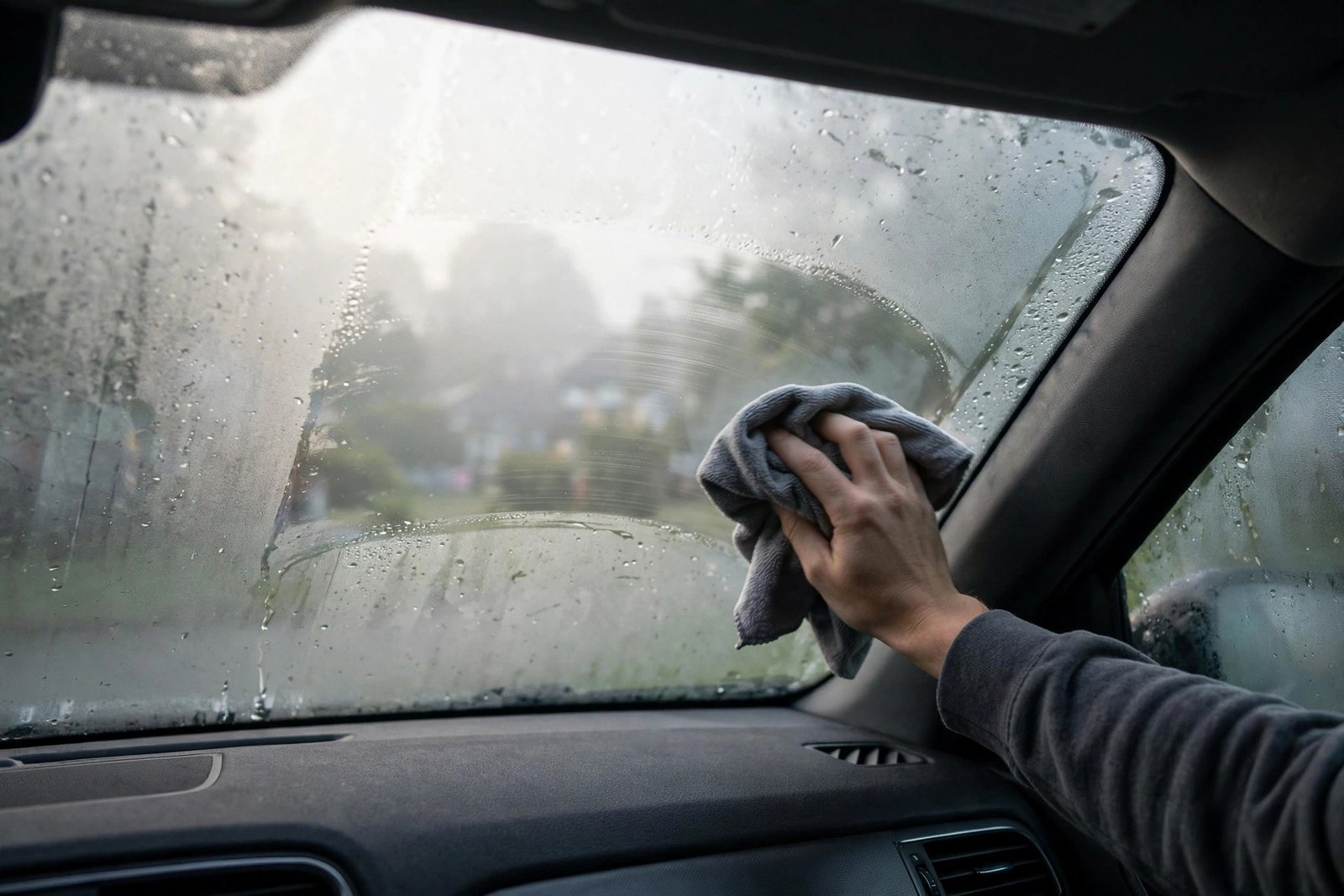
You are running late, the windshield is fogged up, and you cannot see a thing. It is one of the most common — and most dangerous — driving annoyances, especially in fall and winter. Foggy windows reduce visibility to near zero, and wiping with your hand just smears the moisture around. The good news: defogging is pure physics, and once you understand what causes fog, you can clear it in under a minute every time. Clear visibility is a safety issue as much as a comfort one — NHTSA’s safe driving resources explain why.
This guide explains why windshields fog up, the fastest method to clear them, and how to prevent fog from forming in the first place.
Why Windshields Fog Up
Fog is condensation — warm, moist air hitting a cold glass surface. Your breath, wet clothes, and even the moisture in the cabin air raise the humidity inside the car. When that humid air contacts the cold windshield, water vapor condenses into tiny droplets that scatter light and turn the glass opaque.
This is why fogging is worst in cold, damp weather and when the car is full of people. It is the same physics that fogs your bathroom mirror after a shower. Understanding this tells you the solution: you need to either warm the glass, dry the air, or both. Cracking a window helps with a related moisture problem — see what causes mold in bathrooms and how to prevent it for how trapped moisture behaves in enclosed spaces.
The Fastest Defogging Method
Here is the procedure that works fastest on nearly every car. Turn the defroster to its highest setting — this directs air at the windshield. Set the temperature to warm or hot (warm air holds more moisture than cold air). Turn the air conditioning ON, even in winter — the A/C dehumidifies the air, which is the real secret. Turn OFF recirculation mode so you are pulling in drier outside air instead of recirculating humid cabin air. Crack one window slightly for the first 30 seconds to let the most humid air escape.
Done correctly, this clears a badly fogged windshield in 30 to 60 seconds. The most common mistake is using recirculation mode, which traps humid air inside and makes fogging worse. The second most common mistake is using cold air only — cold air cannot absorb as much moisture, so it works much more slowly.
What If Your Car Has a Defrost Button?
Many modern cars have a dedicated front defrost button (a windshield icon with wavy arrows). Pressing it automatically sets the optimal combination: A/C on, recirculation off, fan high, air directed at the windshield. If your car has this, just press it and wait — the engineers already figured out the fastest settings for you.
Preventing Fog Before It Starts
The best defogging is the kind you never need. Start by keeping your windows clean — dirt and film on the inside of the glass give moisture more surface to cling to. Clean interior glass monthly with automotive glass cleaner, or use the vinegar-water method for stubborn film. You will be surprised how much this helps; it is the same principle behind brightening a dark living room — clean glass transmits light dramatically better.
Reduce cabin moisture at the source. Shake snow and rain off your shoes and clothes before getting in. Remove wet floor mats and let them dry — a soaked mat continuously evaporates moisture into the cabin. If your car smells musty, check for leaks in door seals or the trunk; chronic dampness means water is getting in somewhere. Silica gel dehumidifier bags placed on the dashboard absorb ambient moisture and are reusable — just dry them out periodically.
Anti-Fog Products: Do They Work?
Anti-fog sprays and wipes create a hydrophilic coating that prevents droplets from forming — water spreads into a thin transparent film instead of beading into fog. They work reasonably well for a few weeks per application. Shaving cream (the old-school trick) works on the same principle but does not last as long. These are good supplements to proper ventilation, not replacements for it.
Special Situations
Fog on the OUTSIDE of the windshield happens in humid summer weather when your A/C makes the glass colder than the outside air. For this, run the wipers and reduce the A/C slightly — warming the glass a few degrees stops the condensation. Rear window fog clears via the electric defroster grid (the thin lines in the glass) — turn it on and give it a few minutes.
If your windshield fogs excessively even with the defroster running properly, your cabin air filter may be clogged (restricting airflow) or your heater core may be leaking (adding coolant vapor to the cabin — you will notice a sweet smell). Both need attention. The Department of Energy’s vehicle technologies resources cover climate control efficiency if you want to understand these systems better.
Long-Term Fog Prevention Strategies
Beyond the immediate defogging technique, several long-term strategies reduce how often you deal with fog. Replace your cabin air filter on schedule — a clogged filter restricts airflow, making the defroster less effective and allowing moisture to build up. If your defroster seems weak even on high, the filter is the first thing to check.
Check for water leaks. If your car consistently fogs excessively, water may be entering through worn door seals, a leaking windshield seal, or a clogged sunroof drain. Look for damp carpets, musty smells, or water stains on the headliner. These leaks not only cause fogging but lead to mold and corrosion if ignored. A professional can pressure-test seals to find elusive leaks.
Consider your parking situation. Cars parked in garages fog less than those outside (the glass stays warmer). If you park outside, a windshield cover prevents frost and reduces morning fog by keeping the glass closer to ambient temperature. And always remove snow from the entire car, not just the windshield — snow on the roof melts and runs down, refreezing on glass and creating ice that is harder to clear than the original snow.
When Defogging Does Not Work
If your windshield will not clear despite correct technique, something is wrong. A clogged cabin air filter is the most common culprit — it restricts airflow so severely that the defroster cannot do its job. Replace it (a $15-$30 part, 10 minutes of work) and test again. If that does not help, the heater core may be failing — a leaking heater core introduces coolant vapor into the cabin, which condenses on glass and creates a persistent film that will not clear. You will notice a sweet smell and possibly damp carpets.
Another possibility: the A/C compressor is not engaging. The defroster relies on the A/C for dehumidification; if the compressor clutch has failed, you get heat but no dehumidification. A mechanic can diagnose this quickly. Do not ignore persistent fogging — it is not just annoying, it is a safety issue and often signals a maintenance problem that will get worse.
For more detailed guidance, see Edmunds car maintenance guides.
Frequently Asked Questions
Is it safe to drive with a foggy windshield?
No. In most states it is actually illegal to drive with obstructed visibility. More importantly, you cannot react to hazards you cannot see. Always clear the windshield fully before driving — it takes less than a minute with the right method.
Should I use hot or cold air to defog?
Warm or hot air with the A/C on. Warm air absorbs more moisture, and the A/C dehumidifies it. Cold air alone works but much more slowly. The key combination is warm + A/C + fresh air mode (not recirculation).
Why does my windshield fog up when it rains?
Rain raises outside humidity and cools the glass, while your wet clothes and breath raise inside humidity. It is the perfect fog storm. Use the full defogging procedure and crack a window to equalize moisture.
Can I prevent fog permanently?
You cannot eliminate it entirely — it is physics. But clean glass, a fresh cabin air filter, dry floor mats, and anti-fog treatment together reduce it to a minor, brief inconvenience rather than a recurring ordeal.