
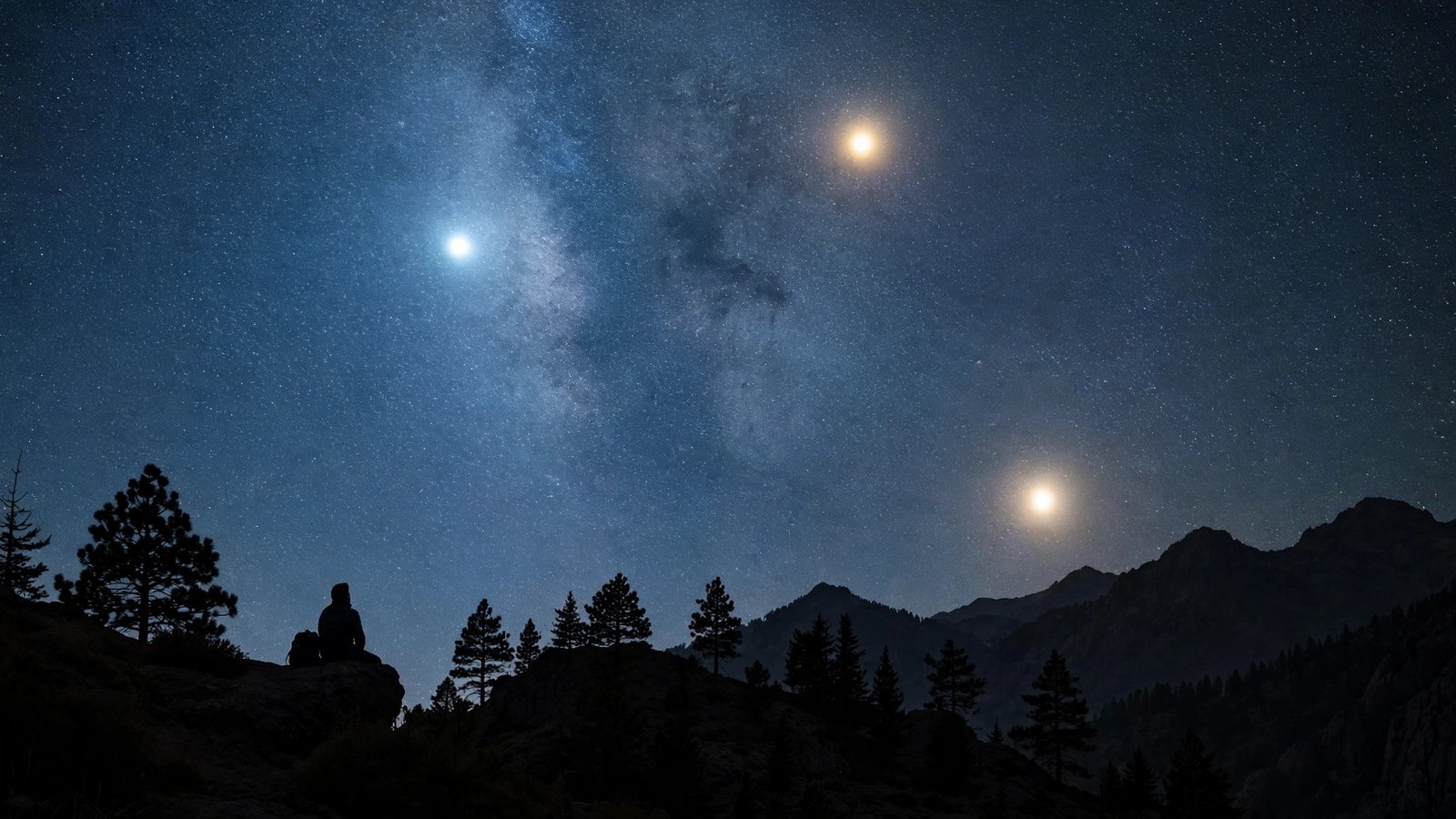
You don’t need a telescope to see other worlds. Five planets — Mercury, Venus, Mars, Jupiter, and Saturn — are visible to the naked eye, and people have watched them wander the sky for millennia (the word “planet” comes from the Greek for “wanderer”). On the right night, you can step into your backyard and see the bands of Jupiter’s moons’ host world, the red glint of Mars, and the impossible brilliance of Venus — no equipment required.
Most people have seen planets without realizing it — that “really bright star” that doesn’t twinkle is usually Venus or Jupiter. Here’s how to identify all five, know when to look, and make the most of what your eyes can do.
The Golden Rule: Planets Don’t Twinkle (Much)
The fastest way to spot a planet: look for bright “stars” that shine with a steady light. Stars twinkle because they’re point sources distorted by Earth’s atmosphere; planets are tiny discs, and their light averages out the atmospheric shimmer. A bright, steady, non-twinkling light is almost always a planet (or occasionally a satellite passing through).
Second rule: planets hug the ecliptic — the sun’s path across the sky. They appear along an imaginary arc stretching from east to west through the southern sky (in the Northern Hemisphere). A brilliant light far from this band is a star, not a planet.
Venus: The Dazzling One (Easiest)
Venus is the brightest planet by far — outshining everything except the sun and moon. Look for an intensely bright white object low in the west just after sunset (as the “Evening Star”) or low in the east just before sunrise (the “Morning Star”). Venus never strays far from the sun, so it’s always near the horizon at dawn or dusk — never overhead at midnight.
Through binoculars, Venus shows phases like the moon — a crescent Venus is a genuine thrill. Check NASA’s skywatching guides for Venus’s current apparition: it alternates between evening and morning visibility in an 8-year cycle.
Jupiter: The Steady Giant (Easiest)
Jupiter is the second-brightest planet — a brilliant cream-white light that doesn’t twinkle, often the brightest thing in the midnight sky when it’s up. It’s visible for months at a time, rising in the east in the evening during opposition season (when Earth passes between Jupiter and the sun).
The magic of Jupiter: even cheap binoculars reveal its four largest moons — Io, Europa, Ganymede, and Callisto — as tiny points in a line flanking the planet. Galileo’s 1610 discovery of these moons overturned humanity’s view of the cosmos; you can repeat the observation from your porch. Their positions change nightly, which never gets old.
Mars: The Red Wanderer (Seasonal)
Mars is unmistakable when it’s bright — a distinctly orange-red point of light. But Mars varies enormously: at opposition (every ~26 months, when Earth laps it), it blazes; between oppositions, it’s a modest reddish star. The great oppositions — when Mars is closest — make headlines for a reason.
Mars is the planet that rewards patience and timing. Check opposition dates (roughly every two years) and plan your viewing then. Even at its best, Mars shows no detail to the naked eye — just that arresting red color that’s fueled human imagination for centuries.
Saturn: The Subtle Jewel (Moderate)
Saturn appears as a steady golden-yellow light — dimmer than Jupiter, brighter than most stars. To the naked eye it’s a beautiful point; the rings need at least a small telescope (even a $100 refractor shows them). Saturn is worth learning to find naked-eye so you can point a telescope at it later — seeing the rings for the first time is a top-tier life experience.
Saturn takes ~29 years to orbit the sun, so it lingers in each constellation for over two years — once you learn its current neighborhood, it stays put for a while.
Mercury: The Challenge (Hardest)
Mercury is visible to the naked eye but elusive — it never strays far from the sun, appearing only in twilight, low on the horizon, for a few weeks at a time during its greatest elongations. The trick: find a flat western horizon (for evening appearances) with zero obstructions, and look during the 30–45 minutes after sunset on the predicted dates.
Mercury rewards the dedicated: a pinkish-white point in the glow of sunset, visible briefly before it sinks. Fewer people have knowingly seen Mercury than any other planet — it’s a genuine achievement for a backyard observer.
When and Where to Look: Practical Tips
- Timing: the hour after sunset and before sunrise are prime — planets near the sun (Venus, Mercury) only appear then, and dark skies help with the rest.
- Location: darker is better, but planets are bright — city observers can see Venus, Jupiter, Mars, and Saturn fine. You need a clear horizon more than dark skies.
- Let your eyes adapt: 15–20 minutes away from bright lights noticeably improves what you can see.
- Use free apps: point-your-phone apps (Stellarium, SkySafari, NASA’s app) identify planets in real time — the fastest way to learn the sky. But learn to find them without the app too; the knowledge sticks better. And since these apps download star data on the fly, it helps to know what 5G actually changes for everyday phone users when you’re relying on mobile data in the field.
- Check what’s up tonight: Sky & Telescope’s observing guides publish monthly “what’s visible” roundups — the easiest way to plan.
Conjunctions — when planets appear close together — are the best beginner events: a bright Venus-Jupiter pairing is unmissable and spectacular. Eclipses and meteor showers pair beautifully with planet-watching on the same night.
Level Up: Binoculars and Beyond
You don’t need to stop at naked-eye. A $50–$100 pair of 7×50 or 10×50 binoculars reveals Jupiter’s moons, Venus’s phases, Saturn’s elongated shape (the rings blurring into an oval), and the moon’s craters in stunning detail. Binoculars are arguably the best first astronomy investment — portable, intuitive, and useful for a lifetime.
From there, a small telescope opens Saturn’s rings, Jupiter’s cloud bands, and Mars’s polar cap at opposition. But master the naked-eye sky first — knowing the planets by sight makes every optical upgrade more rewarding. There’s something profound about the fact that AI now helps map the sky in apps, while the actual photons hitting your eyes left Jupiter 40 minutes ago — ancient light, modern tools.
Frequently Asked Questions
Which planets can I see tonight?
It changes constantly — Venus and Jupiter are frequently visible; Mars and Saturn depend on their orbital positions; Mercury only during elongation windows. Check a skywatching app or monthly guide for tonight’s lineup.
Why do planets look like stars?
They’re reflecting sunlight and are effectively point sources to your eye at interplanetary distances. Their steady shine (vs. stellar twinkle) and position along the ecliptic give them away.
Can I see Uranus or Neptune without a telescope?
Uranus is technically naked-eye visible (magnitude ~5.5) from very dark skies if you know exactly where to look — but it’s star-like and unremarkable. Neptune requires optical aid. Both were found with telescopes, which tells you something.
What’s the best time of year for planet watching?
There’s no single best season — it depends on each planet’s position. Opposition seasons (different months per planet) are the highlights. Year-round, the hour after sunset is the most consistently rewarding window.
The Bottom Line
Five worlds are visible from your backyard tonight (well, not all on the same night): start with brilliant Venus at dusk and steady Jupiter overhead, learn the non-twinkling trick, grab a free sky app, and work toward elusive Mercury. You’ve just joined a tradition of skywatchers stretching back to Babylon — no telescope required.