
Children usually meet the planet twice: first as a place to wonder at, and later as a problem they are told to worry about. The order matters. A child who has learned to love a garden, a stretch of coast, or a patch of woodland has a reason to care long before hard news arrives. A child who hears only warnings, without that early love underneath, has fear without roots. Talking about the planet is therefore not one talk at all. It is a long conversation that changes as the child changes.
A few rules hold at every age. Honesty comes first, but honesty without hopelessness. Problems should be named plainly, in words a child can hold, and never dressed up as smaller than they are. At the same time, a problem should never be handed over alone. Every hard fact needs company: what people are doing about it, and what a family can do at home. The second rule is to answer the question actually asked, and only that question. A small child asking why the sea looks dirty needs an answer about litter and care, not a lecture on warming oceans. A teenager asking a sharp question about energy deserves a full answer, not a softened one. Giving more burdens a child; giving less feels like evasion, and children notice evasion quickly. The same age-by-age patience helps with other grown-up subjects, and families taking that steady approach to teaching children about money will recognise the pattern in practical ways to teach kids about money, where small, honest lessons early on build toward real understanding later.
Feelings belong inside the rules as well. Worry, sadness, and anger about harm to animals or places are signs of care, not problems to be corrected. Dismissal teaches a child that feelings are wrong, while calm acknowledgement teaches that feelings can be carried. Adults also teach by example far more than by speeches: a child watches where litter goes, and those daily habits speak before any explanation does.
The preschool years: wonder before facts
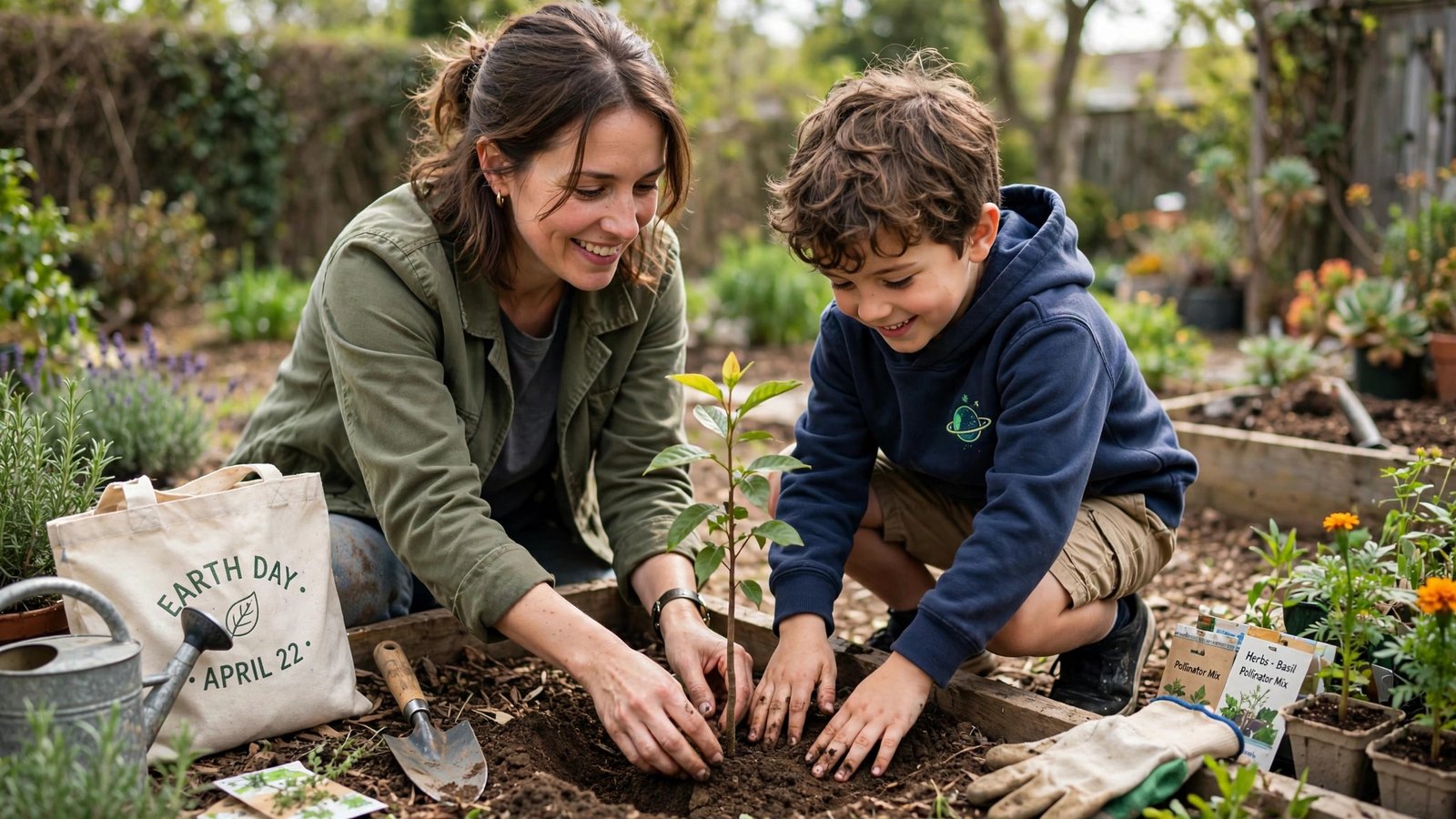
For the youngest children, the task is simple: build love of nature before any talk of problems. A preschool child learns through hands, eyes, and repetition, not through explanations about systems. Time outside is the curriculum. A garden pot with seeds teaches waiting, growth, and care in a way no picture book can match, because the child waters the soil, checks for green shoots, and feels real pride when leaves appear. Bugs deserve attention rather than disgust. A beetle crossing a path or a worm after rain gives a child a reason to look closely, and looking closely is where care begins.
Weather belongs in the same early education. Rain that fills puddles, wind that pushes leaves along the pavement, frost that patterns a window, and sun that warms a wall at midday all connect a child to a living world that changes every day. Naming the seasons as they turn builds a quiet store of knowledge. None of it needs a warning attached.
Small acts of care fit naturally into wonder, as long as the reasons stay concrete and close to home. Putting litter in the bin makes sense because animals live here too, and rubbish left on the ground can hurt a bird or tangle around a small creature. Turning off a tap while brushing teeth makes sense because water is shared and precious. Feeding birds in cold weather and leaving a corner of grass uncut for insects are jobs at exactly the right scale. Big words about gases, melting ice, or dying species have no place yet, because a young child cannot act on them and can only carry them as a vague dread. Wonder first is not avoidance. It is preparation, because the child who loves the natural world early on will want to protect it later.
The early school years: gentle truths and helpers
Once school begins, questions grow teeth. Children hear fragments from news, from older pupils, and from lessons, and the fragments need honest answers at a size a child can manage. Simple true explanations work best: the air and oceans are slowly warming because of gases released when fuels burn, and that warming is changing weather and making life harder for some animals and people. A plain account of how the climate system is changing gives adults the background to keep those explanations accurate. The blanket comparison often helps at this age: a thin extra layer around the Earth traps heat that would otherwise escape, so the planet warms a little more each year. Simple does not mean false, and children who later learn fuller detail should never feel that the early version was a trick.
Helpers and inventors deserve as much airtime as problems. At this age children think in stories and people, so the people fixing things carry the hope. Rangers replanting woodland, engineers building wind turbines, scientists counting seabirds, and inventors designing better batteries all show that action is normal and widespread. Stories of places recovering help too: a cleaned river where fish returned. Each story answers the silent question underneath a child’s worry, which is whether anyone is doing anything. The answer, told often and truthfully, is that many people are.
Small jobs a child can own complete the picture. Sorting recycling at home, carrying a reusable bottle, or tending a plant gives concern somewhere useful to go. The job should be real, regular, and praised for effort rather than perfection. Ownership matters because helplessness, not knowledge, is what frightens children most. A child with a role feels part of the fixing. Questions should still set the pace. If a child asks whether the world will end, the honest answer is no, paired with the truth that some things are changing and need care.
The older child: real science, honestly told
Older children can smell softened answers, and respect drains away the moment an adult fudges. This stage calls for real science at real depth, taught in plain words rather than babyish ones. The greenhouse effect can be explained properly: sunlight reaches the ground and warms it, the ground gives off heat, and certain gases in the air slow that heat as it escapes, much as glass holds warmth in a greenhouse. Burning coal, oil, and gas adds more of those gases, so more heat stays, and the whole system shifts. Warmer air holds more moisture, so heavy rain grows heavier in many places. Warmer seas feed stronger storms and push sea levels upward as ice melts and water expands. Hotter, drier spells strain farms and forests elsewhere. None of this needs exaggeration; the plain chain of cause and effect is strong enough.
Where food and energy come from opens the subject wider. Tracing a meal backwards to soil, water, transport, and seasons shows how deeply daily life rests on a stable climate. Tracing electricity backwards to power stations and wind farms shows the same for energy. Older children can also handle the difference between personal habits and large systems. Turning off lights helps, and so does honesty about scale: power generation, farming, building, and transport shape the problem most, and those change through invention, law, and public pressure as well as household choices. That honesty protects a child from carrying the whole planet as personal guilt. Useful background for adults here is how children’s understanding grows with age, since the jump in reasoning at this stage makes deeper explanations satisfying rather than frightening.
Disagreement needs honest handling too. Older children will meet claims that the problem is invented, exaggerated, or already solved, and pretending those claims do not exist leaves a child unprepared. The better approach teaches how scientists test ideas, why measurements from many places pointing the same way carry weight, and how to check a claim: who said it, and what evidence sits behind it. Genuine open questions can be named as open. Certainty about the core, honesty about the edges: that is the tone.
The teenager: a partner in the subject
Teenagers do not need a pupil’s chair; they need a partner’s seat at the table. Knowledge by this stage may rival or pass that of parents. Debates should be welcomed rather than managed. A teenager arguing that nuclear power matters, that flying should cost more, or that personal sacrifice is overrated is practising exactly the thinking the subject demands. Listening properly, conceding good points, and defending a view with evidence rather than rank turns disagreement into training.
News deserves joint attention as well. Headlines about fires, floods, and new inventions land on teenagers daily, often stripped of context and sharpened for alarm or mockery. Checking news together builds durable habits: reading past the headline, finding the original source, and noticing whether a dramatic claim rests on a single event or a long trend. Projects and choices should be treated as belonging to the teenager. A school campaign, a repaired bike instead of a replaced one, or a letter to a local representative carries more weight when chosen rather than assigned. Adults can offer money, lifts, and encouragement, and then step back. Ownership converts worry into momentum far better than instruction does.
Honesty at this stage includes the hard trade-offs. Energy must come from somewhere, building cleaner systems takes time and materials, and decent people disagree about pace and method. A teenager trusted with those complications gains a realistic picture instead of a slogan. Partnership also means respecting privacy of feeling. Some teenagers talk constantly about the planet; others go quiet while caring just as much. Both styles deserve room.
The close of every stage returns to feelings, because feelings decide whether knowledge becomes action or avoidance. Worry about the planet is not a fault to be argued away. It is a reasonable response to real news, and it deserves company rather than dismissal. A child told not to worry learns only that home is not a place to bring hard feelings. A child whose worry is met calmly, answered with truth, and paired with action learns something sturdier: hard things can be faced, shared, and worked on. Agency is the other half of the answer. At every age, doing something real shrinks fear to a workable size. The conversation never truly finishes, and that is fine. It changes as the child changes, held together by the same threads throughout: honesty without hopelessness, answers matched to the question asked, and problems always paired with the people fixing them.

1 comment