
It takes five minutes, most drivers put it off for months, and those few units of pressure quietly decide how safe your car is, what it drinks, and how long its tires live. Tire pressure is the least glamorous subject in all of driving, and it may be the most consequential one a driver can check alone, for free, on a driveway. No appointment, no mechanic, no parts. Just a small gauge, a number fixed to your own car, and a few honest minutes each month. What follows explains why those few units of pressure carry so much weight, walks through the check in four plain steps, and finishes with the dashboard light that most drivers misunderstand — because it speaks far later than they think it does.
Why a few units of pressure matter so much
Tires are the only part of the car that touches the road. Engine, brakes, steering, and every safety system aboard all deliver their work through four patches of rubber, each no larger than a hand, and pressure decides how those patches meet the asphalt. When pressure is right, the tread sits flat and full, gripping as it was designed to grip. When pressure drifts, the shape of that contact changes, and everything the car does — starting, stopping, turning, holding a wet road — is done on a compromised footing. Few maintenance items reach so far into a car’s behavior for so little effort.
Underinflation is the dangerous direction, and it is also the common one. A soft tire flexes too much as it rolls, bending its sidewalls with every turn of the wheel, and all that flexing builds heat inside the tire. Heat is the enemy: it weakens the tire’s structure from within, and an overheated tire at highway speed, especially in summer, is the leading road to a blowout — a sudden failure at the exact moment a driver can least afford one. The same soft tire also rolls with more resistance, dragging against the road instead of gliding over it, so the engine works harder for every mile and fuel economy measurably worsens. Steering goes sluggish, because the soft tire squirms before it answers. Braking stretches longer. Wet grip fades sooner, because the tread cannot clear water as it should. One neglected number, half a dozen penalties, all of them silent.
Overinflation is not the safe opposite. Pump a tire too hard and it bulges at the center, shrinking the contact patch to a narrow band down the middle of the tread. Less rubber on the road means less grip, the ride turns harsh as the tire stops absorbing the road’s texture, and that center band wears away faster than the shoulders, shortening the tire’s life from the middle out. Both directions, too soft and too hard, wear tires out early — and a set of tires is far too costly to sacrifice to a free five-minute check skipped month after month. The National Highway Traffic Safety Administration, the national safety agency, treats proper inflation in its tire resources as a safety system rather than a suggestion, and that framing is exactly right: pressure is not fine-tuning. It is part of how the car keeps its promise to stop and steer.
Step One: find your number before you touch a gauge. The correct pressure for your car lives on the driver’s door-jamb sticker, the sticker the car maker placed there for exactly this purpose; it also appears on the glove-box door on some cars and in the owner’s manual on others. For family cars it is typically around thirty to thirty-five pounds per square inch, sometimes set differently for the front and rear tires, so read the sticker rather than guessing a single figure for all four corners. The number molded into the tire’s sidewall is something else entirely: it is the tire’s maximum safe pressure, the ceiling the tire can bear, and not your target. Aiming for the sidewall number is the commonest mistake in the whole topic, and it produces an overinflated tire fitted by a driver who believes they followed the instructions. Learning this one distinction puts you ahead of most of the cars parked around you. It also belongs to the same small family of roadside skills every driver should hold, alongside basics like how to jump-start a dead battery safely — quiet knowledge that turns a bad morning into a manageable one.
Step Two: check them cold, because pressure is honest only when the tires are cold. Cold means the car has sat for hours, or has barely rolled, so a morning before the commute, gauge in hand on your own driveway, is the ideal moment. Driving heats the air inside the tire, heat raises the reading, and a warm reading breeds false confidence: a tire that looks correct after a drive may be quietly soft by the time it cools. Check monthly at minimum, and build the habit without negotiation, because tires slowly breathe air away through the rubber itself, and pressure falls further as temperatures drop — which is why the first cold snap of autumn lights up dashboards everywhere, as summer’s air shrinks in the chill. Check the spare as part of the same faithfulness, on a regular rhythm of its own, since a flat spare discovered in the middle of an actual emergency, at night, in the rain, is its own special misery and entirely preventable. The wider world of the tire, in full, rewards a curious driver, but the cold monthly check remains the heart of the whole subject.
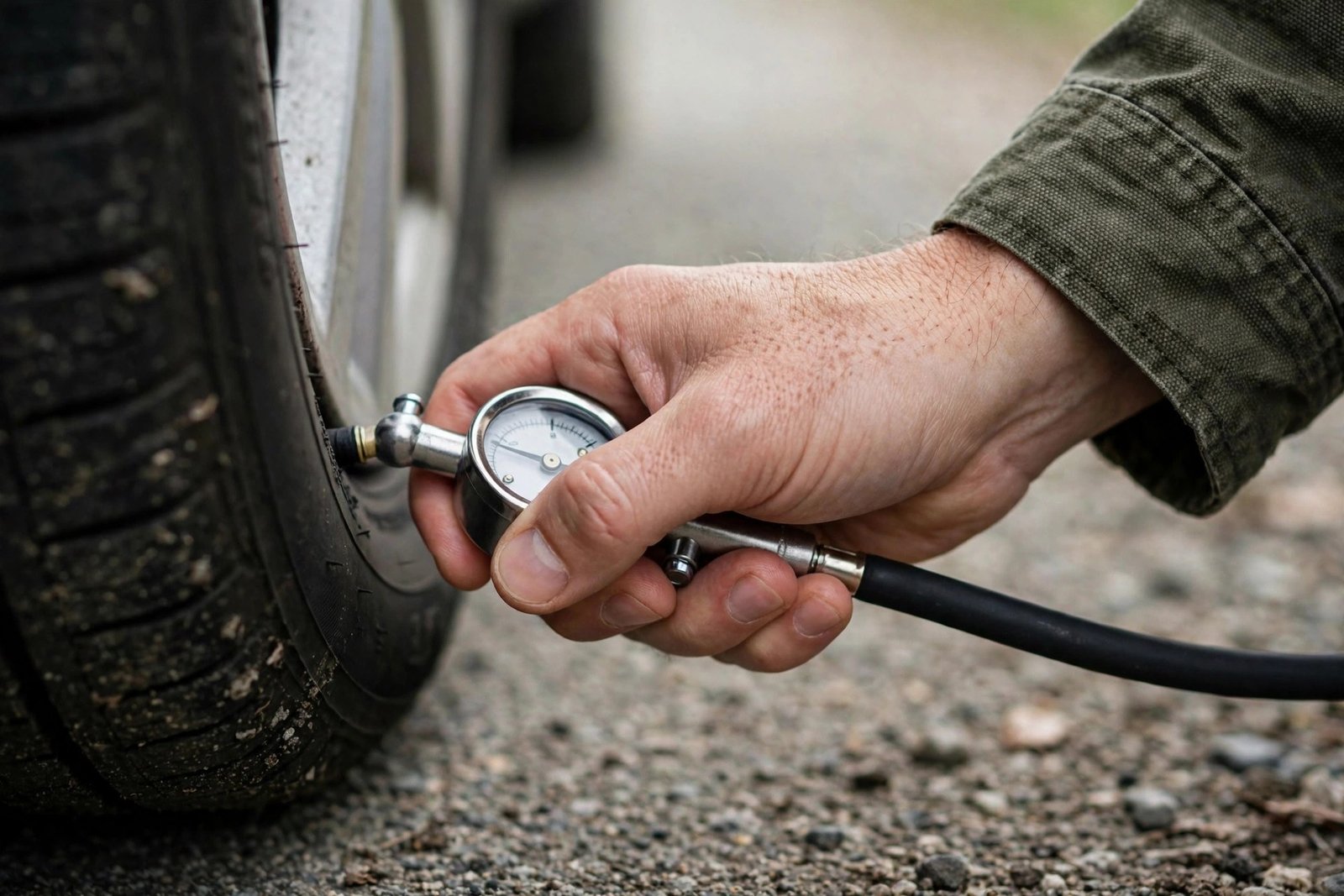
Step Three: adjust with confidence, using a gauge you trust. A sound gauge beats the free pencil kind handed out at counters, because the whole routine rests on believing the number it shows you. The technique itself is simple enough to teach in one breath: cap off, gauge pressed firmly onto the valve stem, read, and compare against your sticker. If a tire is low, add air in short bursts at the service-station pump, rechecking as you go rather than overshooting and starting again. If a tire is high, let air out with a brief press on the valve pin, then read it once more. Caps go back on at the end, always, because those small caps keep dirt and moisture out of the valve, and a fouled valve leaks the pressure you just set. Consider keeping a small portable inflator that runs off the car’s own outlet. It earns its keep in pure convenience, and convenience decides habits: the routine you can do on your own driveway, in your own time, is the routine that actually happens, while the routine that needs a special trip quietly becomes next month’s intention.
Step Four: keep the rhythm, and learn to read the warnings. Build the check into the month alongside the other small rituals of ownership, the fluid checks and walk-arounds; the AAA’s tire care guidance recommends exactly that monthly rhythm, treating pressure as routine care rather than emergency response. Then learn the two alarms a tire can raise. The first is pattern: one tire consistently losing pressure faster than its siblings is not a quirk to top up forever. It is a slow leak with a cause — a nail lodged in the tread, a tired valve stem, corrosion where the tire seals against the wheel — and it deserves a repair rather than endless topping up, because slow leaks choose bad moments to become fast ones. The second alarm arrives when buying: read the age markings on any tire before paying, and buy from reputable dealers, because a tire sold as new that sat in a warehouse for years is not new in any sense that matters; rubber ages on the shelf as surely as on the road. Pair a fresh set with an alignment, and the new tires begin life rolling straight, at the right pressure, wearing as evenly as the road allows.
The dashboard light is a late warning
Most modern cars watch pressure for you, through the tire-pressure monitoring system, and most drivers trust that system far more than it deserves. The system’s job is narrow: it speaks up only when a tire is already about a quarter below its recommended pressure. Read that again and its meaning lands. By the time the light glows on your dashboard, the tire has been running soft for a while, and fuel, grip, and tread have all been paying the toll in silence. The light is not an early warning. It is an overdue notice. A clear explanation of the tire-pressure monitoring system, explained shows how the sensors work and where their limits sit, and the limit that matters is that threshold: the system is a safety net with a wide mesh, designed to catch neglect, not to replace attention.
There is a second, quieter failure mode on older cars. The sensors live inside the wheels and run on small batteries, and batteries die. A monitoring system that never speaks may not be reporting healthy tires at all; it may simply be a silent system with a dead sensor, giving a driver false peace for months. That possibility is an argument for the gauge, not against it, because the gauge never needs a battery of its own to tell the truth, and thirty seconds with one settles what a dashboard cannot. When the light does come on, treat it as homework for the same day: check all four tires cold at the next honest chance, set them to the sticker, and if one is far below its siblings, go looking for the leak instead of merely refilling and forgetting.
So the whole subject folds down to a small, sturdy routine. Five minutes a month, a gauge kept in the glove box where it can be found without a search, a sticker on the door jamb treated as the one true number, and a healthy distrust of any dashboard that stays silent. In exchange, the only part of the car that touches the road stays worthy of that job: gripping in the wet, answering the steering honestly, stopping as short as physics allows, and wearing slowly and evenly through a long working life. Few bargains in car ownership are this lopsided. The tires are already carrying everything you love, every time you drive. The least the rest of us can do is keep them properly full of air.