Ask five cat owners how much they feed and you will get five different answers — a scoop, half a can, whenever the bowl looks empty. None of those answers is really a measurement, and that looseness is exactly how cats gain weight slowly in otherwise loving homes. Portions creep, treats multiply, and a cat that was lean in spring can be round by winter without any single meal looking excessive. A clearer way to think about feeding exists, and it starts with energy rather than with the size of a scoop or the depth of a bowl.
The short answer: think calories, not scoops
Forget cups and scoops as the unit of feeding, and think in calories instead. The rule of thumb vets use is simple enough to remember: an indoor adult cat needs roughly twenty to twenty-five calories per pound of ideal body weight a day. Ideal weight matters in that sentence, because feeding for the weight a cat carries now can lock in extra pounds that should not be there. Kittens need roughly twice as much per pound because they are growing fast and building everything at once. Active outdoor cats may need a little more than the indoor rule suggests, while a quiet, neutered indoor cat often sits comfortably at the lower end of the range.
Age bends the rule at the other end of life as well. Older cats often need a little less energy overall, but more digestible protein, because aging bodies use protein less efficiently and lose muscle more easily. Cutting an older cat’s food carelessly can therefore remove the very nutrient that cat most needs to keep. Anyone feeding an aging animal will find senior pet care basics for aging dogs and cats useful for judging when a smaller appetite is normal aging and when it deserves a vet visit. A senior cat eating less because of sore teeth, kidney trouble, or another illness needs treatment, not simply a smaller bowl.
The practical move is unglamorous and effective. Read the label on the food already in the cupboard, note its calorie content, do the division once, and weigh portions for the first week or so until the eye learns what the right amount actually looks like. Most people are surprised by how small a correct portion appears next to a habitual freehand scoop. That surprise is worth paying attention to, because veterinary surveys consistently find most pet cats carry too much weight, and overfeeding is the main reason. A cheap kitchen scale used briefly at the start can prevent years of slow overfeeding, and once the visual lesson has landed, daily weighing of food becomes optional rather than essential.
Wet food, dry food, and the hydration argument
The wet-versus-dry lean is clearer than the marketing on either side suggests. Cats descend from desert animals and carry a low thirst drive, so they do not drink enough voluntarily to make up for a dry diet. A cat can have a full water bowl nearby all day and still take in less water than its body would ideally use. Chronic low-level dehydration then feeds the urinary and kidney problems that cats are prone to, especially as they age. Wet food delivers water along with its calories, quietly and at every meal, while dry food delivers barely any water at all. That single difference is why so many vets lean toward wet food as the base of the diet.
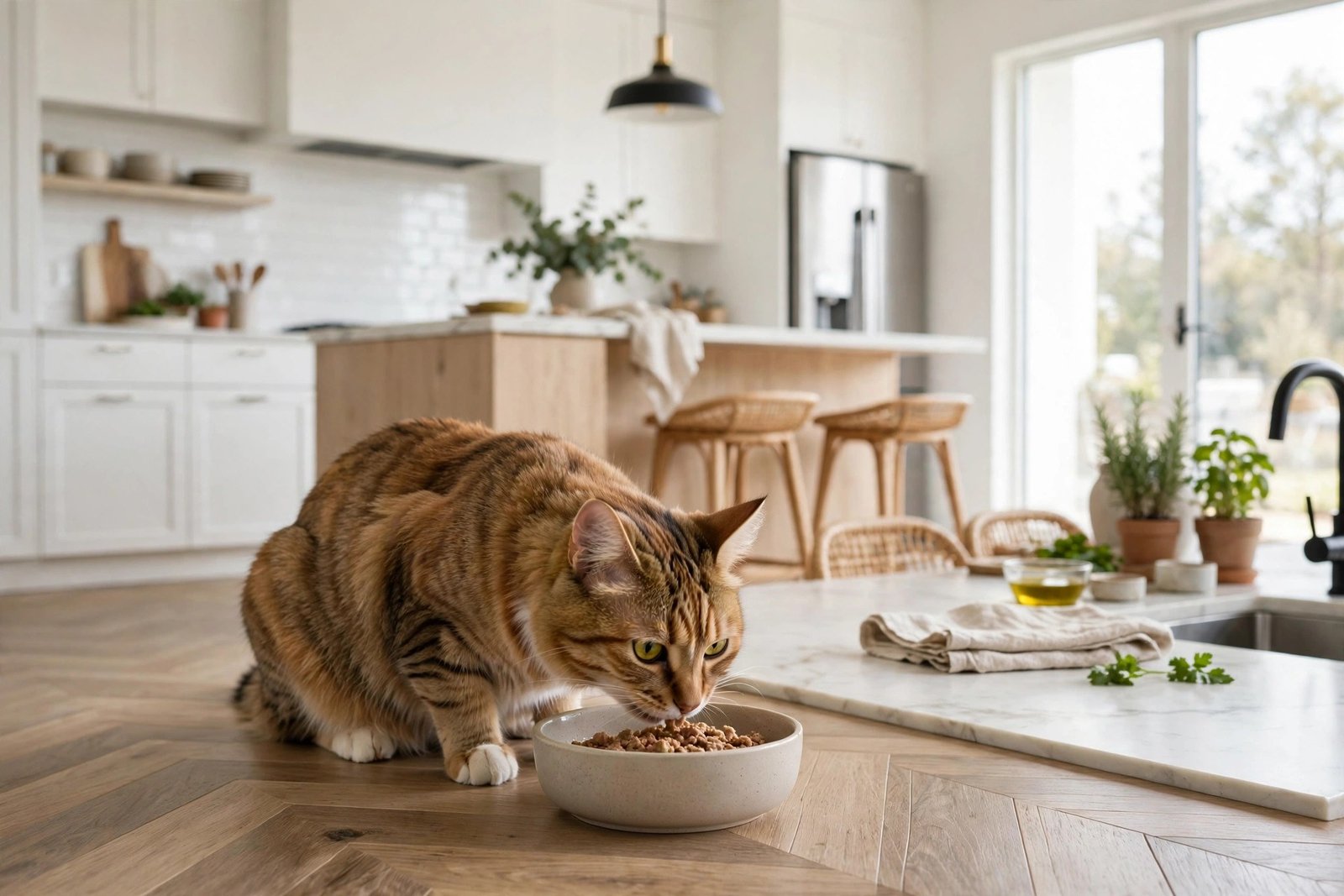
Kibble still has honest virtues. It is complete, convenient, keeps well, and is mildly better for teeth, so nobody needs to treat a good dry food as a failure. The working consensus in practice is mostly wet, some dry, or all wet if the budget allows. Cornell’s feline nutrition resources are a trustworthy place to read the reasoning in more depth, and understanding what cat food is made of helps explain why two products with similar labels can differ so much in moisture and calorie density. Whatever goes in the bowl, measure it. Free-feeding suits the rare self-regulating cat and fattens most others, rather like leaving a bowl of chips on a desk all day and expecting willpower to do the portion control.
Two scheduled meals a day bring a second benefit that has nothing to do with weight. A set routine makes a lost appetite visible early. A cat that leaves a measured breakfast untouched has sent a clear signal, while a free-fed cat can eat less for days before anyone notices the bowl is still full. That early warning matters, because a cat off its food is telling the household something, and cats that stop eating entirely can become seriously ill surprisingly fast. Fresh water should always be available alongside any feeding pattern, changed daily, and placed a little away from the food bowl, since many cats prefer to drink in a separate spot from where they eat.
Reading your cat’s body, not just the scale
Weight alone misleads, because frame size differs. A large-framed cat can be lean at a weight that would make a small-framed cat obese, so the number on the scale needs company. Use the hands-on body-condition test instead of any numbered scale of condition. Run flat hands along the ribs: they should be felt easily under light pressure, under a modest covering of fat, but they should not be prominently seen. Look down from above for a visible waist behind the ribs, and look from the side for a slight tuck where the belly rises toward the hind legs. A healthy cat has shape, not a straight tube from shoulders to hips.
If ribs cannot be felt without pressing hard, and no waist shows from above or from the side, that cat is overweight, whatever the scale says. The risks standing behind that extra weight are not cosmetic. Diabetes, arthritis, liver problems, and urinary trouble all become more likely, and daily life becomes less comfortable long before any diagnosis arrives. Weigh monthly to catch the trend rather than to judge a single day. Stand on the bathroom scale holding the cat, then stand alone, and note the difference. Trends beat single readings, because cats become obese by slow creep, a little at a time, in a way that daily familiarity hides completely. The American Veterinary Medical Association notes that even modest weight loss improves health in heavy cats, which is encouraging news: a small, steady correction is worth making and does not need to be dramatic to matter.
Feeding mistakes that add up
The begging trap catches almost every household eventually. A cat that cries beside the bowl, follows people to the kitchen, and persists with great vocal commitment is training its owners, and persistence often wins. Treats and scraps are where the hidden calories live, so keep treats a small share of the day’s food and count them as food rather than as free extras. A treat given for every trip through the kitchen can quietly equal a second meal. Scheduled meals help here too, because a clear routine gives the household a calm answer: food arrives at set times, and crying in between earns attention, play, or a scratch, but not another serving.
Multi-cat homes face a fairness problem that a shared bowl cannot solve. The grazer that eats a little and wanders off and the gobbler that finishes everything in sight cannot share fairly, and over months the gobbler gains while the grazer may quietly lose. Feed separately, in different rooms or at different heights, or use microchip feeders that open only for the cat they belong to. Weight loss itself must be gradual, never a crash diet. Rapid loss can trigger fatal liver disease in cats, a danger serious enough that any real slimming plan belongs under vet supervision, with small reductions and regular weigh-ins. Food changes need the same patience. Mix a new food in gradually over about a week or more, increasing the new share slowly, to avoid the digestive rebellion that an abrupt swap so often causes in a sensitive stomach.
Decoding the label
Ingredient lists run by weight, so the first few ingredients dominate what is actually in the bag or tin. Named meats beat vague terms like meat by-products and animal digest when judging transparency. By-products are not inherently evil, and they can be nutritious, but a label that names its sources clearly signals a maker willing to be judged on specifics. Beyond the ingredient list, look for the adequacy statement tied to the feed standards body behind the label, and check that the statement matches the right life stage. A food adequate for adult maintenance is not automatically right for a growing kitten, and a food with no adequacy statement at all has not demonstrated that it meets established nutritional standards.
Treat grain-free claims with scepticism. The trend was borrowed largely from dog food marketing, true grain allergy in cats is rare, and removing grains often means adding other fillers rather than adding meat. The guaranteed-analysis panel needs care too. Its figures are given as fed, moisture included, so a wet food and a dry food cannot be compared honestly until the moisture difference is accounted for with a dry-matter conversion. Skipping that step makes wet food look protein-poor when it often is not. Front-of-pack words deserve the coolest eye of all. Premium, natural, holistic, and vet-recommended carry no standard legal definitions, so they promise atmosphere rather than nutrition. Judge the label, not the price tag, since expensive boutique products can be vague and mid-priced products can be excellent, and ask a vet rather than influencers or shop staff when a real choice needs making. The short answer, restated, is the one worth keeping: think calories, feed mostly wet food in measured meals, judge condition by hand and eye, and let the label’s fine print, not its cover, decide what earns a place in the cupboard.